Country
The United States is one of the rare modern republics built without a European-style coat of arms. Instead, two emblems carry the visual identity of the federal government: the Great Seal of 1782 — a bald eagle bearing an olive branch and a sheaf of arrows, paired with an unfinished pyramid surmounted by the Eye of Providence — and the Stars and Stripes, whose thirteen bands and fifty stars chart both the founding of the Republic and its territorial growth.
Click on a country to learn more
| Country | United States of America |
|---|---|
| Great Seal adopted | 20 June 1782, by Resolution of the Continental Congress |
| First US flag | 14 June 1777, by the Flag Resolution of the Second Continental Congress |
| Current 50-star flag | 4 July 1960, after Hawaii's admission as the 50th state |
| Designers (Great Seal) | Charles Thomson, William Barton; refined by three congressional committees (1776–1782) |
| Designer (50-star flag) | Robert G. Heft, 1958 (a high-school class project) |
| Mottos | E Pluribus Unum · Annuit Coeptis · Novus Ordo Seclorum |
| Custodian of the Great Seal | The Secretary of State of the United States |
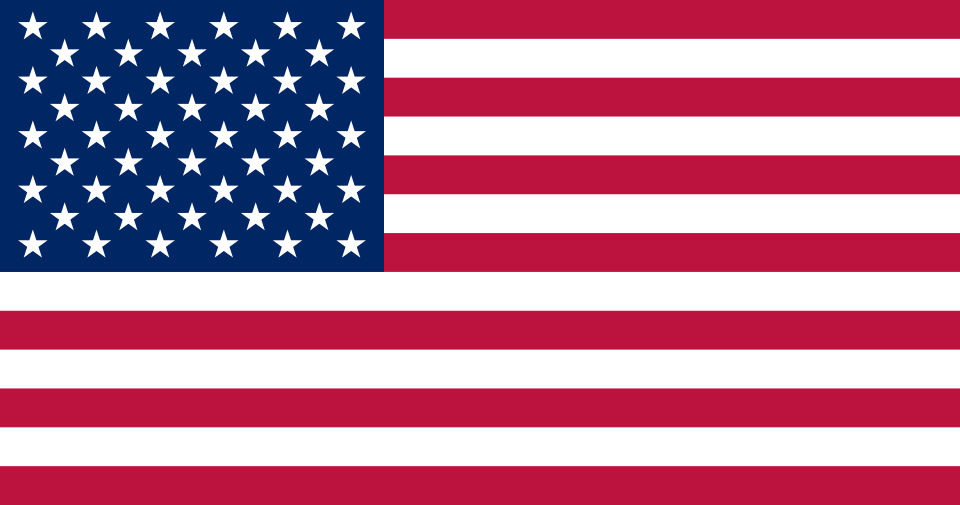
Flag — the Stars and Stripes — Thirteen horizontal stripes of red and white, a blue canton bearing fifty white five-pointed stars in nine offset rows.
The American flag consists of thirteen horizontal stripes of equal width, alternating seven red and six white, beginning and ending with red. In the upper-left corner — the canton, technically called the union — is a rectangle Azure bearing fifty white five-pointed stars arranged in nine offset rows (alternately five and six stars). The official proportions are 1:1.9 (hoist:fly), with the union covering seven stripes and extending two-fifths of the fly.
On 14 June 1777 — the date now celebrated as Flag Day — the Second Continental Congress at Philadelphia passed the brief Flag Resolution:
Resolved, That the flag of the United States be thirteen stripes, alternate red and white; that the union be thirteen stars, white in a blue field, representing a new constellation.
The resolution gave neither star arrangement nor specific proportions. Early flags varied considerably: some had stars in a circle (the so-called Betsy Ross flag), others in rows, others scattered. The phrase "new constellation" was the Founders' deliberate astronomical metaphor — the United States as a fresh sign in the heavens.
The flag's authorship is contested. The earliest documented claim of design comes from Francis Hopkinson, signer of the Declaration of Independence and naval-flag designer, who in 1780 petitioned Congress for compensation as the flag's author. Congress acknowledged the claim but did not pay.
The popular legend that Betsy Ross, a Philadelphia seamstress, sewed the first flag at George Washington's request in May 1776, rests entirely on a story told by her grandson William J. Canby in 1870 — almost a century after the supposed event, with no contemporary document. The story is iconic but historically unsupported.
The 50-star canton currently in use was designed in 1958 by Robert G. Heft, a 17-year-old high-school student in Lancaster, Ohio, as a class project anticipating Hawaii's statehood. His teacher gave the design a B-minus; President Eisenhower selected it from over 1,500 submissions, and the teacher subsequently raised the grade to an A.
The number of stars (and, briefly, stripes) has changed with the growth of the Union. By the Flag Act of 1818, Congress fixed the number of stripes at thirteen (in honour of the original colonies) and provided that the number of stars would increase by one on the 4th of July following each state's admission.
Explore the evolution of the flag — click the thumbnails.
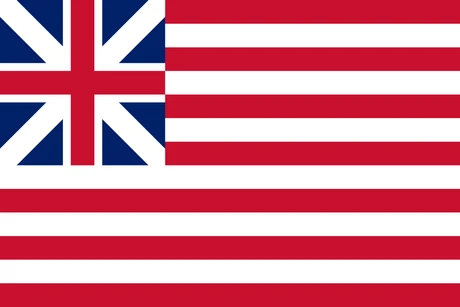
1775
The first flag of the united colonies was not yet a break with Britain: it kept the British Union Jack in the canton, above thirteen red-and-white stripes for the thirteen colonies. It was raised over the Continental Army in December 1775, while independence was still being debated.
Also called the Continental Colors, it was set aside once the colonies declared themselves a new nation — the Union Jack giving way to a field of stars.
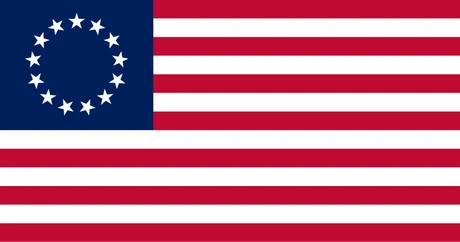
1777
On 14 June 1777, the Second Continental Congress resolved that the flag be thirteen stripes, alternate red and white, with thirteen white stars in a blue field, “representing a new constellation.” The Union Jack was gone; a ring of stars took its place.
Congress never fixed how the stars should be arranged, so many patterns coexisted. The best known — a circle of thirteen — is tied by tradition to the Philadelphia seamstress Betsy Ross, though the story is unproven.
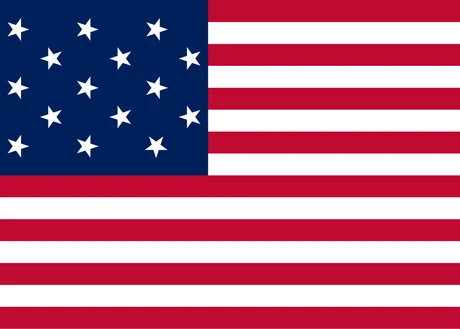
1795
When Vermont and Kentucky joined the Union, Congress added not only two stars but two stripes — making fifteen of each. This is the flag that flew over Fort McHenry during the British bombardment of 1814.
Watching it survive the night, Francis Scott Key wrote the poem that became “The Star-Spangled Banner,” now the national anthem. It remains the only U.S. flag ever to have carried more than thirteen stripes.
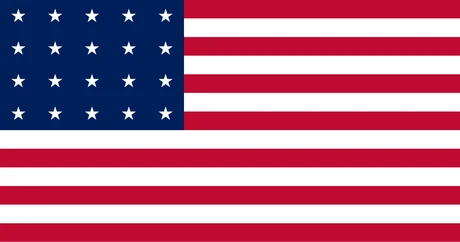
1818
With five more states admitted, adding a stripe each time was unworkable. The Flag Act of 1818 set the rule that still governs the flag: thirteen stripes forever, for the original colonies, and one star for every state, added on the Fourth of July after admission.
The 1818 flag carried twenty stars. From then on the canton would fill and rearrange with each new state, while the stripes never changed again.
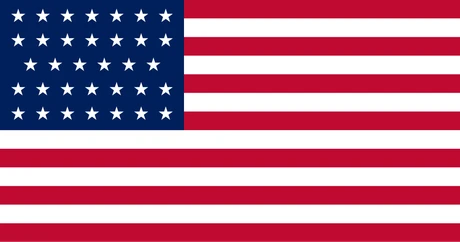
1861
When the Southern states seceded in 1861, the United States pointedly kept their stars on the flag: President Lincoln refused to remove them, insisting the Union was legally indivisible. The 34-star flag — with a new star for Kansas — became the banner of the North.
It flew over the armies of the Union throughout the first years of the war, facing the rival flags of the Confederacy across the battlefield.
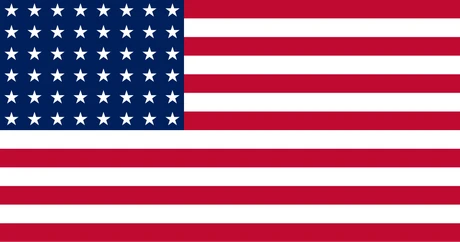
1912
With Arizona and New Mexico, the flag reached forty-eight stars in 1912 — six neat rows of eight. For forty-seven years, the longest run of any design, this was the flag of the United States.
It carried the country through both World Wars and the Great Depression; it is the flag raised at Iwo Jima in 1945. Only Alaska and Hawaii would end its long reign.
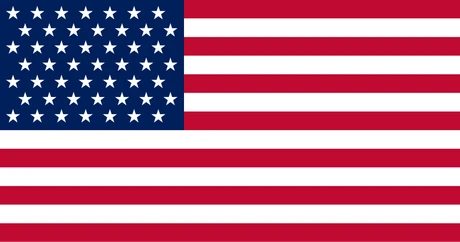
1959
Alaska’s admission in January 1959 added the forty-ninth star, set in staggered rows. It was official for barely a year.
One of the shortest-lived U.S. flags, it was replaced almost at once: Hawaii was only months from statehood.
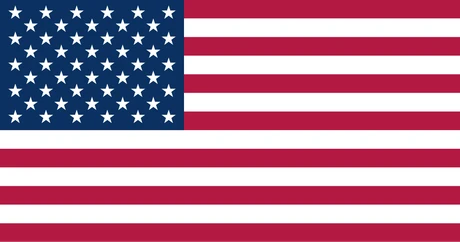
1960
When Hawaii became the fiftieth state, the canton was redrawn into nine rows of alternating five and six stars. The winning layout came from Robert G. Heft, a seventeen-year-old who sewed it for a high-school project — famously graded a B before his design was chosen by President Eisenhower from over 1,500 submissions.
Official since 4 July 1960, it is the longest-serving version of the flag. Unless a fifty-first state is ever admitted, it is the Stars and Stripes as the world knows it today.
The United States Flag Code (4 U.S.C. §§ 1–10) prescribes how the flag is to be displayed, folded, and disposed of. Key rules: the flag must never touch the ground, never be flown upside down except as a distress signal, must be illuminated if flown at night, and must be retired by burning when worn out. When draped over a coffin, the union should be at the head and over the left shoulder. The flag is flown at half-staff on prescribed days, including 15 May (Peace Officers Memorial Day) and 11 September (Patriot Day).
For four years (1861–1865) the United States tore itself apart — and the two sides fought under rival flags. The North kept the Stars and Stripes; the eleven seceded states of the Confederacy invented their own. Here is what each flag was, and what it has come to mean.
Compare the rival flags of the Civil War — click the thumbnails.
1861
The North fought under the flag it had always flown. President Lincoln refused to remove the stars of the seceded states, insisting the Union was legally indivisible — so the 34-star flag (with a new star for Kansas) flew over the armies of the North throughout the war.
For the Union, the Stars and Stripes stood for the nation itself, and for the cause of holding it together.
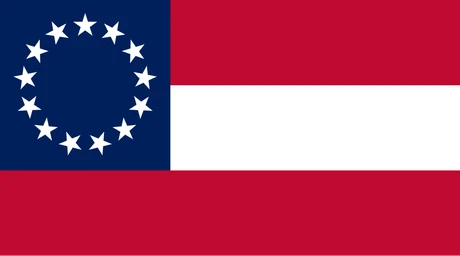
1861
The Confederacy’s first national flag, adopted in March 1861 and designed by the Prussian-American artist Nicola Marschall, bore three bars — red, white, red — with a blue canton and a circle of stars, one for each Confederate state.
Its close resemblance to the U.S. flag caused deadly confusion at First Bull Run, where soldiers could not tell friend from foe through the smoke. That confusion led directly to a separate battle flag.
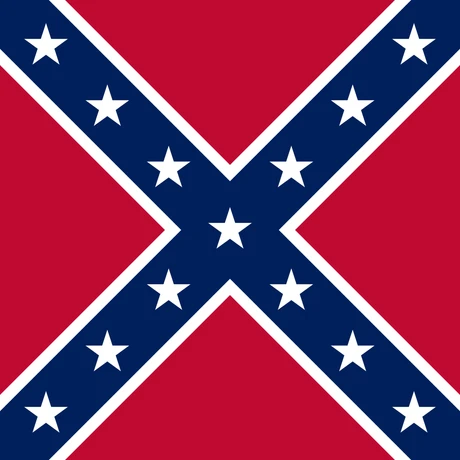
1861
This is the flag most people picture as “the Confederate flag” — a blue diagonal cross (a saltire, or St Andrew’s Cross) strewn with white stars, on a red field. Yet it was never a national flag: it was an army banner, adopted after Bull Run so troops could tell their own side apart. It was made square to save cloth.
It became the Confederacy’s most recognisable emblem only after the war, revived by veterans’ groups — and later by segregationists and, today, by white-supremacist movements. For that reason it remains a deeply contested symbol: Georgia removed it from its state flag in 2003, Mississippi in 2020.

1863
In 1863 the Confederacy adopted a new national flag: a plain white field with the battle flag set in the canton. Its designer, the editor William Tappan Thompson, openly described the white field as a symbol of white supremacy.
The design had a practical flaw — hanging limp, it looked like a plain white flag of truce or surrender. It first served to drape the coffin of General “Stonewall” Jackson, killed in May 1863.
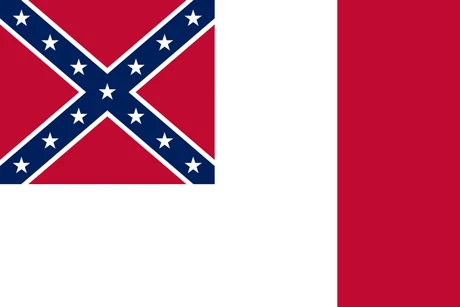
1865
To fix the surrender problem, a broad red bar was added at the fly in March 1865. This was the Confederacy’s last flag.
It was adopted barely a month before the war ended, and very few were ever made. Within weeks, the Confederacy had ceased to exist.
None of these flags holds any official status today. The three Confederate national flags are historical footnotes; only the battle flag lives on — as a private, and hotly disputed, symbol of a cause built on slavery.
The Stars and Stripes has been copied, adapted, and echoed the world over. Some of those flags are genuine descendants, whose designers deliberately borrowed the American pattern; others only share the family look by coincidence. Here are the closest relatives — and a word on the resemblances that are not.
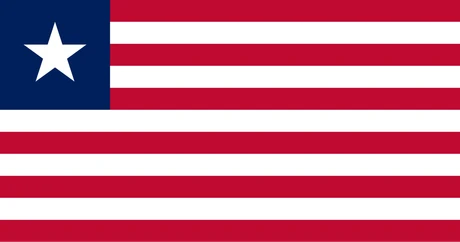
1847
No national flag copies the Stars and Stripes more openly than Liberia’s — and for a reason. Liberia was founded in the 1820s by free-born and formerly enslaved African Americans, resettled through the American Colonization Society; they carried with them the look of the flag they had grown up under.
The design keeps the American structure but rewrites the meaning: eleven red-and-white stripes for the eleven signers of the Liberian Declaration of Independence, and a single white star — Liberia as the first independent republic in Africa — on a blue field standing for the continent. It was adopted in 1847 and hand-stitched by a committee of seven women.
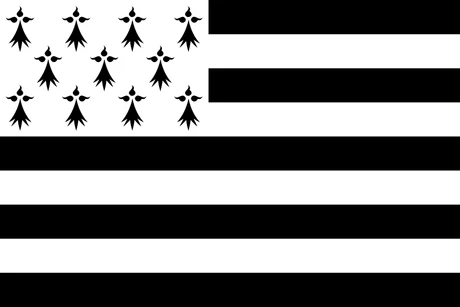
1923
The flag of Brittany, the Gwenn ha du (“white and black”), was drawn in 1923 by Morvan Marchal, who by his own account took the flag of the United States as his model, seeing it as a symbol of freedom. A French-American magazine later dubbed it “the Breton cousin of the Stars and Stripes.”
The canton of American stars becomes a scattering of black ermine spots — the arms of the old Duchy of Brittany. The nine stripes stand for the region’s nine historic dioceses: five black for the Gallo-speaking east, four white for the Breton-speaking west.
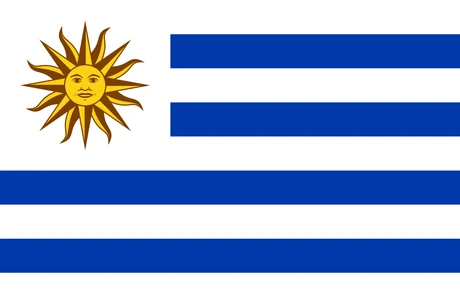
1828
Uruguay’s flag, adopted in 1828, borrows the American idea directly: its horizontal stripes are, in the words of vexillologists, based on the U.S. flag, where the stripes stand for the original thirteen colonies.
Here the nine stripes represent Uruguay’s nine founding departments. But the American canton of stars gives way to a distinctly South American emblem — the golden Sun of May, shared with neighbouring Argentina.
Vexillologists sort dozens of flags into a “stars and stripes family” by their shared look — stripes and a canton — but resemblance is not always descent:
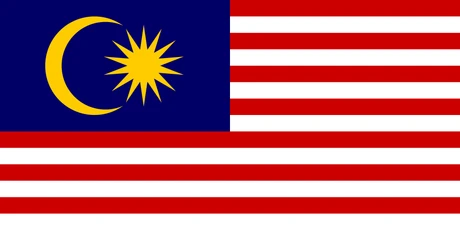
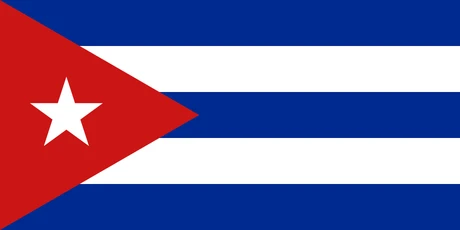
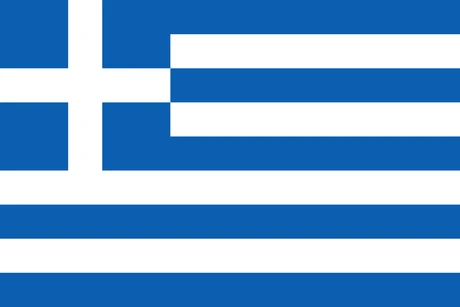
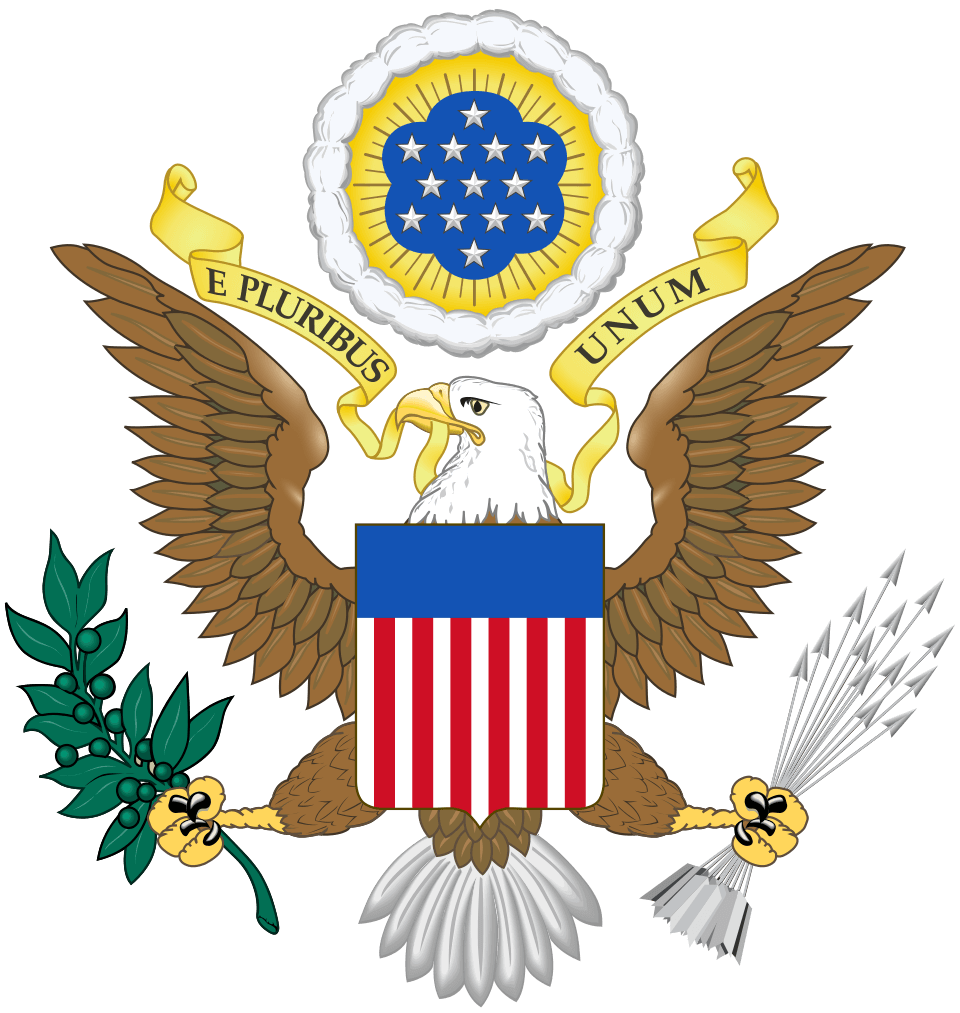
Great Seal — Bald eagle displayed, with olive branch and thirteen arrows; on a striped shield; motto E Pluribus Unum.
The obverse of the Great Seal is dominated by a bald eagle displayed, wings spread, head turned to its right (the viewer's left), the position of honour in classical heraldry. On its breast rests a shield of thirteen pales (vertical stripes, six argent and seven gules) beneath a blue chief — no supporters, no crown, no helm. The shield is upheld by the eagle itself, as a deliberate symbol of self-reliance.
In its dexter talon (the right, viewer's left) the eagle holds an olive branch with thirteen olives and thirteen leaves, signifying peace. In its sinister talon, a bundle of thirteen arrows, signifying readiness for war. The eagle's gaze is fixed upon the olive branch — the Republic faces toward peace.
From the eagle's beak unfurls a scroll bearing the motto E PLURIBUS UNUM ("Out of many, one"), originally drawn from the Latin epigraphic tradition and adopted by the Continental Congress in 1782 as the founding motto of the federal union. Above the eagle's head, a glory of thirteen stars pierces a circle of clouds, arranged in the constellation of the Great Bear pattern according to Charles Thomson's 1782 description.
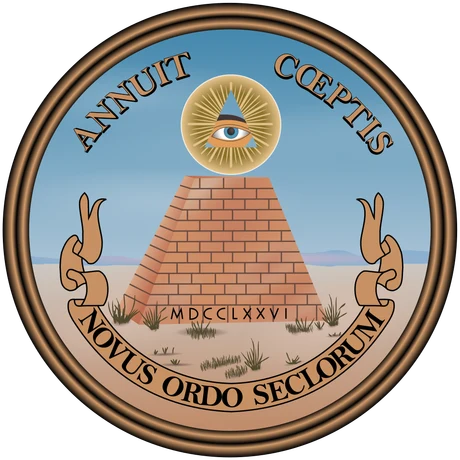
The reverse of the Great Seal is the device that appears on the back of the one-dollar bill since 1935. It depicts an unfinished pyramid of thirteen courses of stone, set on a sandy plain, with the date MDCCLXXVI (1776) inscribed on its base. The unfinished state symbolises the Republic as a work in progress.
Above the pyramid floats the Eye of Providence within a triangle, surrounded by a glory of golden rays — a symbol with deep roots in Renaissance Christian iconography and in eighteenth-century Masonic emblem-books. Two further Latin mottos accompany the pyramid:
The Great Seal was the result of three committees of the Continental Congress working over six years. The first, appointed on 4 July 1776 — the very day of independence — included Benjamin Franklin, John Adams, and Thomas Jefferson, and proposed designs ranging from Hercules between Vice and Virtue to scenes of Moses parting the Red Sea. None survived.
The second committee of 1780 was equally unsuccessful. The decisive work fell to a third committee in 1782, advised by the lawyer and heraldic enthusiast William Barton, whose initial sketches were heavily revised by Charles Thomson, Secretary of the Continental Congress. Thomson's design — the eagle with shield, arrows, olives, and stars — was adopted by Congress on 20 June 1782. The first physical die was cut later that year and remains in continuous use, with successive recuttings in 1825, 1841, 1877, 1885, 1904, 1986, and 2003.
The Great Seal is affixed to treaties, presidential proclamations, ambassadorial commissions, and instruments of ratification. By statute (3 U.S.C. § 11–13 and 4 U.S.C. § 41–44), the seal itself is in the custody of the Secretary of State.
Although the shield on the eagle's breast is technically a heraldic shield, the Founders deliberately rejected the European coat-of-arms tradition. There is no helm, no mantling, no crown, no supporters in the classical sense — the eagle is not a supporter but the principal charge. The reasoning was political: heraldry was perceived as inseparable from aristocracy and monarchy. The Great Seal functions as the federal coat of arms, but is rarely called one in American usage.
The reverse of the Great Seal — the unfinished pyramid and the all-seeing Eye of Providence, printed on the back of every one-dollar bill since 1935
Turn over a one-dollar bill and you meet the strangest emblem in American iconography: a truncated pyramid crowned by a single, radiant eye. It is the reverse of the Great Seal of the United States — and no design in the country has fed more conspiracy theories. Here is what it actually shows, what it means, and why the popular claim that it is a secret Masonic symbol does not survive the dates.
The reverse shows an unfinished pyramid of thirteen courses of stone — thirteen for the original states, unfinished because the young republic was still being built. Its base bears the date MDCCLXXVI, 1776. Floating above it is the Eye of Providence, set inside a triangle and wrapped in a glory of golden rays. Congress approved the design in 1782, but for a century and a half it was hardly used; it entered daily life only in 1935, when it was placed on the back of the one-dollar bill — where hundreds of millions of Americans have carried it ever since.
Two Latin mottos frame the pyramid, both borrowed from the Roman poet Virgil:
ANNUIT CŒPTIS — “He [Providence] has favoured our undertakings.” · NOVUS ORDO SECLORUM — “A new order of the ages.”
The second is the one endlessly misquoted. Novus Ordo Seclorum does not mean “New World Order”: seclorum is the genitive plural of saeculum, “ages” or “generations,” not “world.” Adapted from Virgil’s Fourth Eclogue, the phrase simply announces a new era of history beginning with American independence — not a secret plan for world government.
Because the Eye of Providence later became a common Masonic emblem, many assume the Great Seal was designed by Freemasons to slip their symbolism onto the nation’s money. The chronology makes that almost impossible. Four facts undo the theory:
The pyramid and the eye are genuinely enigmatic — but they speak the language of eighteenth-century Enlightenment optimism and old Christian iconography, not a Masonic or Illuminati cipher.
The United States has no federal heraldic authority — no equivalent of the British College of Arms, the French Conseil français d'héraldique, or the Spanish Cronista de Armas. This absence is itself a political statement: the Founders associated heraldic regulation with monarchical privilege and rejected the very idea of a state office for granting arms.
The consequence is a heraldic landscape that is at once free and chaotic. Federal agencies (the Army, the Department of State, the Postal Service) design their own seals and emblems without external review. States adopt and modify their seals by legislative act. Counties, cities, and even private companies may use coats of arms without authorisation, provided they do not infringe on trademarks.
American official symbolism draws explicitly on the classical Roman republic rather than on medieval European heraldry. The eagle of the Great Seal recalls the aquila of the Roman legions; the Latin mottos quote Virgil; the term "Senate" was borrowed directly from Rome. The Founders deliberately chose this vocabulary as a counterpoint to monarchic France and Britain.
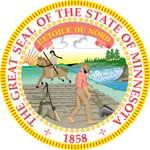
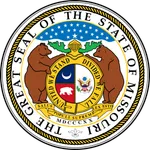
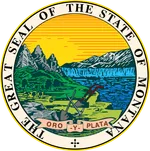
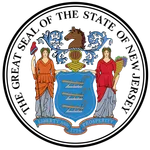
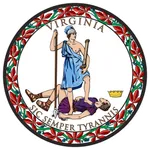
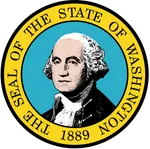
Each of the 50 states retains complete autonomy over its own seal, flag, and emblems — and exercises it diversely. Some, like Massachusetts, preserve colonial Native imagery; others, like California, encode local landscape and economic activity (the grizzly bear, the miner); others again, like the state of Washington, simply display George Washington's profile on a field of green. There is no federal style guide for state heraldry.
The Founders of the Republic rejected the heraldic vocabulary of European monarchies and adopted instead a Great Seal — a single double-sided emblem combining the eagle and the pyramid. The shield on the eagle's breast is technically a coat of arms but is never used independently. There is no federal heraldic authority comparable to those of Britain, France, or Spain.
E Pluribus Unum ("Out of many, one") appears on the obverse on the eagle's scroll, originally referring to the union of the thirteen states. Annuit Coeptis ("He has favoured our undertakings") and Novus Ordo Seclorum ("A new order of the ages") appear on the reverse around the unfinished pyramid, both adapted from Virgil.
The olive branch (in the dexter talon, the position of honour) represents peace; the bundle of thirteen arrows in the sinister talon represents war. The eagle's head is turned toward the olive branch, indicating that the Republic prefers peace but is prepared for war.
The thirteen-step unfinished pyramid on the reverse of the Great Seal symbolises the United States as a work in progress, with each step representing one of the original colonies. The Eye of Providence above the pyramid signifies divine watchfulness over the new nation. The reverse appears on the back of the US one-dollar bill (since 1935).
The 50-star flag was officially adopted on 4 July 1960, after Hawaii became the 50th state on 21 August 1959. The design — fifty stars in nine offset rows — was created by Robert G. Heft, a 17-year-old high school student from Lancaster, Ohio, as a class project that earned a B-minus before being chosen by President Eisenhower.
Almost certainly not. The story rests entirely on the testimony of her grandson William J. Canby in 1870, nearly a century after the supposed events. No contemporary document supports the claim. The earliest documented designer was the signer of the Declaration Francis Hopkinson, who petitioned Congress for compensation as the flag's designer in 1780.
Each of the 50 US states maintains a state seal and a state flag used by the governor, state government, and on official documents. From the bald eagle of New York to the grizzly bear of California, each design encodes local history, geography, and motto. The US state symbols collection is one of the largest sub-national heraldic sets in the world.
Last reviewed by the Emblema Mundi editorial team on 14 June 2026.