US State
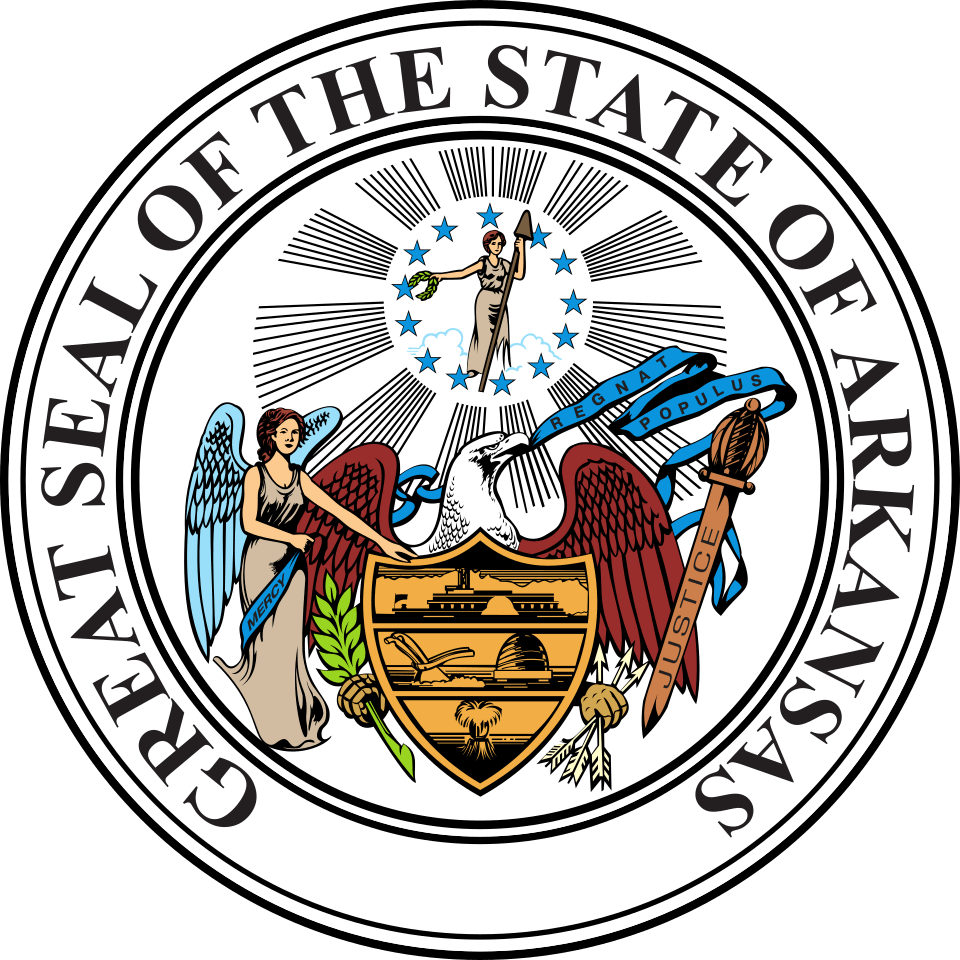
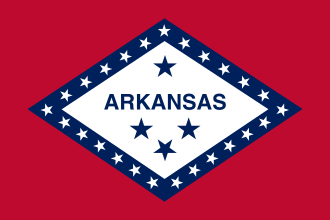
Arkansas’s state emblems weave together layers of history. The Great Seal, redesigned in 1864 during the Civil War and corrected in 1907, features an eagle holding a scroll inscribed Regnat Populus (“The People Rule”), a shield with a steamboat, beehive, plow, and wheat, flanked by an angel of Mercy and a sword of Justice, with the Goddess of Liberty presiding above. The flag was born from an unexpected discovery: when the battleship USS Arkansas was commissioned in 1912, the state realized it had no flag at all. A contest was held, and Willie Kavanaugh Hocker of Wabbaseka won with her design of a white diamond on a red field, bordered by 25 stars for Arkansas’s rank as the 25th state. The diamond itself honors the state’s unique status as the only diamond-producing state in the nation.
Flag
Not available
Seal
Not available
| State | Arkansas (25th state, admitted 15 June 1836) |
|---|---|
| State seal | Eagle, shield (steamboat, beehive, plow, wheat), Goddess of Liberty, Mercy, Justice |
| Seal origins | Territorial seal by Samuel Calhoun Roane, 1820; redesigned 1864; motto corrected 1907 |
| State flag | Red field, white diamond on blue-bordered band, 25 + 4 stars |
| Flag adopted | 26 February 1913; fourth star added 1923 |
| Flag designer | Willie Kavanaugh Hocker (Wabbaseka, Jefferson County) |
| Motto | Regnat Populus (“The People Rule”) |
| Capital | Little Rock |
| Nickname | The Natural State |
| State flower | Apple blossom (Malus domestica) |
Flag of Arkansas — Diamond and 29 stars, designed by Willie Hocker, 1913
The Arkansas flag is a red field bearing a large white diamond (rhombus) bordered by 25 white stars on a blue band, with four larger blue stars and the state’s name inside the diamond.
In 1910, the keel was laid for the battleship USS Arkansas. Early in 1912, with commissioning months away, the Pine Bluff Chapter of the Daughters of the American Revolution resolved to present a “stand of colors” to the new ship. When they contacted Secretary of State Earle W. Hodges, he informed them that Arkansas had no state flag. The chapter organized a statewide design contest, receiving 65 entries.
The winning design was submitted by Willie Kavanaugh Hocker of Wabbaseka, Jefferson County. Her original design placed three blue stars inside the diamond, with the state name. At the committee’s request, Hocker rearranged the stars — one above the name and two below.
In 1923, the General Assembly added a fourth blue star to the central diamond, positioned above the state name, to represent Arkansas’s membership in the Confederate States of America. This addition remains on the flag today.
The flag was officially adopted on 26 February 1913 by the Arkansas General Assembly.
Great Seal of Arkansas — Regnat Populus — since 1864
The Great Seal is a richly layered composition that combines republican symbolism with imagery of Arkansas’s agricultural and commercial economy.
At the bottom, an eagle holds a scroll inscribed Regnat Populus in its beak, with a bundle of arrows in one claw and an olive branch in the other. A shield on the eagle’s breast is engraved with three tiers: a steamboat at the top, a beehive and plow in the middle, and a sheaf of wheat at the bottom. Above presides the Goddess of Liberty, holding a wreath in her right hand and a liberty cap on a pole in her left, surrounded by a circle of stars and rays. An angel inscribed “Mercy” flanks the left, and a sword inscribed “Justice” the right.
The original territorial seal was designed and drawn in 1820 by Samuel Calhoun Roane. When Arkansas became a state in 1836, the seal was modified. In 1864, the General Assembly adopted a substantially new formula — the design that survives to this day.
The 1864 seal bore the motto Regnant Populi (“The Peoples Rule”). In 1907, this was corrected to Regnat Populus (“The People Rule”), recognizing that the people of Arkansas are one body politic, not a plurality of groups.
The Great Seal features an eagle holding a scroll inscribed Regnat Populus (“The People Rule”) with arrows and an olive branch. A shield on the eagle’s breast shows a steamboat, beehive and plow, and wheat. Above stands the Goddess of Liberty with a wreath and liberty cap, flanked by an angel of Mercy and a sword of Justice.
The flag was designed by Willie Kavanaugh Hocker of Wabbaseka, Jefferson County, a member of the Pine Bluff Chapter of the Daughters of the American Revolution. Her design won a statewide contest in 1912, and the flag was adopted on 26 February 1913.
The white diamond represents Arkansas’s unique status as the only diamond-producing state in the United States. The Crater of Diamonds in Pike County has been a source of diamonds since 1906.
The 25 small white stars on the blue border indicate that Arkansas was the 25th state admitted to the Union (15 June 1836). The four larger blue stars inside the diamond represent the three nations that governed Arkansas before statehood (France, Spain, and the United States) and, since 1923, the Confederacy.
Regnat Populus is Latin for “The People Rule.” It has been the state motto since the seal was redesigned in 1864. The original motto read Regnant Populi (“The Peoples Rule”), corrected in 1907 to the singular form.
Last reviewed by the Emblema Mundi editorial team on 2026-06-27.