US State
New Hampshire’s state emblems celebrate the state’s Revolutionary War shipbuilding heritage and its pivotal role in ratifying the Constitution. The state seal, adopted in 1784 and codified in 1931, features the frigate USS Raleigh — one of the first 13 warships authorized by the Continental Congress, built at Portsmouth in 1776 — with a rising sun over the Atlantic and a granite boulder in the foreground. Nine stars in a laurel wreath mark New Hampshire as the 9th state to ratify the Constitution — the decisive vote that made it the law of the land. The flag, adopted in 1909, places the seal on a blue field.
Flag
Not available
Seal
Not available
| State | New Hampshire (9th state, ratified Constitution 21 June 1788) |
|---|---|
| State seal | Frigate USS Raleigh, rising sun, granite boulder, laurel wreath, nine stars |
| Seal adopted | 1784; codified 1931 |
| State flag | Blue field with state seal |
| Flag adopted | 1909 |
| Capital | Concord |
| Nickname | The Granite State |
| Motto | “Live Free or Die” |
| State flower | Purple lilac (Syringa vulgaris) |
| Historic role | Decisive 9th vote ratifying the US Constitution |
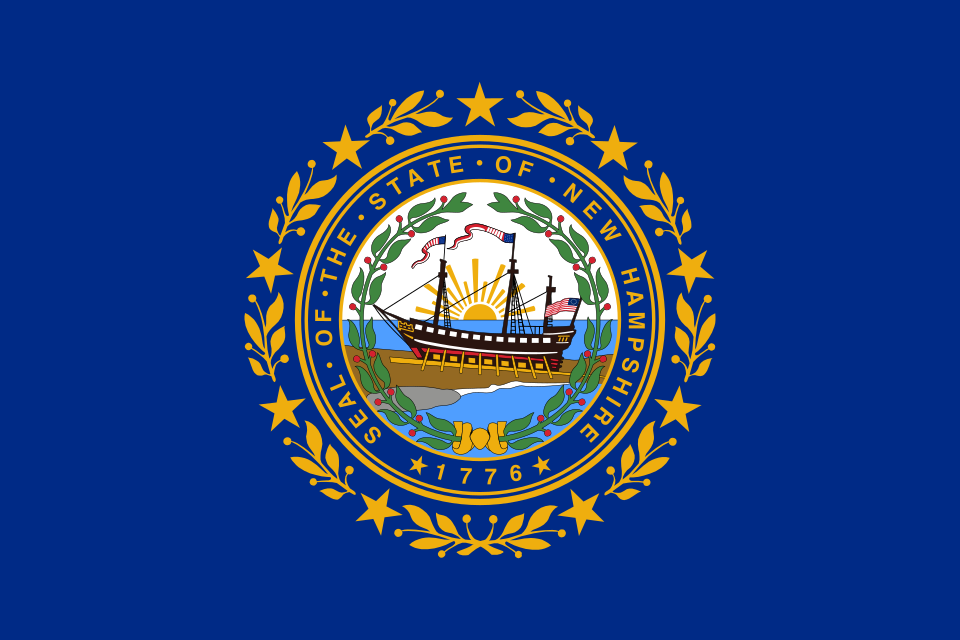
Flag of New Hampshire — Seal on blue, adopted 1909
The New Hampshire flag is one of the simpler state flags — the seal on a blue field, unchanged in basic design since 1909.
The flag was adopted in 1909, featuring the state seal centered on a blue field. The laurel wreath with nine stars frames the frigate Raleigh.
The only change to the flag since 1909 was the 1931 revision of the seal itself — not a change to the flag’s layout. The revised seal standardized the design, officially identifying the ship and eliminating the unauthorized additions that had accumulated over the years.
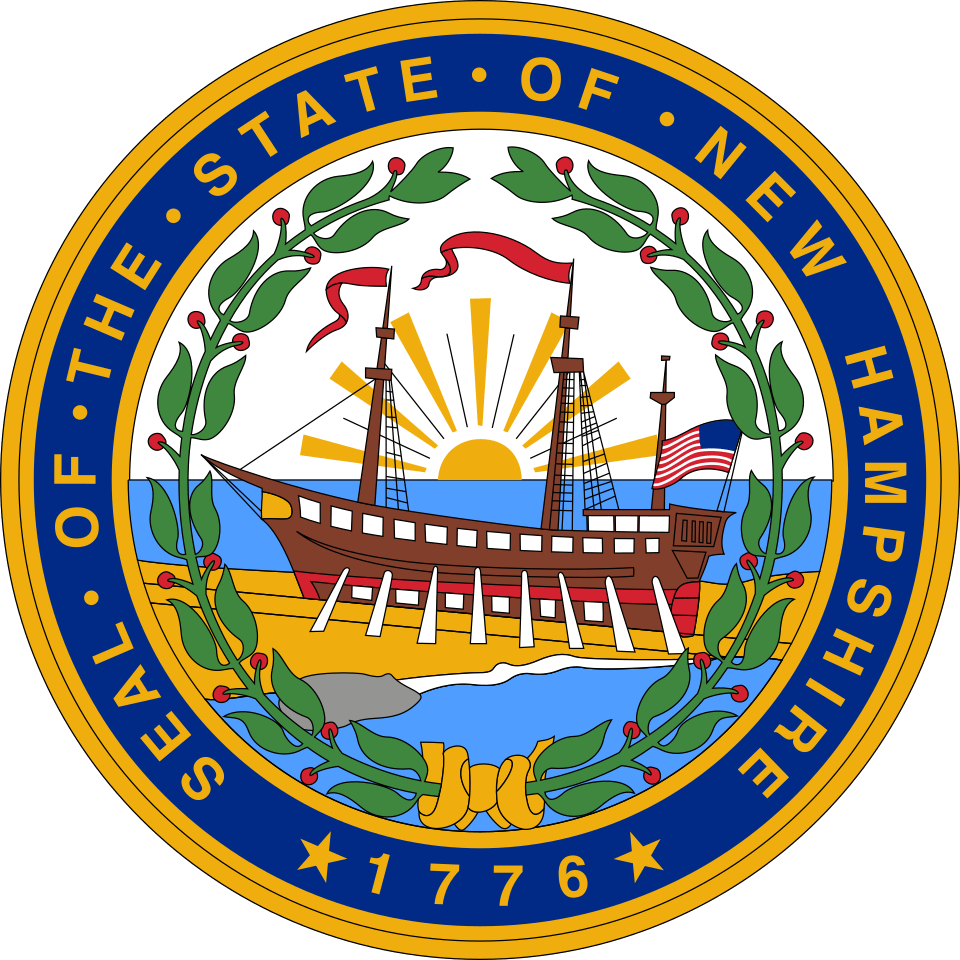
State Seal of New Hampshire — Frigate Raleigh and nine stars — since 1784
The New Hampshire seal is a naval emblem that ties the state’s identity to its shipbuilding heritage and the birth of the American republic.
The frigate USS Raleigh sits on stocks at center, with the sun rising over the Atlantic Ocean behind. A granite boulder appears in the foreground, and water represents the harbor of Portsmouth. A laurel wreath encircles the scene, with nine stars interspersed. The date 1776 appears at the bottom.
The USS Raleigh was one of the first 13 warships authorized by the Continental Congress for the new American navy. It was built at Portsmouth, New Hampshire, in 1776 and named after the English explorer Sir Walter Raleigh.
The nine stars represent New Hampshire as the 9th state to ratify the United States Constitution, on 21 June 1788. New Hampshire’s vote was the decisive one — it provided the required two-thirds majority that made the Constitution the supreme law of the land.
New Hampshire declared independence from Britain on 5 January 1776 and adopted its first seal shortly after. In 1784, when the state constitution took effect, the seal was revised to show a ship on stocks with a rising sun. Over 150 years, artists introduced unauthorized details — rum barrels on the dock, even human figures. In 1931, prompted by historian Otis G. Hammond, Governor John G. Winant formed a committee that standardized the design and officially identified the ship as the Raleigh.
The frigate USS Raleigh on stocks, rising sun, granite boulder, laurel wreath with nine stars, and the date 1776. Adopted 1784, codified 1931.
One of the first 13 warships of the Continental Congress, built at Portsmouth in 1776. The 1931 revision officially identified it on the seal.
New Hampshire was the 9th state to ratify the Constitution (21 June 1788) — the decisive vote that made it the law of the land.
Adopted in 1909 with the seal on a blue field. The seal was revised in 1931 but the flag layout is unchanged.
Over 150 years, artists had introduced rum barrels and human figures into reproductions. Governor John G. Winant’s committee standardized the design.
Last reviewed by the Emblema Mundi editorial team on 2026-06-27.