US State
Louisiana bears one of the most ancient and powerful symbols in all of heraldry: the pelican in her piety — a mother pelican piercing her own breast to feed her three nestlings with drops of her blood. Rooted in medieval Christian tradition, the image symbolises Christ’s sacrifice and the Eucharist. Governor William C. C. Claiborne placed it on the state seal in 1812, replacing the bald eagle to honour Louisiana’s deep Catholic heritage. The Pelican Flag — azure, with the vulning pelican in white — has been the state flag since 1912. In 2006, an eighth-grader named Joseph Louviere made a remarkable discovery: the three drops of blood had vanished from modern reproductions. The legislature restored them by law, and artist Curtis Vann Jr. redesigned the flag in 2010 with the blood drops and a more accurate brown pelican.

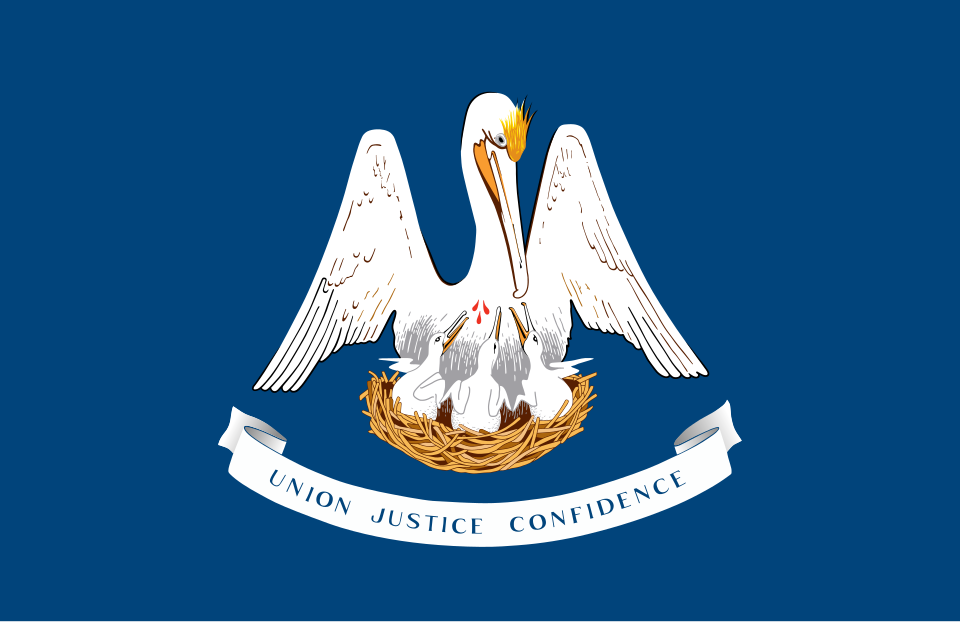
Flag
Not available
Seal
Not available
| State | Louisiana (18th state, admitted 30 April 1812) |
|---|---|
| Nickname | The Pelican State |
| State seal | Pelican in her piety — vulning herself to feed three nestlings |
| Seal devised | 1812 (Claiborne); current version 2006/2010 |
| Motto | Union Justice Confidence |
| State flag | Azure field, white pelican vulning, white ribbon with motto |
| Flag adopted | 1 July 1912; redesigned 22 November 2010 |
| Blood drops restored | 2006 (law); prompted by Joseph Louviere, 8th-grader from Houma |
| 2010 redesign artist | Curtis Vann Jr. (Baton Rouge) |
| Capital | Baton Rouge |
Flag of Louisiana — The Pelican Flag, adopted 1912, redesigned 2010
The Louisiana flag is an azure (blue) field bearing the state arms — a pelican vulning herself in white, feeding three nestlings — above a white ribbon inscribed with the motto Union Justice Confidence in blue letters.
The flag was officially adopted on 1 July 1912. Over the following century, at least half a dozen different pelican designs decorated the seal and flag: the pelican sometimes faced left, sometimes right; the nestlings numbered anywhere from three to eighteen. This inconsistency was finally resolved in the 2010 standardisation.
Following the 2006 blood-drops law, Baton Rouge artist Curtis Vann Jr. created a standardised design featuring a more realistic brown pelican rendered in white, with the species’ distinctive yellow-brown crown. The word “and” was removed from the motto ribbon, changing “Union, Justice and Confidence” to the simpler “Union Justice Confidence.”
State Seal of Louisiana — The pelican in her piety, since 1812
The seal of Louisiana centres on one of the oldest heraldic charges in Western tradition: the pelican in her piety.
In heraldic language, a pelican “vulning herself” (se vulnans) is depicted piercing her own breast with her beak, drawing drops of blood to feed her young in the nest below. The term “in her piety” denotes this specific posture of self-sacrifice. It is one of the most emotionally charged symbols in European heraldry, appearing on the arms of religious orders, universities, and cities across the continent.
In medieval bestiaries, pelicans were believed to revive their dead chicks by feeding them with their own blood after three days — a direct parallel to the Resurrection of Christ. The image became a symbol of the Passion and the Eucharist: just as Christ shed his blood for humanity, the pelican gives her life-blood for her young. This made the pelican an ideal emblem for Catholic Louisiana.
After the Louisiana Purchase of 1803, Governor William C. C. Claiborne initially placed a bald eagle on the state seal. But when Louisiana became the 18th state on 30 April 1812, Claiborne replaced the eagle with the pelican — most likely to honour the state’s predominantly Catholic population. The original seal depicted the pelican with ten chicks rather than the traditional three.
Over the decades, the three drops of blood gradually disappeared from reproductions of the seal. In 2006, Joseph Louviere, an eighth-grade student from Houma working on his Eagle Scout project, discovered the omission and brought it to the legislature’s attention. A law was passed requiring “an appropriate display of three drops of blood.” On 22 November 2010, a redesigned flag by Curtis Vann Jr. was formally introduced, with a more realistic brown pelican (with its characteristic yellow-brown crown) and the blood drops restored.
The pelican is depicted “in her piety” — a heraldic term for a pelican wounding herself to feed her young with her own blood. In Christian tradition, this symbolises Christ’s sacrifice and the Eucharist. Governor Claiborne adopted the symbol in 1812 to honour Louisiana’s Catholic heritage.
Over time, the three blood drops had vanished from reproductions. In 2006, Joseph Louviere, an eighth-grader from Houma working on his Eagle Scout project, discovered the omission. The legislature passed a law requiring “an appropriate display of three drops of blood.” The redesigned flag by Curtis Vann Jr. was introduced on 22 November 2010.
Union Justice Confidence is the state motto, inscribed on the ribbon beneath the pelican’s nest. It expresses the values of national unity, justice under law, and public trust. The 2010 redesign simplified the phrasing by removing the word “and.”
The brown pelican has been associated with Louisiana since 1812, when it replaced the bald eagle on the state seal. It is the official state bird (since 1966), appears on the seal, flag, and license plate, and earned Louisiana its nickname.
The current seal shows three, the traditional heraldic number. However, the original 1812 seal depicted ten chicks — a highly unusual composition. The number was later standardised to three to conform with heraldic convention.
Last reviewed by the Emblema Mundi editorial team on 2026-06-25.