US State
Idaho’s state emblems carry a remarkable distinction: the Great Seal was designed by Emma Edwards Green, the only woman to have designed a US state seal. Adopted on 14 March 1891, shortly after Idaho became the 43rd state on 3 July 1890, the seal depicts a miner and a woman representing justice, liberty, and equality, flanking a shield adorned with wheat, cornucopias, and an elk’s head, under the Latin motto Esto Perpetua (“Let it be perpetual”). The flag, adopted on 12 March 1907, has an equally stirring origin: it reproduces the battle flag carried by the First Idaho Infantry to the Philippines during the Spanish-American War in 1899.
Flag
Not available
Seal
Not available
| State | Idaho (43rd state, admitted 3 July 1890) |
|---|---|
| State seal | Miner, woman of justice, shield, elk head, wheat, cornucopias |
| Seal designer | Emma Edwards Green (only woman to design a US state seal) |
| Seal adopted | 14 March 1891; redrawn 1957 |
| State flag | State seal on blue field, gold/red band “State of Idaho” |
| Flag adopted | 12 March 1907 |
| Flag origin | Based on the First Idaho Infantry battle flag (1899) |
| Motto | Esto Perpetua (“Let it be perpetual”) |
| Capital | Boise |
| Nickname | The Gem State |
| State flower | Syringa (Philadelphus lewisii) |
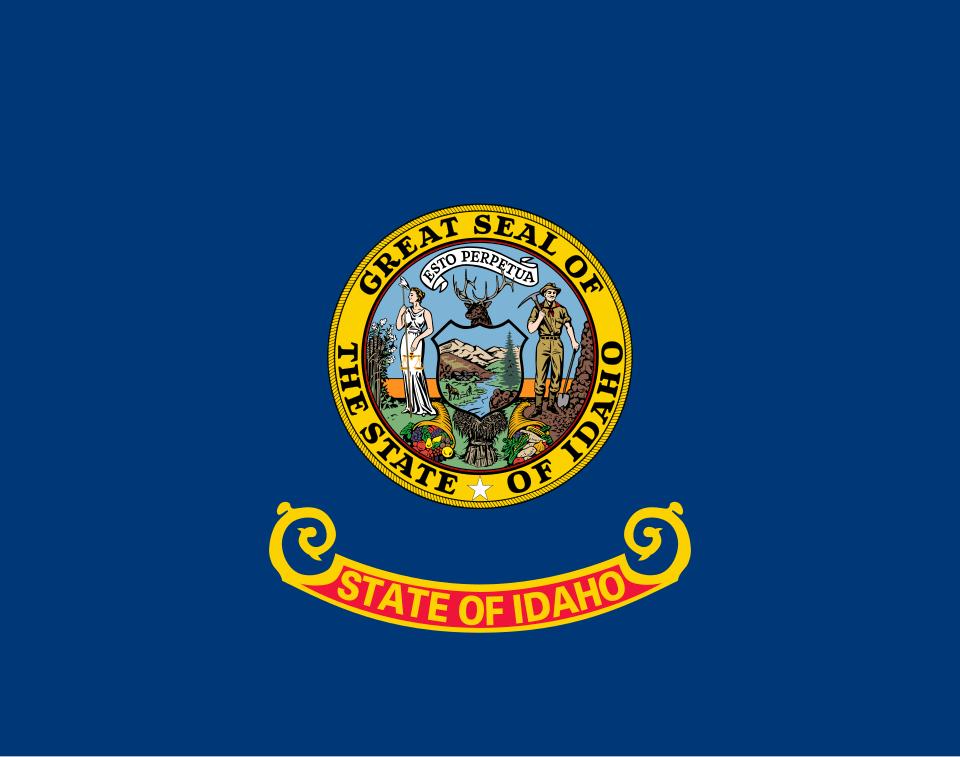
Flag of Idaho — Battle flag of the First Idaho Infantry, adopted 1907
The Idaho flag has its roots in the Spanish-American War, carrying the memory of a citizen-soldier regiment into the state’s official symbolism.
During the Spanish-American War, the First Idaho Infantry received a regimental flag with the state seal centered on a blue field. The regiment carried this flag to the Philippines in 1899.
The legislature honored the First Idaho Infantry by adopting their battle flag as the official state flag on 12 March 1907, replacing the regiment’s name with “State of Idaho” on a gold and red band below the seal.
The flag is a blue field bearing the state seal at center. Below the seal, a red and gold band reads “State of Idaho” in gold capital letters.
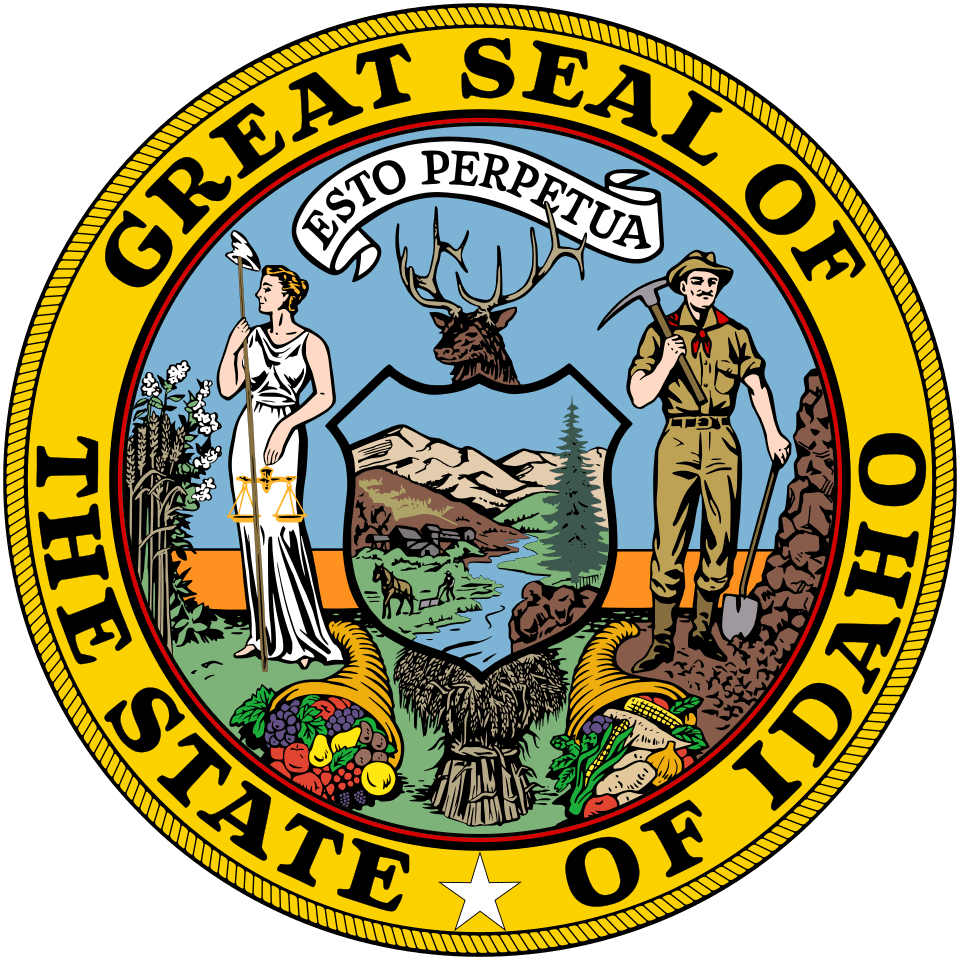
Great Seal of Idaho — Esto Perpetua — designed by Emma Edwards Green, 1891
The Idaho seal is notable both for its rich symbolism and for the story of its creator — a woman who embedded the cause of women’s equality into a state emblem five years before Idaho granted women the right to vote.
In 1891, the First Idaho Legislature sponsored a design competition for the state seal, offering a $100 prize. The judges unanimously selected the design submitted by Emma Edwards Green, making her the only woman to design a US state seal. Green later explained her symbolic choices in detail, connecting them to the political debates of her time.
A miner stands on the right, representing Idaho’s chief industry at statehood. A woman stands on the left, holding scales of justice and a spear topped with a liberty cap — signifying justice, liberty, and equality with men. Between them, a central shield rests on a sheaf of wheat flanked by two cornucopias (horns of plenty). An elk’s head rises from the top of the shield as a crest, representing Idaho’s pioneering game laws. The landscape within the shield includes forests, farmland, and rivers.
Esto Perpetua (“Let it be perpetual”) appears on a banner within the inner ring. The phrase is attributed to the Venetian scholar Pietro Sarpi, who reportedly uttered it on his deathbed as a prayer for the Republic of Venice.
In 1957, the seal was slightly redrawn by Paul B. Evans and the Caxton Printers at the request of the state government, adding more anthropocentric elements to the shield. The core design remains faithful to Green’s original.
The seal depicts a miner and a woman representing justice, liberty, and equality, flanking a shield with wheat, cornucopias, and an elk’s head crest. The motto Esto Perpetua (“Let it be perpetual”) appears on a banner. Designed by Emma Edwards Green, adopted 14 March 1891.
Emma Edwards Green designed the seal in 1891, winning a statewide competition unanimously. She is the only woman to have designed a US state seal. The seal was slightly redrawn in 1957 by Paul B. Evans.
Esto Perpetua is Latin for “Let it be perpetual” or “It is forever.” The phrase is attributed to the Venetian scholar Pietro Sarpi, who reportedly uttered it on his deathbed as a prayer for the Republic of Venice.
Emma Edwards Green included a woman holding scales of justice and a liberty cap to represent justice, liberty, and equality with men. At the time, woman suffrage was being debated in Idaho, which would grant women the vote in 1896.
During the Spanish-American War, the First Idaho Infantry carried a regimental flag with the state seal on a blue field to the Philippines in 1899. The legislature honored this battle flag by adopting it as the state flag on 12 March 1907.
Last reviewed by the Emblema Mundi editorial team on 2026-06-27.