US State
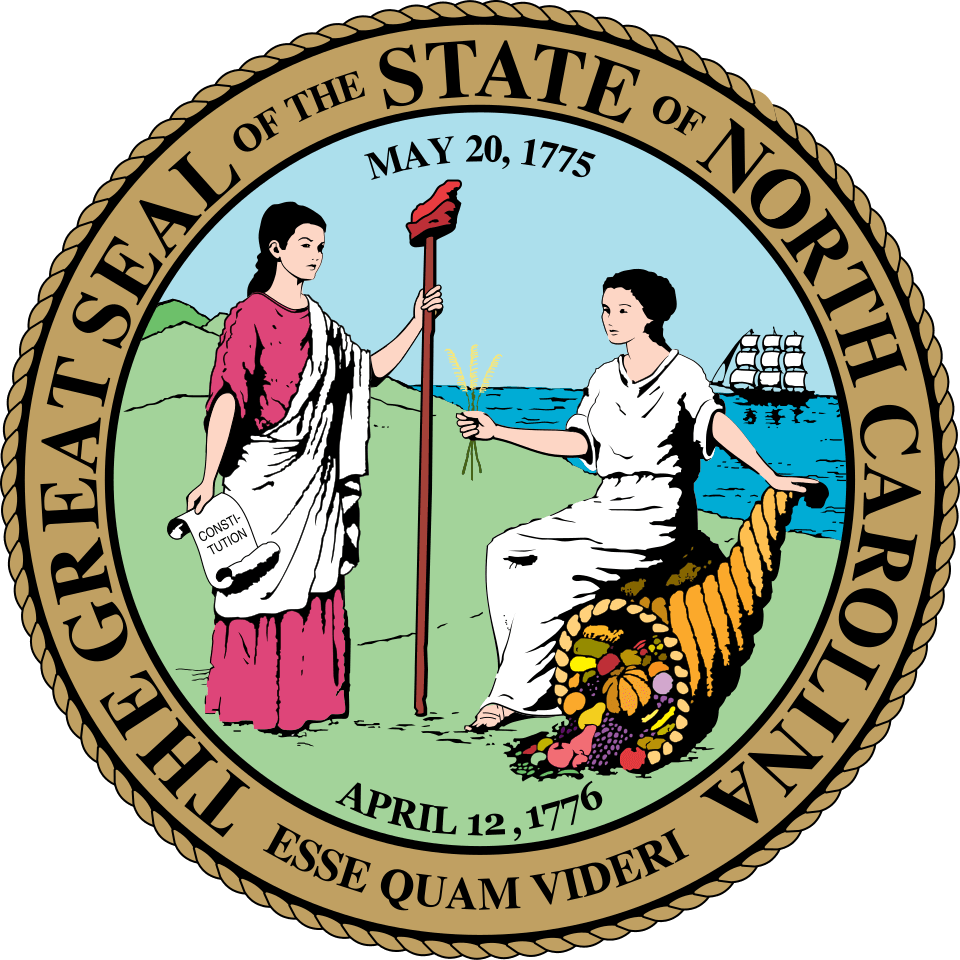
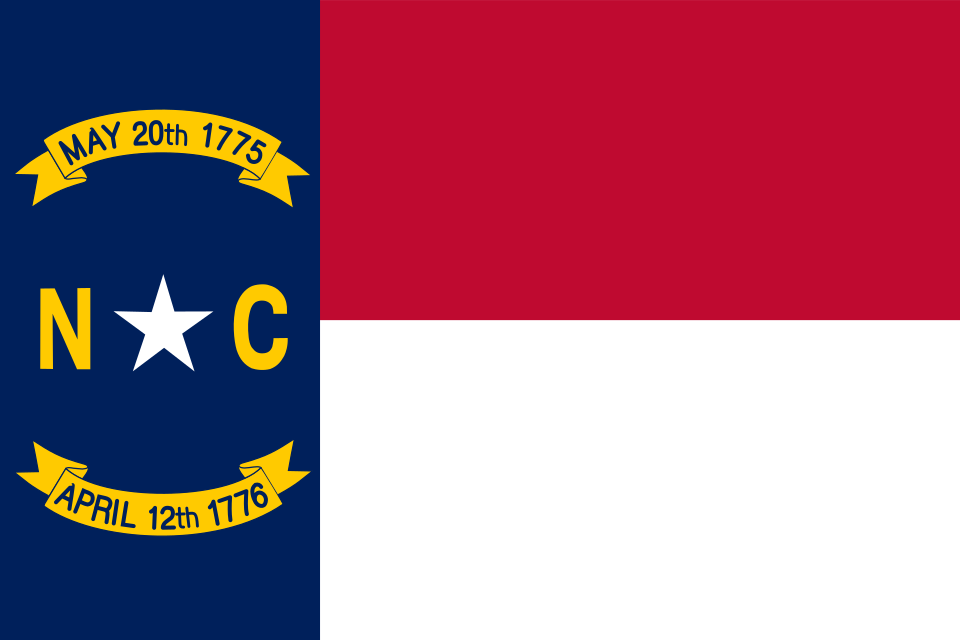
North Carolina’s state emblems carry two historic dates that predate the national Declaration of Independence. The Great Seal, standardized in 1871, depicts Liberty holding a scroll inscribed “Constitution” and Plenty seated with a cornucopia, under the motto Esse Quam Videri (“To be, rather than to seem”). The dates May 20, 1775 — the Mecklenburg Declaration of Independence — and April 12, 1776 — the Halifax Resolves, the first official colonial call for independence — appear prominently on both the seal and the flag. The flag, designed by Confederate veteran General Johnstone Jones and adopted on 9 March 1885, features a blue union with a white star and gilt N and C, flanked by the two date scrolls, with red and white horizontal bars.
Flag
Not available
Seal
Not available
| State | North Carolina (12th state, ratified Constitution 21 November 1789) |
|---|---|
| State seal | Liberty and Plenty, dates May 20 1775 and April 12 1776 |
| Seal standardized | 1871; current form 1983 |
| State flag | Blue union with white star, N-C, date scrolls; red and white bars |
| Flag designer | General Johnstone Jones |
| Flag adopted | 9 March 1885; proportions revised 1991 |
| Motto | Esse Quam Videri (“To be, rather than to seem”) |
| Capital | Raleigh |
| Nickname | The Tar Heel State |
| State flower | Dogwood (Cornus florida) |
Flag of North Carolina — Mecklenburg and Halifax dates, adopted 1885
The North Carolina flag is one of the few US state flags to commemorate specific historic dates directly on its face.
A blue union on the left contains a white star flanked by the gilt letters “N” and “C.” Above the star, a gilt scroll reads “May 20th, 1775”; below, another scroll reads “April 12th, 1776.” The fly consists of two horizontal bars: red above, white below.
The flag was designed by General Johnstone Jones, a Confederate veteran, and adopted by the General Assembly on 9 March 1885. It replaced an earlier Civil War-era flag by swapping the positions of the blue and red and replacing the secession date with April 12, 1776 (the Halifax Resolves).
In 1991, the official proportions were changed from “one-third more than its width” to “one-half more than its width,” standardizing the flag’s dimensions.
Great Seal of North Carolina — Esse Quam Videri — since 1871
The North Carolina seal is a classical allegory of liberty and abundance, anchored by two dates that claim North Carolina as a pioneer of American independence.
Liberty stands on the left, holding a pole in her left hand and a scroll inscribed “Constitution” in her right. Plenty is seated on the right, extending three heads of grain toward Liberty, with a cornucopia (horn of plenty) spilling its contents beside her. Above: “May 20, 1775.” Below: “April 12, 1776.”
Esse Quam Videri (“To be, rather than to seem”) was added to the seal in 1893. The phrase comes from Cicero’s De Amicitia (“On Friendship”).
The first seal was adopted in 1779. The design was standardized by the General Assembly in 1871 and again in 1971. The current form dates to 1983.
Liberty standing with a “Constitution” scroll and Plenty seated with a cornucopia. Dates May 20, 1775 and April 12, 1776. Motto Esse Quam Videri. Standardized 1871, current form 1983.
Latin for “To be, rather than to seem.” From Cicero’s De Amicitia. Adopted as the state motto in 1893.
May 20, 1775 = Mecklenburg Declaration of Independence. April 12, 1776 = Halifax Resolves, the first official colonial call for independence.
General Johnstone Jones, a Confederate veteran. Adopted 9 March 1885. Proportions revised 1991.
First seal 1779. Standardized 1871 and 1971. Current version 1983. Motto added 1893.
Last reviewed by the Emblema Mundi editorial team on 2026-06-27.