US State
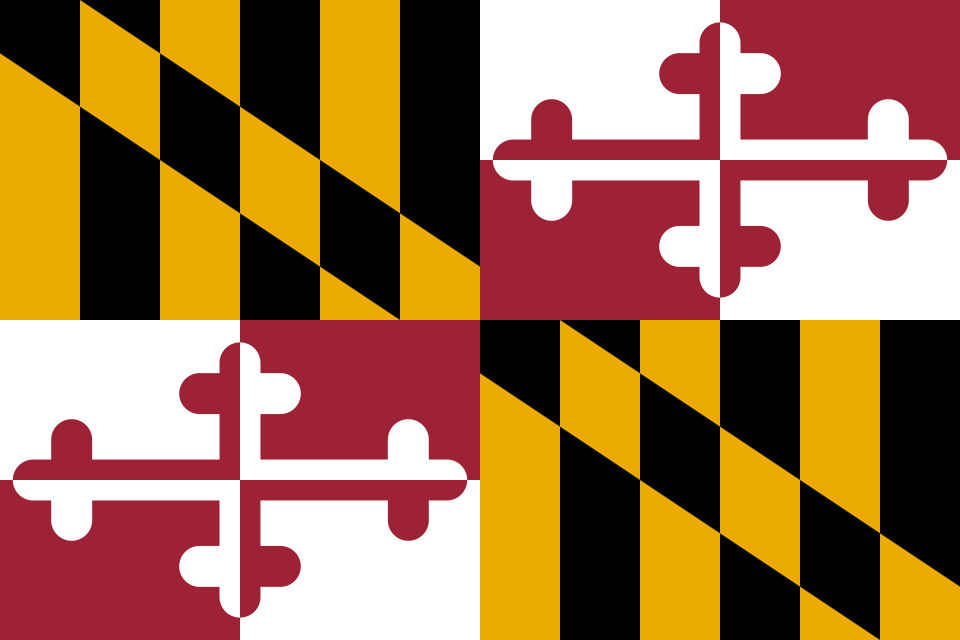
The flag of Maryland is the banner of arms of the Barons Baltimore, the family that founded the colony: the gold and black of the Calverts quartered with the red and white cross of the Crosslands. The Great Seal bears the same arms between a plowman and a fisherman, with the Calvert motto Fatti maschii, parole femine. Their return was gradual: the Calvert colours in 1854, the Calvert seal in 1874 and 1876, then a new flag uniting Calvert and Crossland, made official in 1904.
Flag
Not available
Seal
Not available
| Flag | Quarterly, Calvert and Crossland; adopted in 1904 |
|---|---|
| Arms | Quarterly, 1st and 4th paly of six Or and Sable, a bend counterchanged; 2nd and 3rd quarterly Argent and Gules, a cross bottony counterchanged |
| Great Seal | The reverse of the Calvert seal, readopted in 1874 and 1876 |
| Motto | Fatti maschii, parole femine — “Strong deeds, gentle words” |
| In law | Code of Maryland, General Provisions, §§ 7-101 to 7-104 and 7-201 to 7-203 |
Flag of Maryland — adopted in 1904.
The flag of Maryland is the banner of arms of the Barons Baltimore, the family that founded the colony. The law describes it in heraldic terms:
“The State flag is divided into quarters. The first and fourth quarters are a paly of six pieces, or (gold) and sable (black), and a bend dexter (right diagonal band) counterchanged… The second and third quarters are quartered argent (white) and gules (red), a cross bottony counterchanged…”
The gold and black quarters are the arms of George Calvert, 1st Baron Baltimore (1579–1632). The red and white quarters are those of the Crossland family: his mother, Alicia Crossland, was a heraldic heiress, which entitled him to bear her arms with his own. When George Calvert died in April 1632, the arms and the banner passed to his eldest son, Cecil Calvert, 2nd Baron Baltimore, to whom King Charles I granted the Province of Maryland that same year. In colonial times, however, only the gold and black Calvert arms were associated with Maryland; the colours fell out of use after independence and returned in 1854.
By the time of the war, Maryland was most often represented by the state seal on a blue field. During the war, Maryland units fought on both sides: Union troops favoured the gold and black Calvert arms, while Confederate units became associated with the red and white Crossland banner and its cross bottony. The flag that unites both may have been a compromise or, as the Maryland Secretary of State suggests, a sign of the reunion of all the state’s citizens after the war.
According to the Maryland State Archives, the flag was first flown on 11 October 1880 in Baltimore, at a parade marking the city’s 150th anniversary, and again on 25 October 1888 at Gettysburg, when monuments to the Maryland regiments of the Army of the Potomac were dedicated. Wikipedia gives an earlier appearance, in 1876, on the Maryland building at the Centennial Exposition. It became the state flag in 1904 (Chapter 48, Acts of 1904, in force from 9 March 1904).
Since 1945, Maryland law has required that any ornament on top of a staff carrying the state flag be a gold cross bottony, like the cross of the Crossland arms.
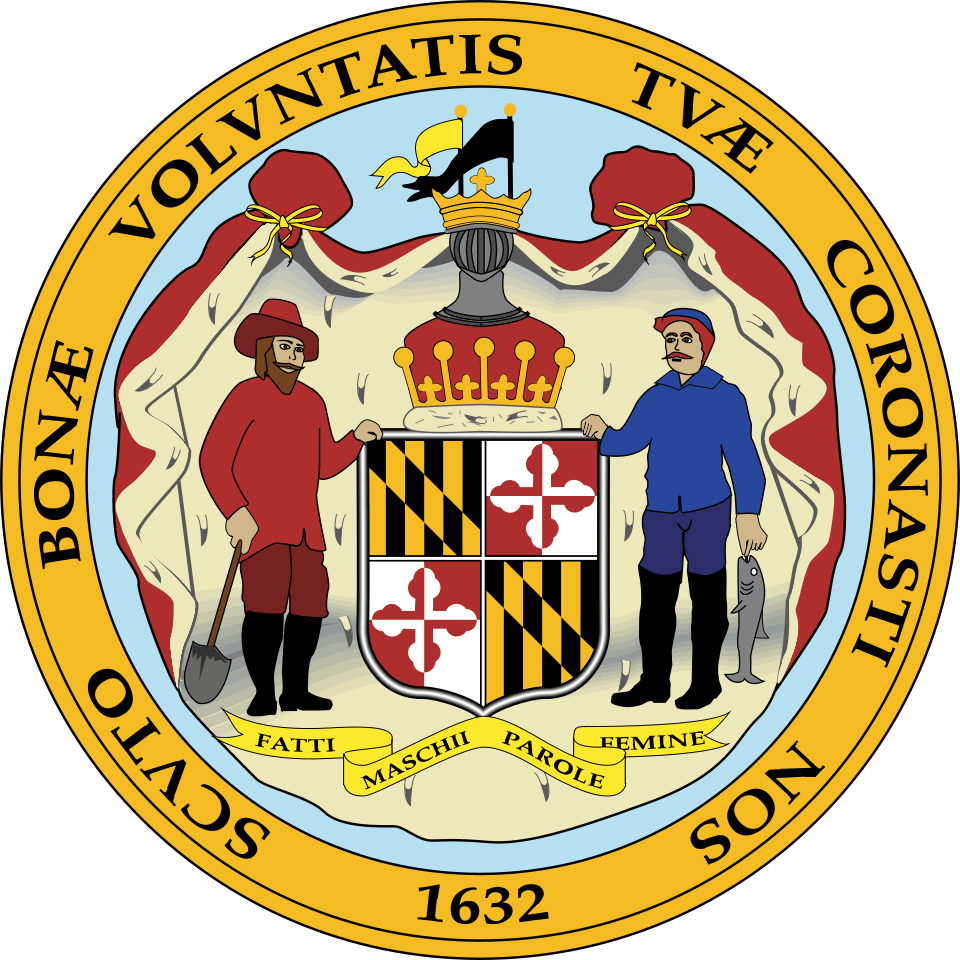
Great Seal of Maryland — the reverse, readopted in 1874 and 1876.
The Great Seal is used by the Governor and the Secretary of State to authenticate the Acts of the General Assembly. It has two sides, which is rare among American states, but only the reverse is used officially.
Quarterly first and fourth, a paly of six Or and Sable, a bend counterchanged; quarterly second and third, quarterly Argent and Gules a cross bottony counterchanged. Above the shield an earl’s coronet surmounted by a barred helm affronté Argent.
The supporters are a plowman holding a spade and a fisherman holding a fish. The crest is a crown with two pennants, the dexter gold and the sinister black, and an ermine mantle surrounds the whole composition. The Latin legend around the seal, Scuto bonæ voluntatis tuæ coronasti nos, comes from Psalm 5: “With favour wilt thou compass us as with a shield”; the founding date of 1632 completes the circle.
The motto is archaic Italian, literally “deeds are males, words are females”. George Calvert made it his family’s motto in 1622. Maryland has translated it as “Manly deeds, womanly words”; the official translation since the 2017 legislative session is “Strong deeds, gentle words”. Maryland is the only state with a motto in Italian.
The obverse shows Lord Baltimore as a knight in full armour on a charger, a drawn sword in hand, the trappings of the horse bearing his arms. The legend reads Cecilius Absolutus Dominus Terræ Mariæ et Avaloniæ Baro de Baltimore, “Cecil, Absolute Lord of Maryland and Avalon, Baron of Baltimore”. It was described by statute in 1959 and often adorns public buildings, but it has never been cut as a seal.
The first seal of the colony was stolen in 1645 by Richard Ingle during his rebellion; Cecil Calvert sent a similar one in 1648. Except during the period of royal rule (1692–1715), it stayed in use until the end of the 18th century, the Council having authorised its continued use in 1777. A seal with republican imagery, designed by Charles Willson Peale, followed in 1794; then, in 1817, a single-sided seal with an eagle holding a shield, and in 1854 a seal with an eagle and a version of the Calvert arms. Maryland readopted the reverse of the original Calvert seal in 1874 and 1876, correcting the arms of 1854. The seal was set out in statute in 1959 and revised in 1969 and 2017.
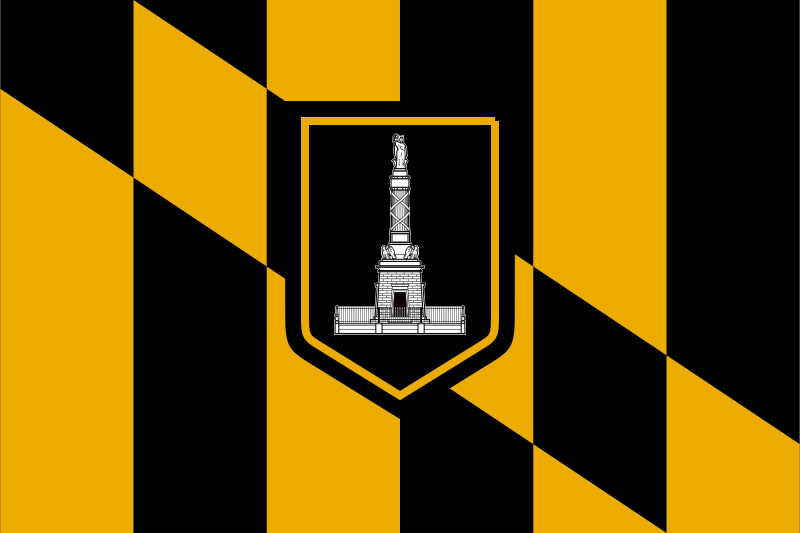
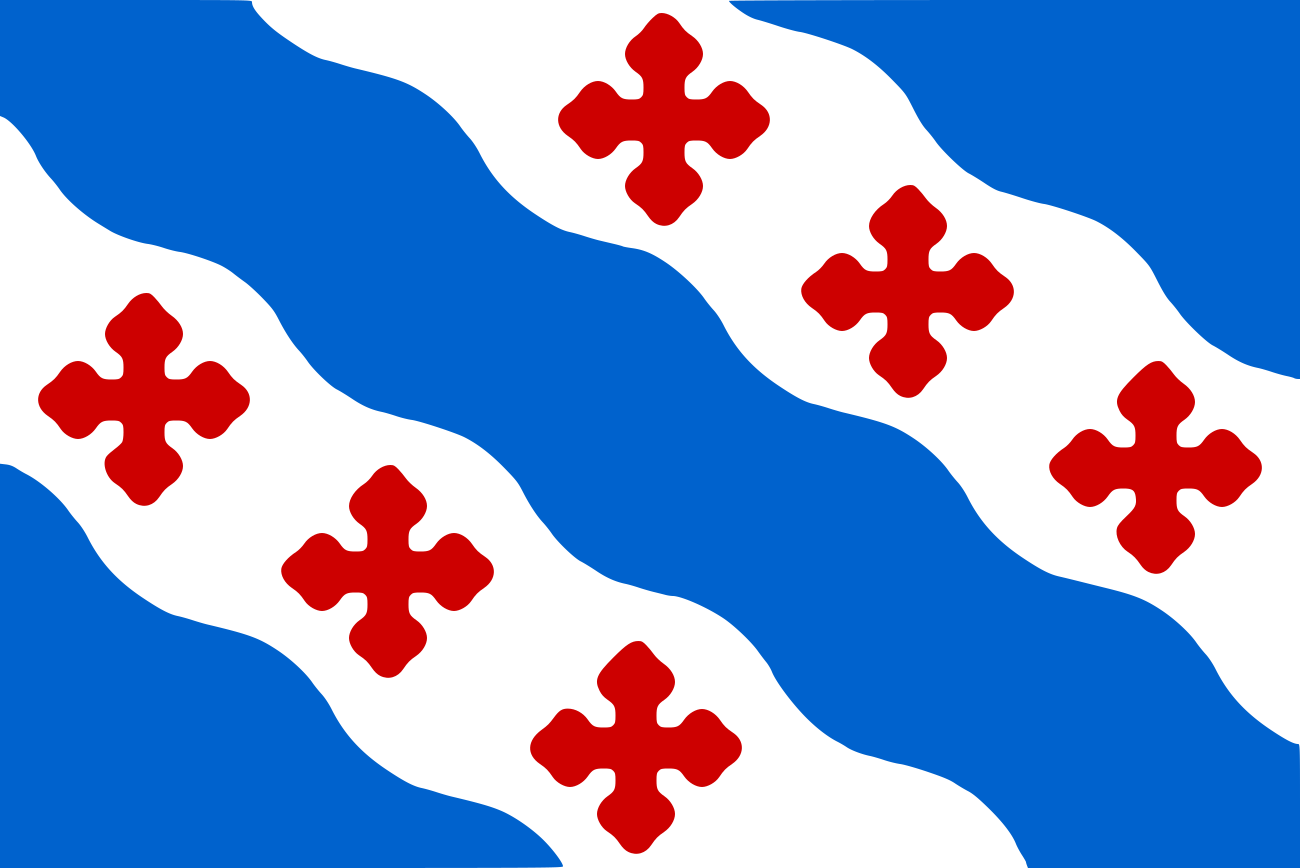
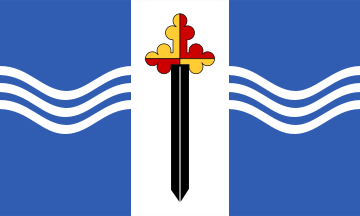
Some Maryland counties and municipalities, the city of Baltimore among them, use elements of the Calvert and Crossland arms in their own emblems. These cities each have their own page.
It is a banner of arms: the gold and black Calvert arms in the first and fourth quarters and the red and white Crossland arms in the second and third. George Calvert, 1st Baron Baltimore, was entitled to the Crossland arms through his mother, a heraldic heiress.
The Calverts, Barons Baltimore, were the family who founded Maryland: the province was granted to Cecil Calvert, 2nd Baron Baltimore, in 1632. The Crosslands were the family of George Calvert’s mother, Alicia Crossland.
It was first flown on 11 October 1880 in Baltimore, according to the Maryland State Archives, and became the official state flag in 1904, in force from 9 March 1904.
Maryland units fought on both sides. Union troops favoured the gold and black Calvert arms, while Confederate units became associated with the red and white Crossland banner and its cross bottony. The present flag combines the two.
The reverse, the side used officially, shows the Calvert and Crossland arms under an earl’s coronet and a helm, between a plowman and a fisherman, on an ermine mantle, with the motto Fatti maschii, parole femine and the date 1632. The obverse shows Lord Baltimore on horseback.
It is archaic Italian, literally “deeds are males, words are females”. The official translation since 2017 is “Strong deeds, gentle words”. It has been the Calvert family motto since 1622.
Since 1945, Maryland law has required that any ornament on top of a staff carrying the state flag be a gold cross bottony, like the cross of the Crossland arms.
Last reviewed by the Emblema Mundi editorial team on 3 October 2026.