US State
South Carolina’s emblems are born from a single Revolutionary War battle. The Great Seal, adopted in 1776 and designed by William Henry Drayton and Arthur Middleton, depicts a palmetto tree standing over a fallen oak — the victory at the Battle of Sullivan’s Island on 28 June 1776, where a fort of palmetto logs absorbed British cannonballs without breaking. Two Latin mottos adorn the seal: Animis Opibusque Parati (“Prepared in mind and resources”) and Dum Spiro Spero (“While I breathe, I hope”). The flag, rooted in Colonel William Moultrie’s 1776 signal flag, features a white crescent and palmetto tree on indigo blue — one of the most recognized state flags in America.
Flag
Not available
Seal
Not available
| State | South Carolina (8th state, ratified Constitution 23 May 1788) |
|---|---|
| State seal | Palmetto over fallen oak, 12 spears, goddess Spes |
| Seal designers | William Henry Drayton, Arthur Middleton (1776) |
| State flag | Indigo blue field, white crescent, white palmetto tree |
| Flag origins | Moultrie’s signal flag (1776); palmetto added post-battle; adopted 1861 |
| Mottos | Dum Spiro Spero • Animis Opibusque Parati |
| Capital | Columbia |
| Nickname | The Palmetto State |
| State flower | Yellow jessamine (Gelsemium sempervirens) |
| Key battle | Sullivan’s Island, 28 June 1776 |
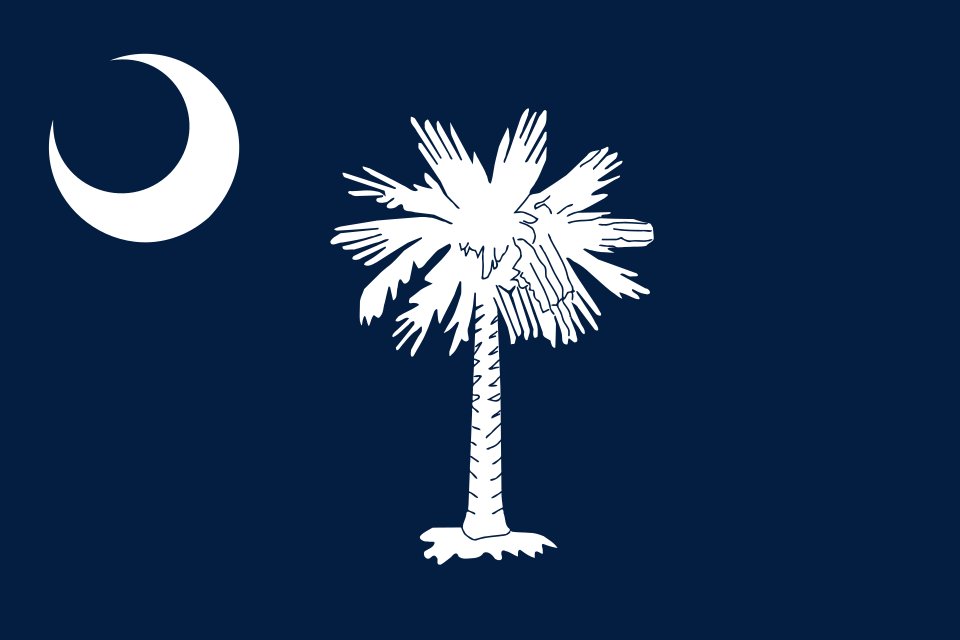
Flag of South Carolina — Crescent and palmetto on indigo blue, from 1776
The South Carolina flag is one of the most iconic and recognizable state flags in the nation — and one of the oldest in origin.
In 1776, the Council of Safety ordered Colonel William Moultrie to produce a signal flag and supplied blue cloth. Moultrie placed the silver crescent worn on his troops’ hats in the upper corner of the blue field. This flag flew during the Battle of Sullivan’s Island.
After the battle, the palmetto tree was added to the flag to commemorate the palmetto-log fort that had withstood the British bombardment.
An indigo blue field bears a white crescent in the upper left and a white palmetto tree at center. The indigo blue represents the color of the troops’ uniforms.
The white crescent is generally believed to represent a gorget — a crescent-shaped piece of armor worn at the throat — that adorned the caps of South Carolina’s Revolutionary War soldiers.
The current flag was formally adopted in 1861, but its design has roots stretching back to 1776.
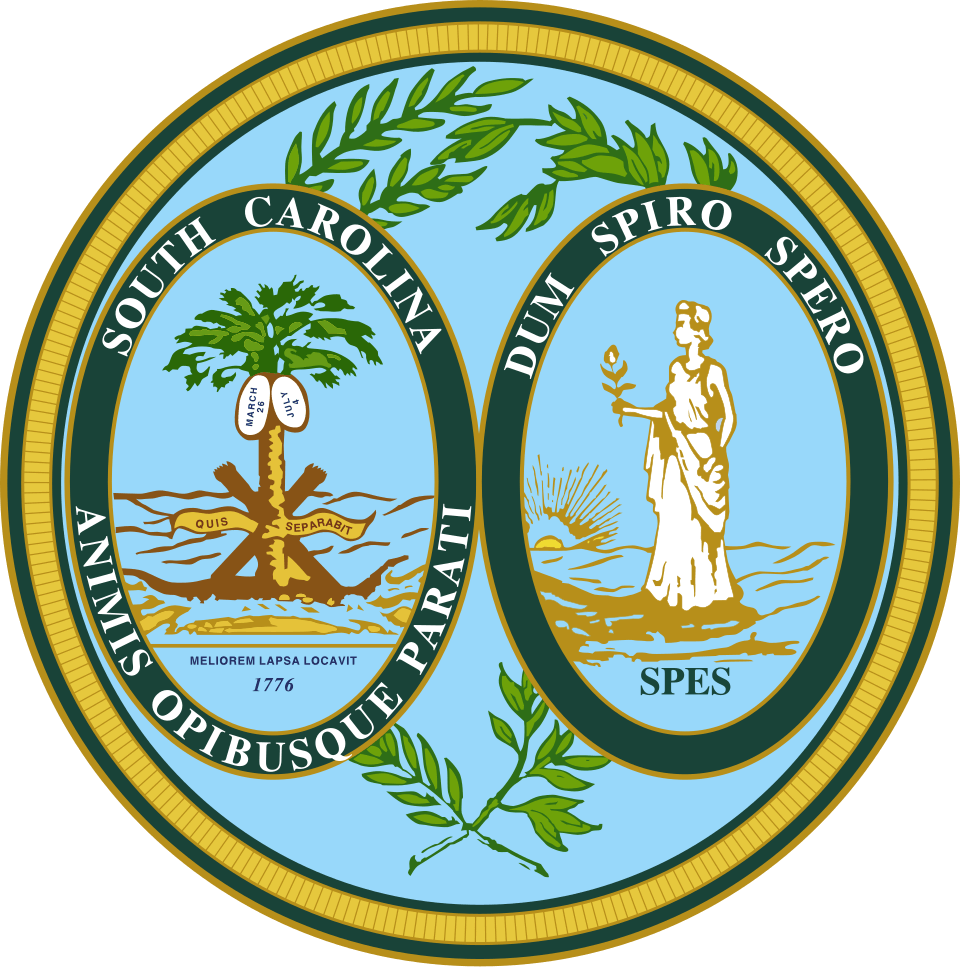
Great Seal of South Carolina — Dum Spiro Spero — since 1776
South Carolina’s seal is one of the most battle-specific in the nation — every element references a single day of combat.
A tall palmetto tree stands over a fallen, broken oak. This represents the Battle of Sullivan’s Island on 28 June 1776: the unfinished fort built of spongy palmetto logs absorbed the British fleet’s cannonballs, while the British “oak” was broken. Twelve spears bound to the palmetto represent the other original states. The motto Animis Opibusque Parati (“Prepared in mind and resources”) appears below — from Virgil’s Aeneid.
The Roman goddess Spes (Hope) walks along a shore littered with weapons, grasping a laurel branch as the sun rises behind her. The motto Dum Spiro Spero (“While I breathe, I hope”) appears below.
The seal was designed by William Henry Drayton and Arthur Middleton under the authority of President John Rutledge. It was first used in May 1777.
Palmetto tree over fallen oak (Battle of Sullivan’s Island), 12 spears, goddess Spes. Mottos: Animis Opibusque Parati and Dum Spiro Spero. Adopted 1776.
A gorget (crescent-shaped armor) from Revolutionary War soldiers’ caps. Colonel Moultrie placed it on his signal flag in 1776.
Latin for “While I breathe, I hope.”
The palmetto-log fort at Sullivan’s Island absorbed British cannonballs on 28 June 1776. The palmetto became South Carolina’s symbol of resistance.
Formally adopted 1861, but rooted in Colonel Moultrie’s 1776 signal flag.
Last reviewed by the Emblema Mundi editorial team on 2026-06-27.