US State
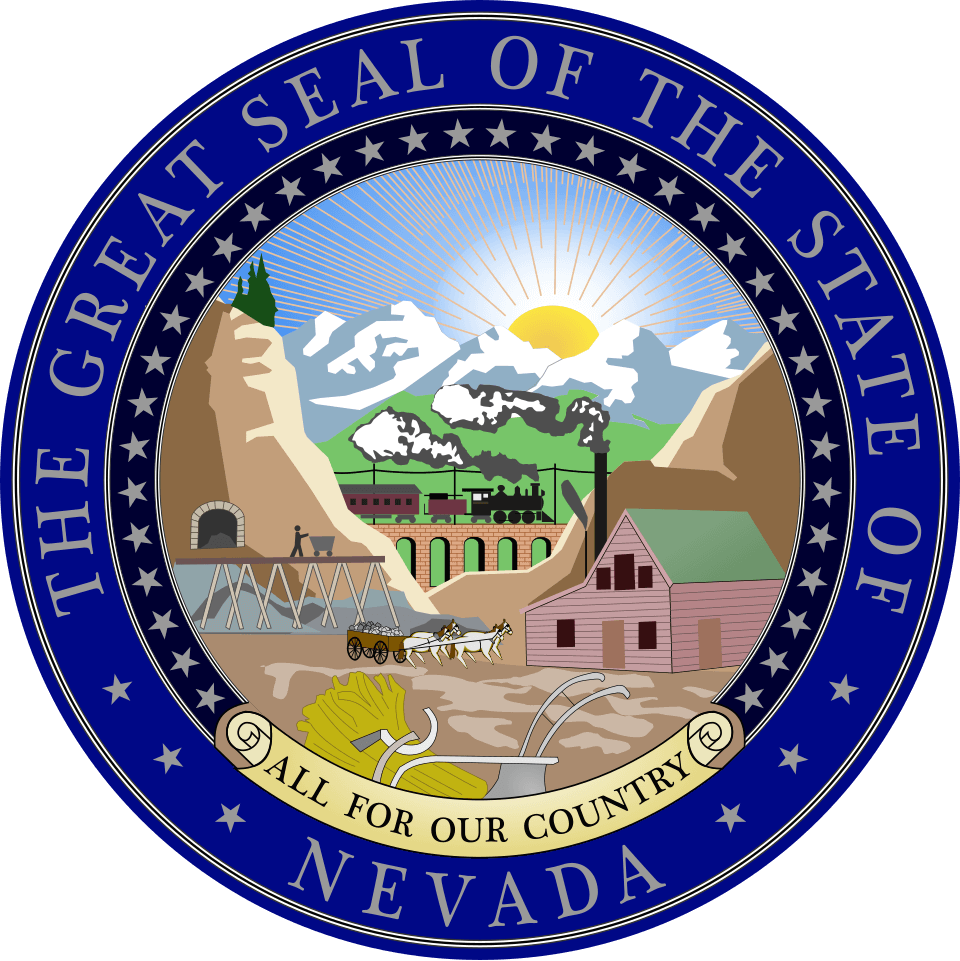
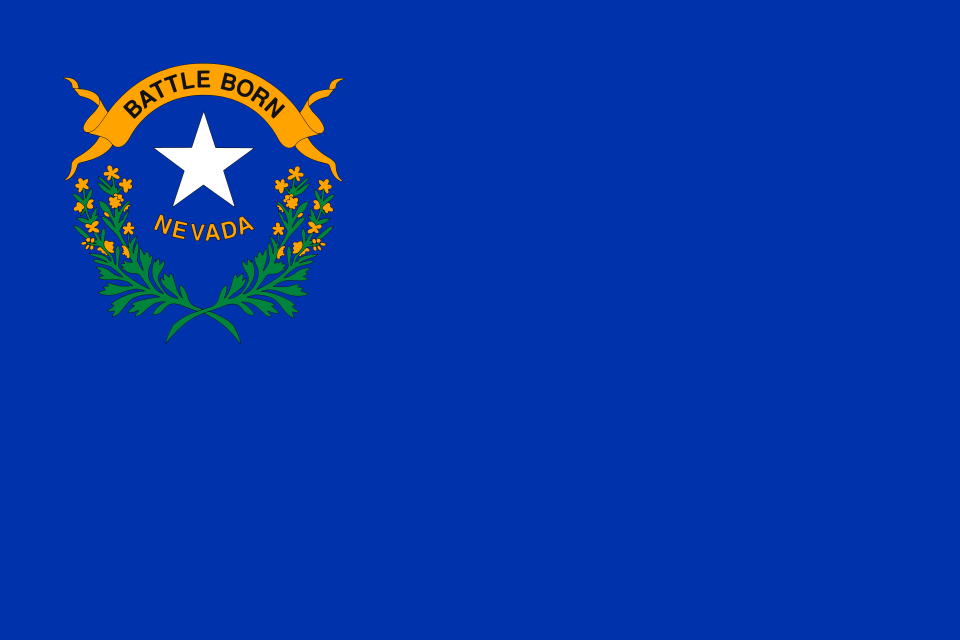
Nevada’s state emblems are stamped with the urgency of the Civil War and the silver rush. The Great Seal, adopted on 24 February 1866, depicts a quartz mill, a mine tunnel with a miner pushing ore, mountains, and agricultural tools, encircled by 36 stars and the motto “All for Our Country.” Nevada was admitted as the 36th state on 31 October 1864 — during the war itself — earning the nickname “Battle Born.” The flag, designed by Louis Shellback III for a 1926 contest and adopted in 1929, places a silver star within a sagebrush wreath on a cobalt blue field, with “Battle Born” on a golden scroll above.
Flag
Not available
Seal
Not available
| State | Nevada (36th state, admitted 31 October 1864) |
|---|---|
| State seal | Mountains, quartz mill, mine tunnel, miner, plow, 36 stars |
| Seal adopted | 24 February 1866 (from 1861 territorial seal) |
| State flag | Cobalt blue field, silver star, sagebrush wreath, Battle Born scroll |
| Flag designer | Louis Shellback III (1926 contest winner) |
| Flag adopted | 1929; revised 1991 |
| Seal motto | “All for Our Country” |
| Flag motto | “Battle Born” |
| Capital | Carson City |
| Nickname | The Silver State; The Battle Born State |
| State flower | Sagebrush (Artemisia tridentata) |
Flag of Nevada — Battle Born — silver star on cobalt blue, 1929
The Nevada flag went through a 62-year drafting error before reaching its current form — one of the more unusual stories in American vexillology.
A design contest was announced in 1926, and the winning entry was submitted by Louis Shellback III. Governor Fred B. Balzar signed it into law in 1929. The flag features a cobalt blue field with, in the upper hoist quarter, a silver star centered within a wreath of two crossed sprays of sagebrush (the state flower). “NEVADA” appears in golden-yellow letters, and a golden scroll above reads “Battle Born.”
Between 1929 and 1991, the letters of “NEVADA” were placed in a circle around the star’s points rather than below it. In 1989, a legislative researcher discovered that the bill as signed did not accurately reflect the legislature’s original intent.
A 1991 law corrected the placement: “NEVADA” now appears below the star and above the sagebrush sprays. The revision also introduced standardized Pantone colors, eliminating the variations that had characterized earlier reproductions.
“Battle Born” refers to Nevada’s admission during the Civil War on 31 October 1864. It is one of the state’s official mottos.
Great Seal of Nevada — All for Our Country — since 1866
The Nevada seal is a mining panorama that captures the Comstock Lode era — the silver strikes that built the state and financed the Union war effort.
Two large mountains dominate the background. At the base, a quartz mill stands on the right and a mine tunnel on the left, with a miner pushing a cart of ore out of the tunnel. A team loaded with ore heads for the mill. In the foreground, a plow, sheaf of wheat, and sickle represent agriculture. 36 stars encircle the scene, and the motto “All for Our Country” arcs across the top.
The territorial seal, adopted in 1861, featured the same mining imagery with the Latin motto Volens et Potens (“Willing and Able”). When Nevada became a state in 1864, the motto was changed to “All for Our Country” and the seal was formally adopted on 24 February 1866.
President Abraham Lincoln rushed Nevada’s admission to secure additional electoral votes and Congressional support for the Thirteenth Amendment abolishing slavery. The state’s silver wealth was crucial to financing the Union war effort.
The seal depicts mountains, a quartz mill, a mine tunnel with a miner, a plow and wheat. 36 stars and the motto “All for Our Country” encircle the scene. Derived from the 1861 territorial seal, adopted 24 February 1866.
“Battle Born” refers to Nevada’s statehood on 31 October 1864, during the Civil War. President Lincoln rushed admission for electoral votes and support for the Thirteenth Amendment.
Louis Shellback III won a 1926 contest. Governor Fred B. Balzar signed it into law in 1929. A 1991 revision corrected a drafting error and standardized colors.
“All for Our Country” is Nevada’s state motto on the seal. It replaced the territorial motto Volens et Potens (“Willing and Able”) in 1866, expressing Nevada’s commitment to the Union.
The 36 stars represent Nevada as the 36th state, admitted 31 October 1864 during the Civil War.
Last reviewed by the Emblema Mundi editorial team on 2026-06-27.