US State
Nebraska’s state emblems tell the story of a frontier crossroads — where the mechanic arts, agriculture, river commerce, and the railroad converged on the way west. The Great Seal, adopted on 15 June 1867 (just months after statehood), depicts a blacksmith at an anvil, a settler’s cabin with wheat and corn, a steamboat on the Missouri River, and a train heading toward the Rocky Mountains, all under the motto “Equality Before the Law.” The flag, adopted on 28 March 1925 by Representative J. Lloyd McMaster, was a pragmatic solution: Nebraska was the last of the contiguous 48 states to adopt a flag, and McMaster simply placed the existing seal on a blue field in gold and silver.
Flag
Not available
Seal
Not available
| State | Nebraska (37th state, admitted 1 March 1867) |
|---|---|
| State seal | Blacksmith, steamboat, settler’s cabin, train, Rocky Mountains |
| Seal adopted | 15 June 1867 |
| State flag | Blue field with seal in gold and silver |
| Flag adopted | 28 March 1925 (banner); officially “state flag” 1963 |
| Flag champion | Representative J. Lloyd McMaster; Florence Hazen Miller |
| Motto | “Equality Before the Law” |
| Capital | Lincoln |
| Nickname | The Cornhusker State |
| State flower | Goldenrod (Solidago) |
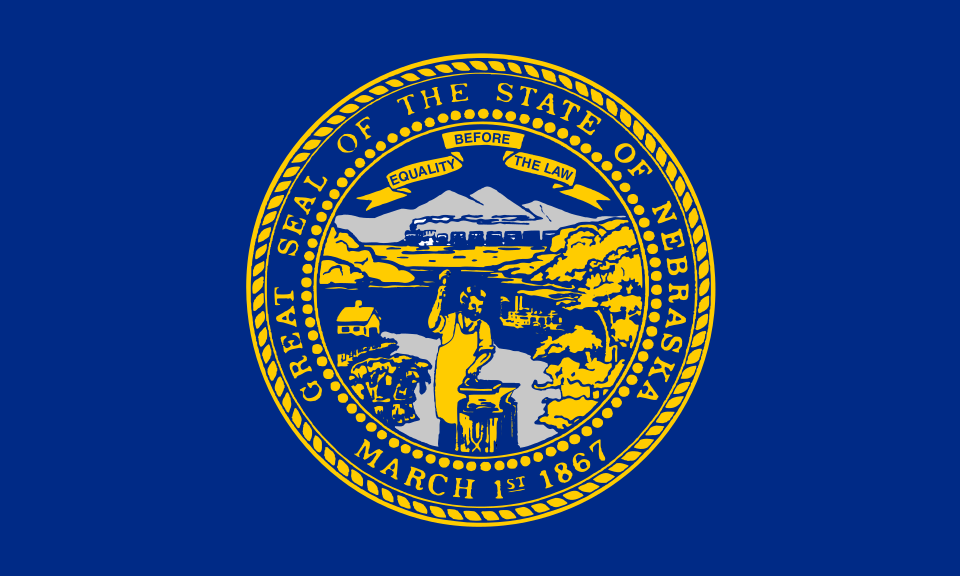
Flag of Nebraska — Seal on blue, adopted 1925
Nebraska was the last of the contiguous 48 states to adopt a flag — a distinction that took three legislative attempts to resolve.
In 1921, the legislature considered a proposal to redesign both the state seal and create a flag featuring the new seal. The redesign stalled, and because the flag was tied to it, Nebraska remained without a banner. A 1923 attempt died in committee.
Florence Hazen Miller of Crete, a staunch advocate for a Nebraska flag, prevailed upon Representative J. Lloyd McMaster of Lincoln to introduce a simpler bill. McMaster’s HR 67 bypassed the stalled redesign entirely, simply placing the existing 1867 seal on a field of national blue. The bill passed on 28 March 1925.
A blue field bears the state seal at center, rendered in gold and silver.
The 1925 law created a “state banner,” not a “state flag.” It was not officially designated as the state flag until 1963.
Great Seal of Nebraska — Equality Before the Law — since 1867
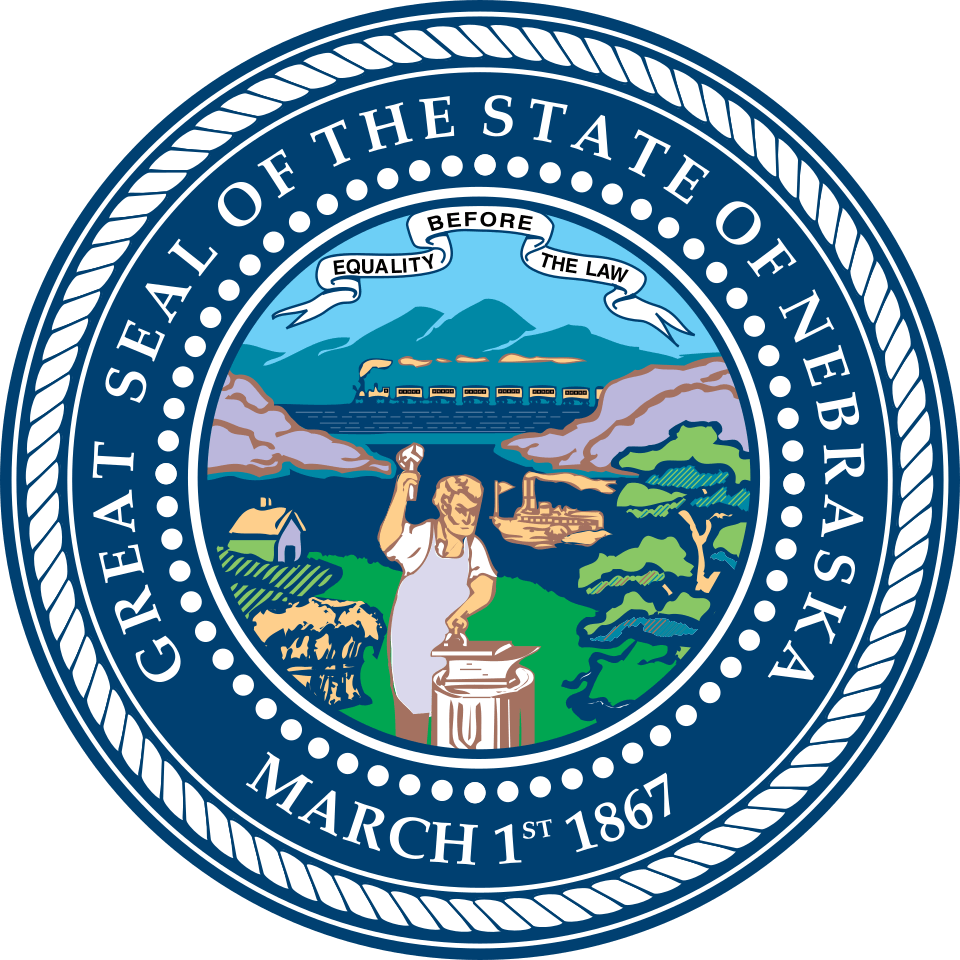
The Nebraska seal is a panoramic scene of the state’s economy at the dawn of statehood — a frontier tableau that reads from east to west.
In the foreground, a blacksmith works at his hammer and anvil, representing the mechanic arts. Behind him, a settler’s cabin sits amid sheaves of wheat and stalks of growing corn, representing agriculture. To the east, a steamboat ascends the Missouri River. In the background, a railroad train heads toward the Rocky Mountains on the western horizon. The motto “Equality Before the Law” arcs across the top.
The seal was adopted on 15 June 1867, just three months after Nebraska became the 37th state on 1 March 1867. The legislature appropriated $25 for a cast-iron press in the shape of a lion’s head to stamp the seal. The identity of the original designer remains unknown.
The Rocky Mountains appear on the seal even though they are not in Nebraska. In 1921, the Nebraska State Journal criticized the design as “archaic in conception and mediocre in drawing,” noting that the mountains “never belonged in the picture.” Despite this, the seal has never been changed.
A blacksmith at an anvil, a settler’s cabin with wheat and corn, a steamboat on the Missouri, and a train heading toward the Rocky Mountains. The motto “Equality Before the Law” arcs above. Adopted 15 June 1867.
A 1921 seal redesign stalled, and because the proposed flag was tied to the new seal, both failed. In 1925, Representative J. Lloyd McMaster bypassed the redesign by placing the existing seal on a blue field.
“Equality Before the Law” is Nebraska’s state motto, expressing equal justice for all citizens. It was adopted just two years after the Civil War and the Thirteenth Amendment.
The Rocky Mountains represent westward expansion and Nebraska’s role as a gateway to the frontier. They were criticized in 1921 as not belonging to Nebraska, but the seal has never been changed.
The banner was adopted 28 March 1925. It was not officially designated as the “state flag” until 1963.
Last reviewed by the Emblema Mundi editorial team on 2026-06-27.