US State
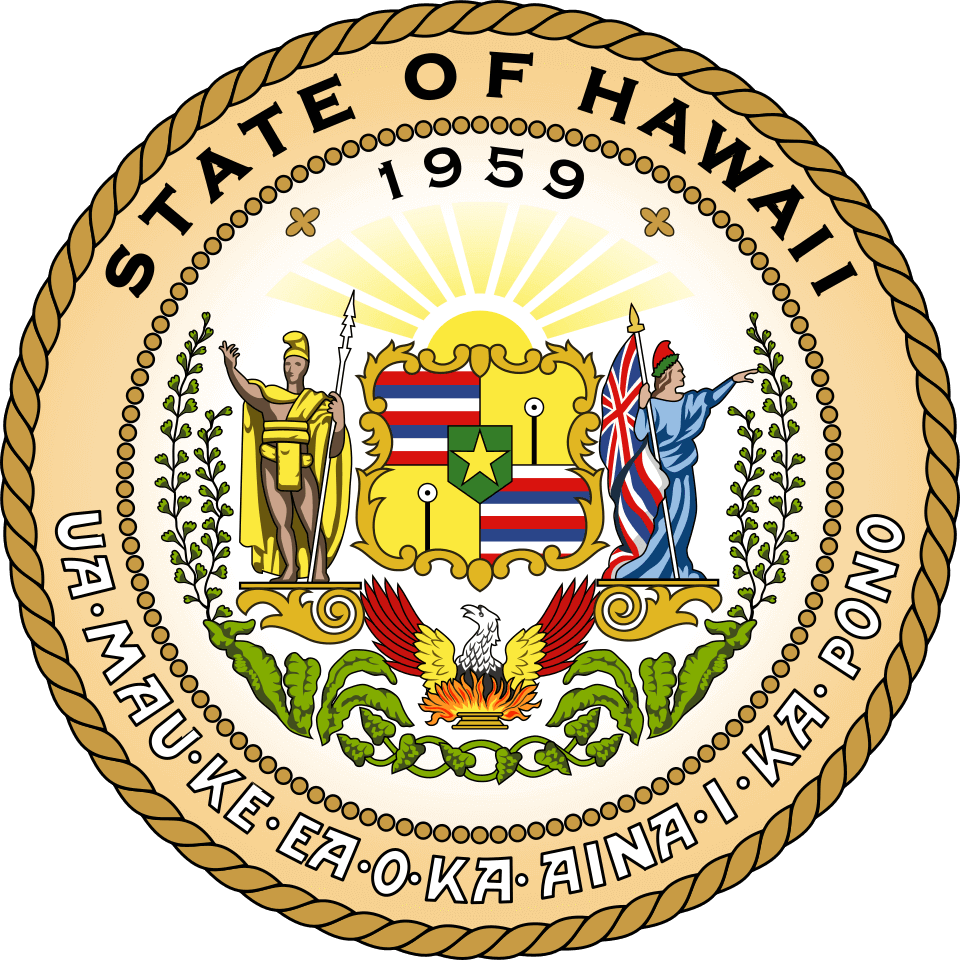
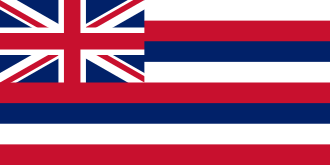
Hawaii’s state emblems are unlike any other in the Union — a living record of the islands’ passage from Polynesian kingdom to American state. The Great Seal, adopted on 21 August 1959 when Hawaii became the 50th state, is derived from the Royal Arms of the Kingdom of Hawai’i, designed by the College of Arms in London in 1842. It features Kamehameha I and the Goddess of Liberty flanking a quartered shield, with a phoenix rising from flames below — symbolizing the transformation from monarchy to democracy. The flag is the only US state flag to incorporate a foreign nation’s flag: the British Union Jack in the canton, a legacy of King Kamehameha I’s friendship with Britain. Its eight stripes of white, red, and blue represent the eight main islands.
Flag
Not available
Seal
Not available
| State | Hawaii (50th state, admitted 21 August 1959) |
|---|---|
| State seal | Quartered shield, Kamehameha I, Liberty, phoenix |
| Seal origins | Royal Arms designed by College of Arms, London, 1842; state seal 1959 |
| State flag | Eight stripes (white-red-blue), Union Jack canton |
| Flag origins | Designed c. 1816; current form standardized 1845 |
| Motto | Ua Mau ke Ea o ka ʻĀina i ka Pono (“The life of the land is perpetuated in righteousness”) |
| Capital | Honolulu |
| Nickname | The Aloha State |
| State flower | Yellow hibiscus (Hibiscus brackenridgei) |
| Unique distinction | Only US state flag with a foreign nation’s flag (Union Jack) |
Flag of Hawaii — Union Jack and eight stripes, since 1845
The Hawaiian flag is the only US state flag to feature the national flag of a foreign country — the British Union Jack in the canton.
Eight horizontal stripes alternate white, red, and blue (white-red-blue-white-red-blue-white-red). The British Union Jack occupies the upper-left canton.
In 1793, British explorer Captain George Vancouver gave King Kamehameha I a British flag. Kamehameha flew it over his kingdom, but during the War of 1812, an exclusively British banner became a liability. Around 1816, advised by Captain Alexander Adams, Kamehameha commissioned a new flag that blended British and American influences into something uniquely Hawaiian.
The eight stripes represent the eight main islands of Hawaii: Hawai’i, Maui, O’ahu, Kaua’i, Moloka’i, Lāna’i, Ni’ihau, and Kaho’olawe.
The current eight-stripe design was officially standardized and first flown on 25 May 1845 at the opening of the legislative council. It has served as the flag of the Kingdom, the Republic, the Territory, and now the State of Hawaii — an unbroken continuity across four forms of government.
Great Seal of Hawaii — Ua Mau ke Ea o ka ʻĀina i ka Pono — since 1959
The Hawaii seal is the most heraldically complex of all US state seals, directly descended from the Royal Arms of the Kingdom of Hawai’i.
The central shield is quartered. The first and fourth quarters display the stripes of the Hawaiian flag (representing the eight main islands). The second and third quarters show a puloulou (sacred staff) on a yellow field with a green escutcheon bearing a yellow star.
On the left stands Kamehameha I, the king who unified the Hawaiian Islands, depicted as in the bronze statue before Aliʻiōlani Hale in Honolulu. On the right stands the Goddess of Liberty, wearing a Phrygian cap and laurel wreath, holding the Hawaiian flag partly unfurled.
Below the shield, a phoenix rises from flames, with wings half yellow and half dark red (traditional Hawaiian royal colors). It symbolizes the transformation from absolute monarchy to democratic government.
The motto Ua Mau ke Ea o ka ʻĀina i ka Pono (“The life of the land is perpetuated in righteousness”) was first proclaimed by Kamehameha III on 31 July 1843, celebrating the restoration of Hawaiian sovereignty after the Paulet Affair — a five-month British occupation.
The Royal Arms were designed by the College of Arms in London in 1842 and officially adopted in 1845. Designer Viggo Jacobsen adapted them into a territorial seal. When Hawaii became the 50th state on 21 August 1959, the seal was updated with “State of Hawaii” and the date “1959.”
The seal features a quartered heraldic shield with Hawaiian flag stripes and puloulou (sacred staffs). Kamehameha I stands on the left and the Goddess of Liberty on the right. A phoenix rises from flames below. The motto Ua Mau ke Ea o ka ʻĀina i ka Pono encircles the design. Adopted 21 August 1959.
Captain George Vancouver gave King Kamehameha I a British flag in 1793, and it was incorporated into the Hawaiian flag around 1816. The Union Jack reflects the historical friendship between the Kingdom of Hawai’i and Britain. Hawaii is the only US state whose flag includes a foreign nation’s flag.
The eight horizontal stripes represent the eight main islands: Hawai’i, Maui, O’ahu, Kaua’i, Moloka’i, Lāna’i, Ni’ihau, and Kaho’olawe.
The state motto is Hawaiian for “The life of the land is perpetuated in righteousness.” It was first proclaimed by Kamehameha III on 31 July 1843 during a ceremony celebrating the restoration of sovereignty after the British Paulet Affair.
The phoenix rising from flames symbolizes Hawaii’s transformation from monarchy to democracy. Its wings are half yellow and half dark red, incorporating traditional Hawaiian royal colors.
Last reviewed by the Emblema Mundi editorial team on 2026-06-27.