US State
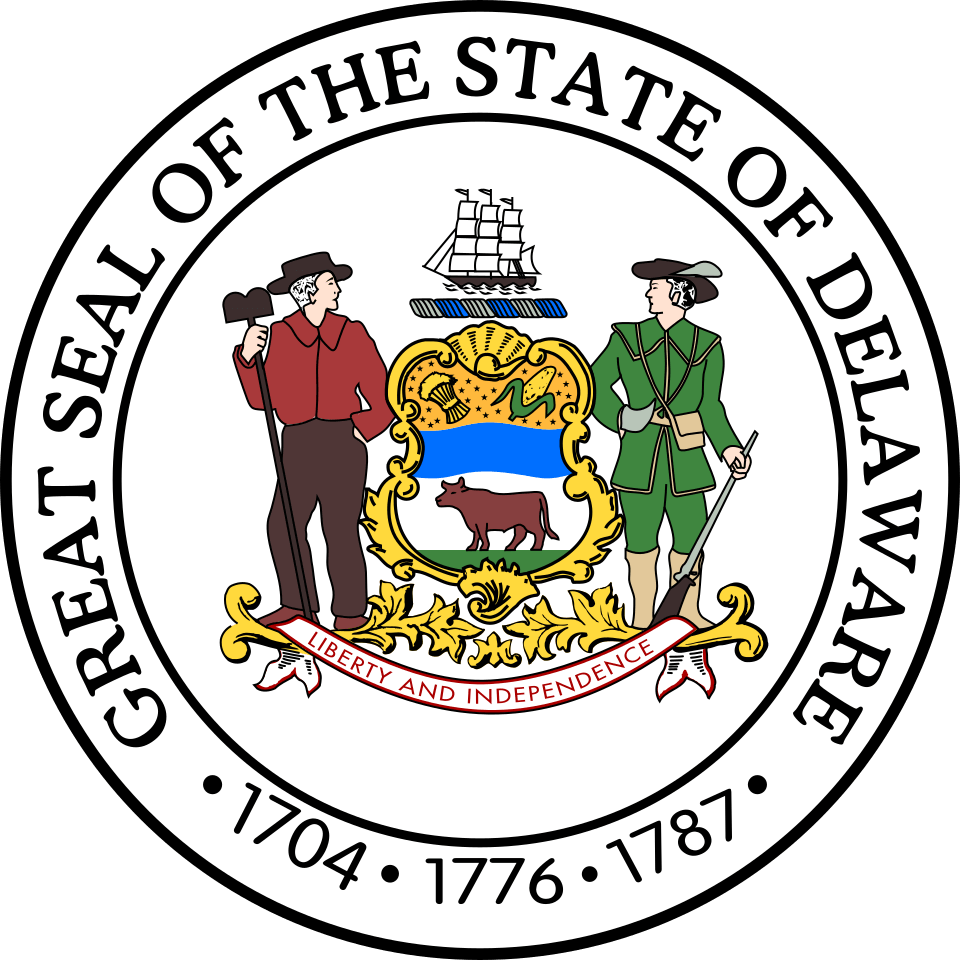
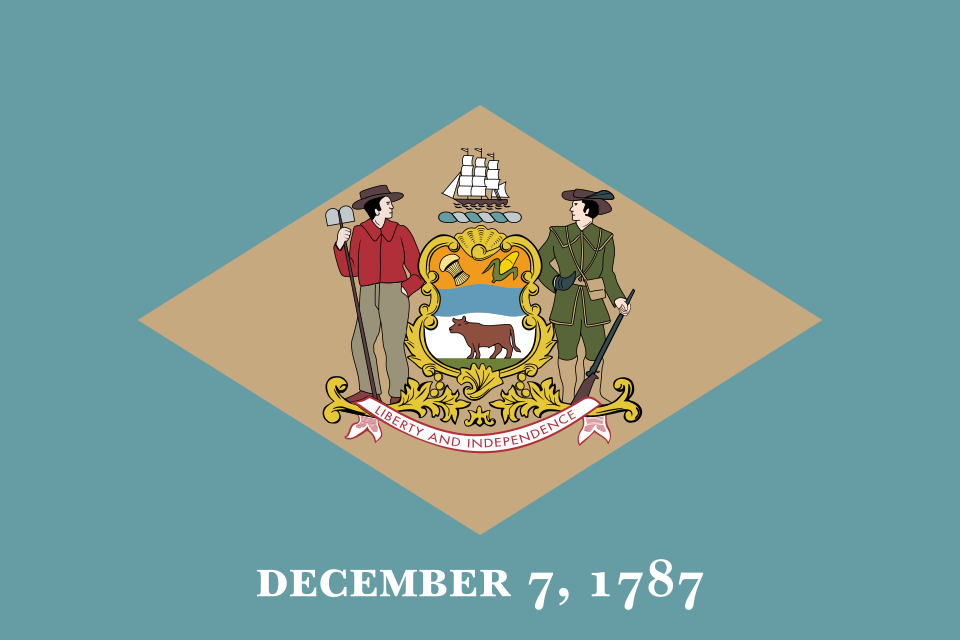
Delaware holds a singular place in American history as The First State — the first of the original 13 colonies to ratify the United States Constitution on 7 December 1787. Its Great Seal, first adopted on 17 January 1777, is a rich tableau of the state’s agricultural and maritime economy: a shield bearing a sheaf of wheat, an ear of corn, and an ox, topped by a sailing ship and flanked by a farmer and a rifleman, with the motto “Liberty and Independence” below. The flag, adopted on 24 July 1913, places the coat of arms inside a buff-colored diamond on a field of colonial blue — the colors of General George Washington’s Continental Army uniform.
Flag
Not available
Seal
Not available
| State | Delaware (1st state, ratified Constitution 7 December 1787) |
|---|---|
| State seal | Shield with wheat, corn, ox; farmer and soldier supporters; ship crest |
| Seal adopted | 17 January 1777; current version 29 April 2004 |
| State flag | Colonial blue field, buff diamond with coat of arms |
| Flag adopted | 24 July 1913 |
| Motto | “Liberty and Independence” (added 1847) |
| Capital | Dover |
| Nickname | The First State; The Diamond State |
| State flower | Peach blossom (Prunus persica) |
| Flag colors | Colonial blue and buff — Washington’s uniform colors |
Flag of Delaware — Colonial blue and buff, adopted 1913
The Delaware flag places the state coat of arms inside a buff-colored diamond on a field of colonial blue, with the historic date below.
The flag consists of a colonial blue field bearing a buff (golden tan) diamond at center. Inside the diamond, the full coat of arms — shield, farmer, soldier, ship, and motto — appears in natural colors. Below the diamond, the date “December 7, 1787” is inscribed, marking the day Delaware became the first state to ratify the Constitution.
The colonial blue and buff were chosen to honor General George Washington. According to members of the original flag commission, these were the colors of Washington’s Continental Army uniform: colonial blue for the coat, buff for the facings.
In February 1913, a commission was formed to design an official state flag. The resulting design was adopted on 24 July 1913.
Great Seal of Delaware — Liberty and Independence — since 1777
The Delaware seal is one of the earliest state seals in the nation, adopted just months after independence from Great Britain.
The central shield is divided by a wavy blue line (fess) representing the Delaware River. Above the line: a sheaf of wheat (from the Sussex County seal) and an ear of corn (from the Kent County seal), representing agricultural vitality. Below: an ox standing on grass, symbolizing the importance of animal husbandry. A sailing ship tops the shield as a crest, representing New Castle County’s shipbuilding industry and Delaware’s coastal commerce.
A farmer with a hoe stands to the left, representing agriculture’s central role. A rifleman (militiaman with musket) stands to the right, recognizing the citizen-soldier’s role in defending American liberties.
Delaware declared independence from Great Britain on 15 June 1776 and adopted its first constitution on 20 September 1776. The Great Seal was adopted on 17 January 1777. From 1793 to 1847, the farmer and soldier figures were temporarily removed. In 1847, they were restored and the motto “Liberty and Independence” was added on a ribbon below the shield. The current version dates to 29 April 2004.
The Great Seal features a shield with a sheaf of wheat, ear of corn, ox, and a wavy blue line for the Delaware River. A farmer and a rifleman support the shield, and a sailing ship serves as the crest. The motto “Liberty and Independence” appears below. First adopted 17 January 1777, current version 29 April 2004.
Delaware was the first of the 13 colonies to ratify the United States Constitution, on 7 December 1787. This date is prominently displayed on the state flag below the coat of arms.
The colonial blue and buff represent the colors of General George Washington’s Continental Army uniform. Colonial blue was the coat color, buff the facing color. The flag was adopted on 24 July 1913.
The motto “Liberty and Independence” was added to the seal in 1847. It reflects Delaware’s pioneering role — the state was the first to ratify the Constitution and one of the first to declare independence from Great Britain, on 15 June 1776.
The farmer with a hoe represents agriculture’s central role in Delaware’s economy. The militiaman with his musket represents the citizen-soldier and defense of American liberties. They were part of the original 1777 design, removed from 1793 to 1847, then restored.
Last reviewed by the Emblema Mundi editorial team on 2026-06-27.