US State
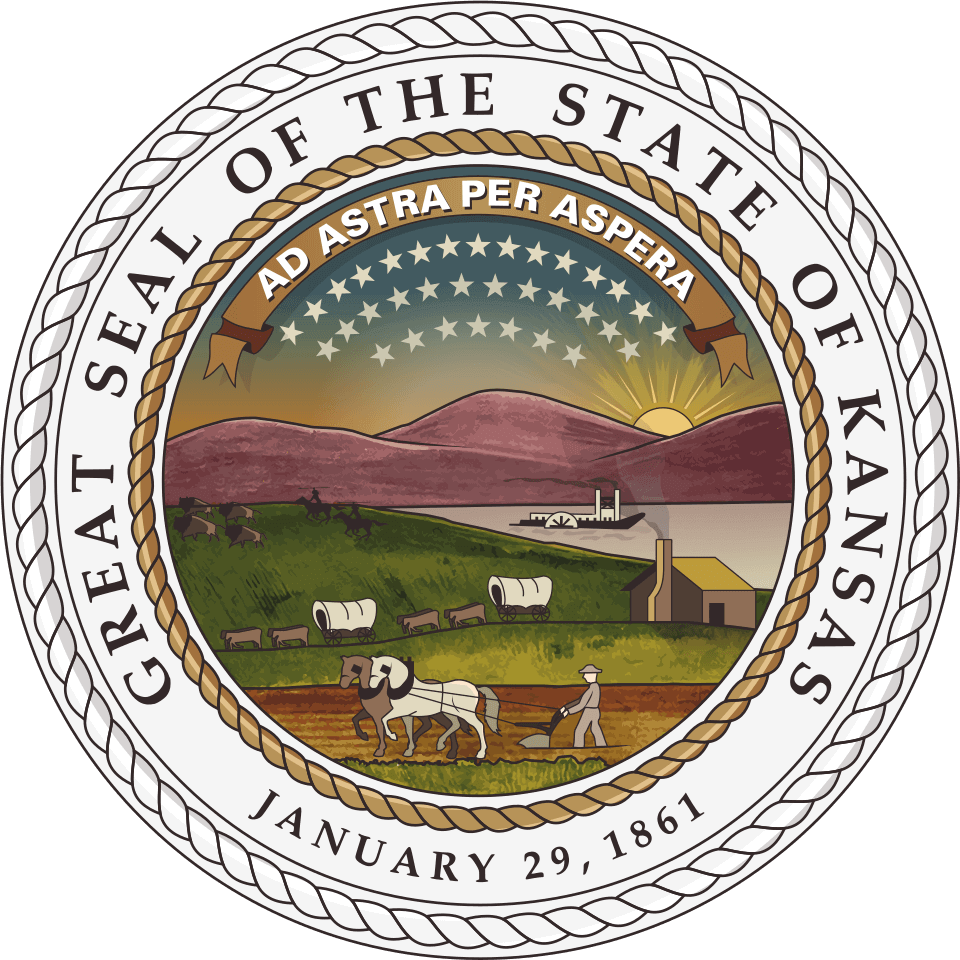
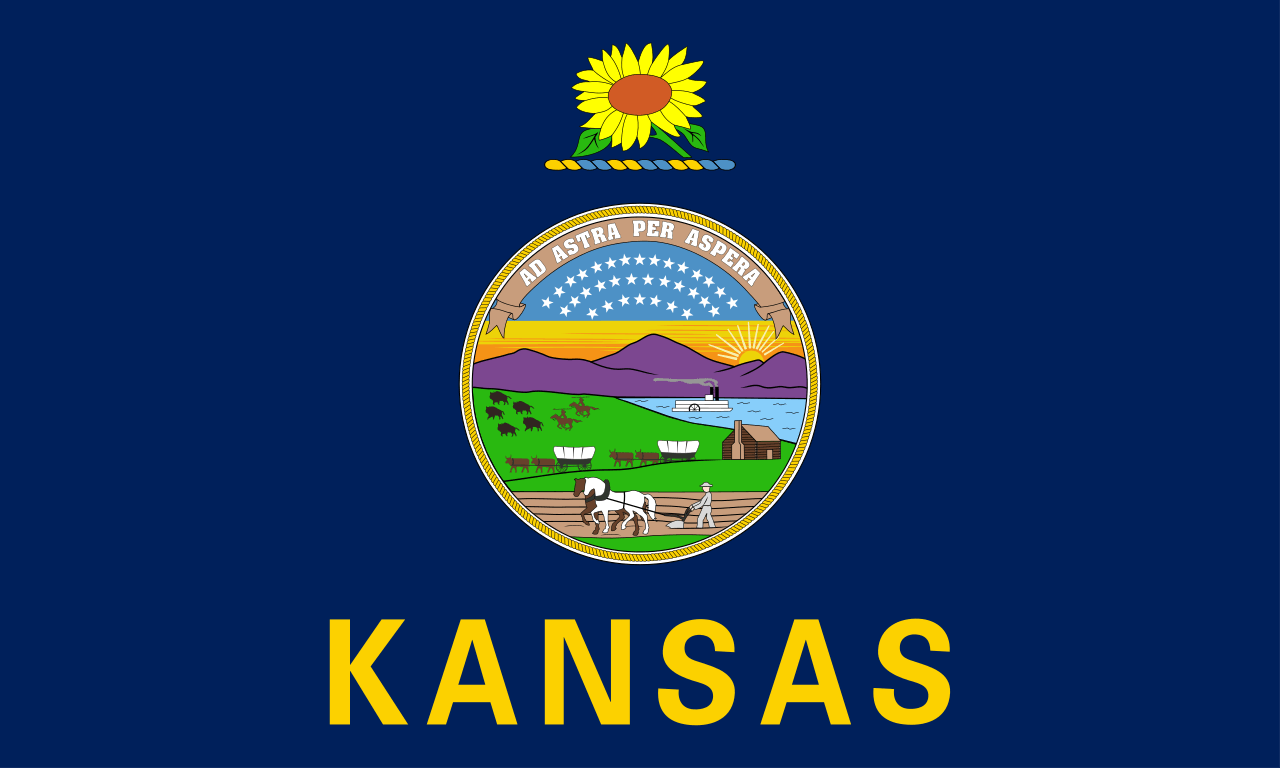
Kansas’s state emblems are a panoramic record of the American frontier — and of the violent struggle over slavery that earned the territory the name “Bleeding Kansas.” The Great Seal, designed by Senator John James Ingalls and adopted on 25 May 1861, depicts a rising sun, a steamboat on the river, a settler plowing, an ox-wagon train heading west, and a herd of buffalo pursued by horsemen — all under the Latin motto Ad Astra Per Aspera (“To the Stars through Difficulties”), a reference to Kansas’s troubled path to statehood. The flag, designed by Hazel Avery in 1925 and adopted in 1927, places the seal on a dark blue field crowned by a sunflower — the state flower and the source of Kansas’s nickname.
Flag
Not available
Seal
Not available
| State | Kansas (34th state, admitted 29 January 1861) |
|---|---|
| State seal | Rising sun, steamboat, settler plowing, ox-wagon train, buffalo, 34 stars |
| Seal designer | Senator John James Ingalls (Atchison) |
| Seal adopted | 25 May 1861 |
| State flag | Dark blue field, state seal, sunflower crest, state name |
| Flag designer | Hazel Avery (1925) |
| Flag adopted | 1927; state name added 1961 |
| Motto | Ad Astra Per Aspera (“To the Stars through Difficulties”) |
| Capital | Topeka |
| Nickname | The Sunflower State |
| State flower | Sunflower (Helianthus annuus) |
Flag of Kansas — Sunflower and seal on dark blue, adopted 1927
The Kansas flag combines the state seal with the sunflower, creating one of the most symbolically dense state flags in the nation.
A rectangle of dark blue silk bears the state seal at center. Above the seal, the state crest: a sunflower resting on a twisted bar of blue and gold (representing the Louisiana Purchase). Below the seal, the word “KANSAS” appears in gold block letters (added in 1961).
Hazel Avery designed the flag in 1925. Kansas Adjutant General Milton R. McLean championed the legislation that adopted it in 1927. It was first flown at Fort Riley by Governor Benjamin S. Paulen.
In 1961, the state name “KANSAS” was added below the seal to improve recognition — a common pattern among mid-century flag revisions across the United States.
Great Seal of Kansas — Ad Astra Per Aspera — since 1861
The Kansas seal is one of the most narrative state seals in the nation — a single image that tells the story of westward expansion, from agriculture to commerce to the vanishing frontier.
Reading from east to west across the seal: a rising sun in the right-hand corner represents the east. A river with a steamboat symbolizes commerce. In the foreground, a settler’s cabin and a man plowing with a pair of horses represent agriculture as the foundation of the state’s prosperity. Beyond, an ox-wagon train heads west. In the background, a herd of buffalo retreats, pursued by two Indians on horseback. Above the scene, 34 stars mark Kansas as the 34th state.
Ad Astra Per Aspera (“To the Stars through Difficulties”) was proposed by Senator John James Ingalls of Atchison, who also submitted the overall seal design. The motto refers to Kansas’s violent path to statehood — the years of armed conflict between pro-slavery and free-state settlers known as “Bleeding Kansas” (1854–1861).
The seal was established by a joint resolution of the Kansas Legislature on 25 May 1861, just four months after Kansas entered the Union on 29 January 1861 — and one month after the start of the Civil War.
The seal depicts a rising sun, a steamboat on a river, a settler plowing, an ox-wagon train heading west, and buffalo pursued by horsemen. 34 stars and the motto Ad Astra Per Aspera appear above. Designed by John James Ingalls, adopted 25 May 1861.
Ad Astra Per Aspera is Latin for “To the Stars through Difficulties.” It refers to Kansas’s violent path to statehood during “Bleeding Kansas” — the armed conflict over slavery in the 1850s.
The flag was designed by Hazel Avery in 1925 and adopted in 1927 through the efforts of Adjutant General Milton R. McLean. The state name was added in 1961.
The sunflower is the official state flower, and Kansas is nicknamed “The Sunflower State.” It sits on a blue-and-gold bar representing the Louisiana Purchase above the state seal as the state crest.
The 34 stars mark Kansas as the 34th state admitted to the Union, on 29 January 1861 — months before the Civil War began.
Last reviewed by the Emblema Mundi editorial team on 2026-06-27.