US State
Maine’s state emblems celebrate the twin pillars of the state’s identity: the forest and the sea. The Great Seal, adopted in June 1820 when Maine separated from Massachusetts to become the 23rd state, depicts a moose resting under a tall pine tree, flanked by a farmer with a scythe and a seaman with an anchor, under the North Star and the motto Dirigo (“I lead”). The flag, adopted on 23 February 1909, places the full coat of arms on a blue field — replacing an earlier 1901 design that featured a lone green pine tree and North Star on a buff background.
Flag
Not available
Seal
Not available
| State | Maine (23rd state, admitted 15 March 1820) |
|---|---|
| State seal | Moose under pine tree, farmer, seaman, North Star |
| Seal designers | Benjamin Vaughan (concept); Bertha Smouse (sketch) |
| Seal adopted | June 1820; standardized 1919 |
| State flag | Blue field with coat of arms |
| Flag adopted | 23 February 1909 (replacing 1901 pine-tree flag) |
| Motto | Dirigo (“I lead” / “I direct”) |
| Capital | Augusta |
| Nickname | The Pine Tree State |
| State flower | White pine cone and tassel (Pinus strobus) |
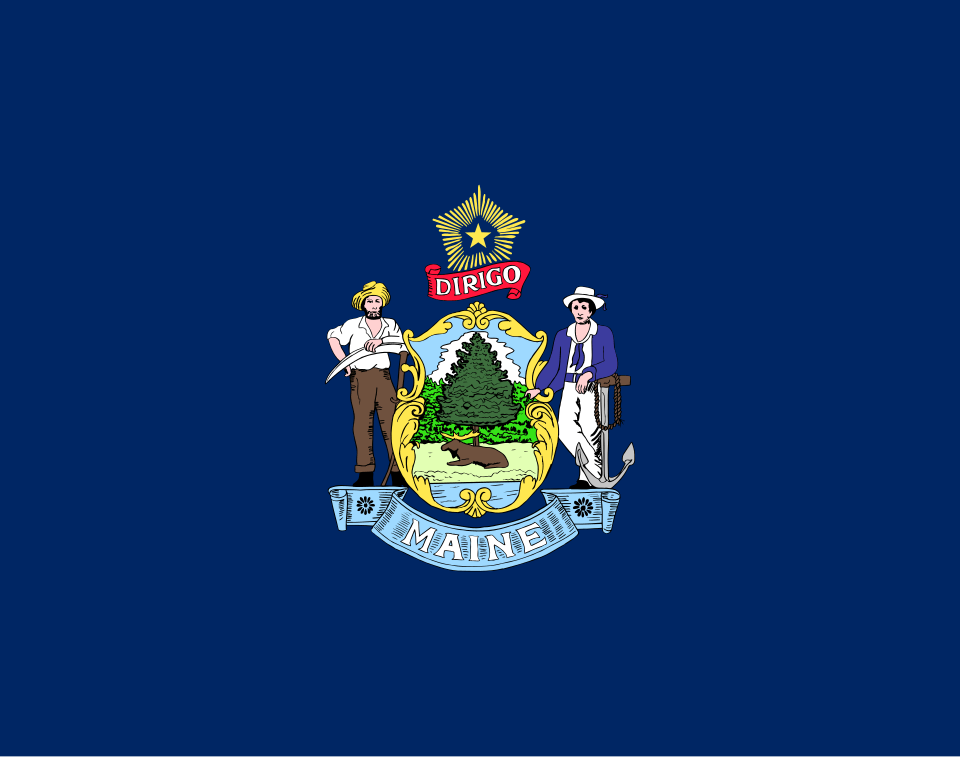
Flag of Maine — Coat of arms on blue, adopted 1909
Maine has had two official flags — the first a simple pine-tree banner, the second the full coat of arms on blue.
Maine’s first flag, adopted on 21 March 1901, featured a green pine tree and a blue North Star on a buff-colored background. It was designed by Adjutant General John T. Richards. Simple and distinctive, it lasted only eight years.
On 23 February 1909, the legislature replaced the pine-tree flag with the current design: the full state coat of arms on a blue field. The change was modeled on Civil War-era regimental flags that Maine troops had carried into battle.
The blue field bears the complete coat of arms — shield with moose and pine tree, farmer and seaman as supporters, North Star, and motto Dirigo.
Maine also uses an ensign with a different design, adopted on 16 March 1939. The simple 1901 pine-tree flag has gained a popular following in recent years, with periodic calls to restore it as the primary state flag.
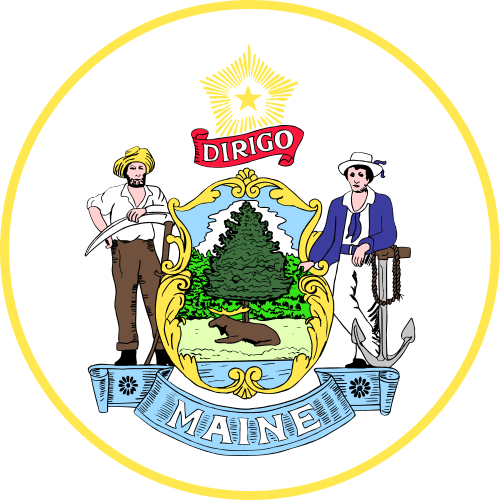
Great Seal of Maine — Dirigo — since 1820
The Maine seal is a quintessentially New England emblem — the forest, the sea, and the guiding star.
The center of the seal is a shield adorned with a tranquil scene: a moose resting in a field bordered by water and woods, with a tall pine tree standing directly behind. On the left, a farmer rests on his scythe, representing agriculture. On the right, a seaman leans on an anchor, representing Maine’s maritime heritage. Above the shield, the North Star and the motto Dirigo. Below, a banner reads “Maine.”
The concept is attributed to Benjamin Vaughan of Hallowell, Maine. The original sketch is credited to Bertha Smouse, step-daughter of Col. Isaac Reed of Waldoboro, who also wrote the official description and explanation.
Dirigo is Latin for “I lead” or “I direct.” It refers to the North Star — the mariner’s guide — and implies that Maine serves as a guide within the Union. Maine was the first state to hold elections in September, often setting political trends, giving rise to the old saying: “As Maine goes, so goes the nation.”
Over the decades, the seal’s details varied across reproductions. In 1919, the legislature standardized the design, and that version remains in use today.
The seal features a moose resting under a pine tree, with a farmer and a seaman as supporters, the North Star, and the motto Dirigo (“I lead”). Conceived by Benjamin Vaughan, adopted June 1820.
Dirigo is Latin for “I lead” or “I direct.” It refers to the North Star and implies that Maine serves as a guide within the Union.
The moose represents Maine’s vast wilderness and abundant wildlife. It rests peacefully under a white pine — the state tree — in a tranquil scene symbolizing the state’s natural beauty.
The first flag (1901–1909) featured a green pine tree and blue North Star on a buff background, designed by Adjutant General John T. Richards. It was replaced in 1909 with the coat of arms on blue.
The concept is attributed to Benjamin Vaughan of Hallowell. The original sketch is credited to Bertha Smouse of Waldoboro. The design was standardized in 1919.
Last reviewed by the Emblema Mundi editorial team on 2026-06-27.