US State
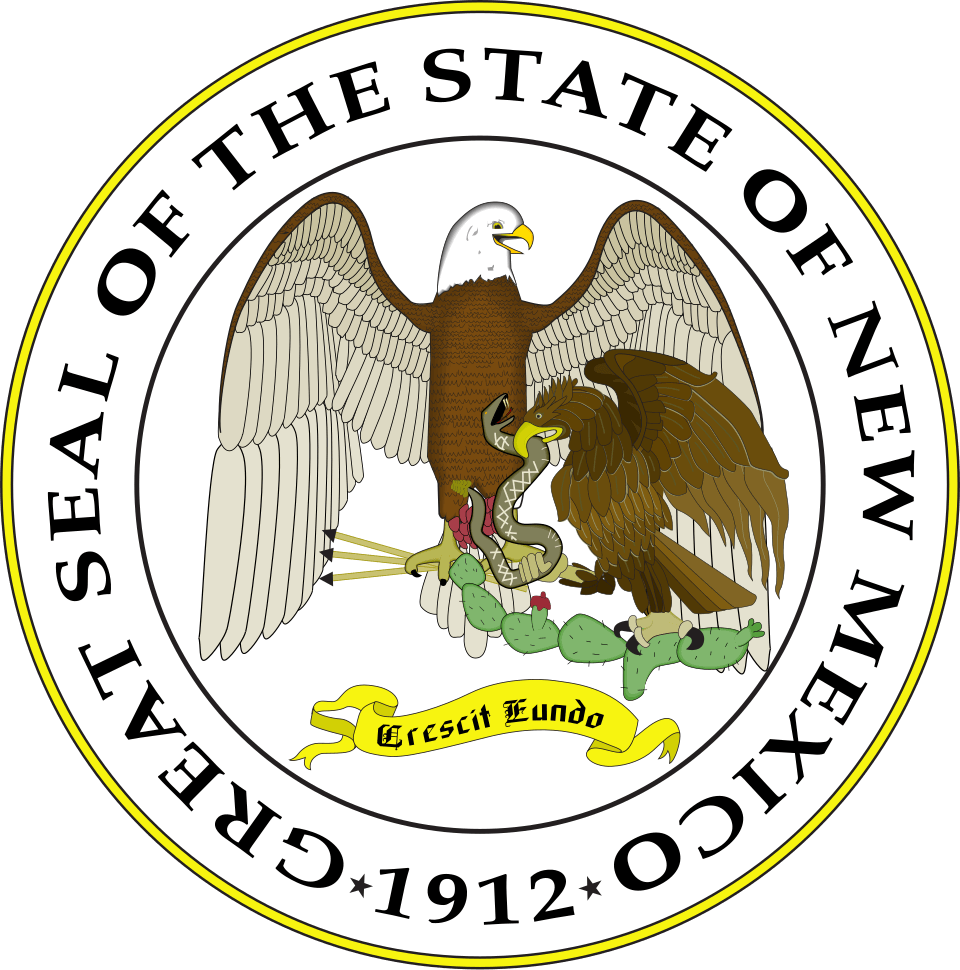
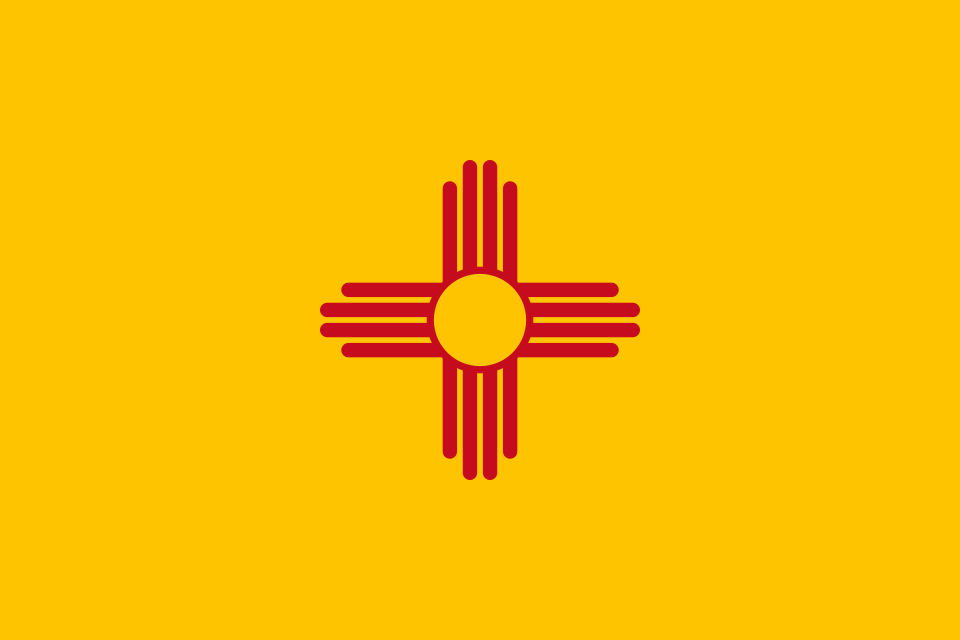
New Mexico carries two of the most remarkable state symbols in America. The Great Seal is the only US state seal to depict two nations’ eagles together: an American bald eagle sheltering a smaller Mexican eagle perched on a nopal cactus with a snake — the ancient Aztec symbol — representing the transfer of sovereignty from Mexico to the United States in 1846. The flag — the Zia Banner — is one of the most celebrated in the country: a red Zia sun symbol on a gold field, combining the sacred iconography of the Zia Pueblo people with the colours of Spain. Designed by archaeologist Dr Harry Mera after encountering the symbol on a Zia water jar, and sewn by his wife Reba, it was adopted on 19 March 1925.
Flag
Not available
Seal
Not available
| State | New Mexico (47th state, admitted 6 January 1912) |
|---|---|
| Nickname | Land of Enchantment |
| State seal | American eagle shielding Mexican eagle on cactus with snake |
| Seal adopted | 1913 (based on 1860s territorial design) |
| Motto | Crescit Eundo (“It grows as it goes”) |
| State flag | Red Zia sun symbol on gold (yellow) field |
| Flag adopted | 19 March 1925 |
| Flag designer | Dr Harry Mera (Santa Fe); flag sewn by Reba Mera |
| Capital | Santa Fe (oldest US state capital, founded 1610) |
| Zia sacred number | 4 (directions, seasons, times of day, stages of life) |
Flag of New Mexico — The Zia Banner, adopted 19 March 1925
The New Mexico flag — a red Zia sun symbol on a gold (yellow) field — is consistently ranked among the best-designed state flags in the United States. It is one of only four US flags without the colour blue, and the only one without white.
The Zia sun is a sacred symbol of the Zia Pueblo people, a Native American community in central New Mexico. It consists of a circle with four groups of four rays radiating outward. The number four is sacred to the Zia, embodying the Circle of Life:
The circle at the centre binds all four groups of four together.
In 1920, the New Mexico chapter of the Daughters of the American Revolution called for a distinctive state flag. A design competition was held, won by Dr Harry Mera, a Santa Fe physician and archaeologist who had encountered the Zia sun on a late 19th-century water jar from Zia Pueblo. His wife Reba Mera sewed the winning flag. Governor Arthur T. Hannett signed it into law on 19 March 1925.
The red and gold are the colours of the Spanish flag — honouring the 250+ years (1598–1821) during which Spain ruled Nuevo México, one of the oldest European-settled regions in North America. The flag thus blends Indigenous and Hispanic heritage in a single composition.
Great Seal of New Mexico — Two eagles, two nations, one state
The Great Seal of New Mexico tells the story of a transfer of sovereignty in a single image — unique among all 50 US state seals.
The state motto — Crescit Eundo (“It grows as it goes”) — is inscribed on a ribbon below the eagles. The phrase comes from Book VI of Lucretius’ De Rerum Natura, where it describes a lightning bolt gathering strength as it crosses the sky.
The dual-eagle design first appeared on an unofficial territorial seal in the early 1860s, replacing an earlier 1851 design that featured only an American eagle with an olive branch and arrows. When New Mexico became the 47th state on 6 January 1912, a legislative commission adopted the existing territorial design with minor modifications in 1913, adding the date 1912 at the base.
The Zia sun is a sacred emblem of the Zia Pueblo people: a circle with four groups of four rays representing the four directions, four seasons, four times of day, and four stages of life. Dr Harry Mera adapted it for the flag after finding it on a Zia water jar.
The American bald eagle shelters a smaller Mexican eagle on a cactus with a snake — the Aztec symbol from the Mexican flag. It represents the transfer of sovereignty from Mexico to the United States in 1846. It is the only US state seal to feature the symbols of two nations.
Crescit Eundo is Latin for “It grows as it goes,” taken from Lucretius’ De Rerum Natura, describing a lightning bolt gathering strength across the sky.
Dr Harry Mera, a physician and archaeologist in Santa Fe, won a DAR competition. His wife Reba made the flag. Governor Arthur T. Hannett signed it into law on 19 March 1925.
They are the colours of the Spanish flag, honouring New Mexico’s 250+ years under Spanish rule (1598–1821). The flag blends Indigenous (Zia symbol) and Hispanic (Spanish colours) identity.
Last reviewed by the Emblema Mundi editorial team on 2026-06-25.