US State
Rhode Island’s state emblems are among the simplest and oldest in the nation — a single golden anchor and the word “Hope,” unchanged in essence since 1664. The seal, first drawn by William Dyer in 1647, draws on the biblical passage Hebrews 6:18–19: “hope we have as an anchor of the soul.” The flag, adopted in 1897, places the anchor at the center of a white field, surrounded by 13 gold stars — representing the original colonies and Rhode Island’s position as the 13th and last of those colonies to ratify the Constitution.
Flag
Not available
Seal
Not available
| State | Rhode Island (13th state, ratified Constitution 29 May 1790) |
|---|---|
| State seal | Golden anchor on blue field, “Hope” above |
| Seal origins | First drawn by William Dyer, 1647; anchor + Hope adopted 1664 |
| State flag | White field, gold anchor, 13 gold stars, blue “Hope” ribbon |
| Flag adopted | 1897 |
| Motto | “Hope” |
| Capital | Providence |
| Nickname | The Ocean State |
| State flower | Violet (Viola sororia) |
| Founded | 1636 by Roger Williams |
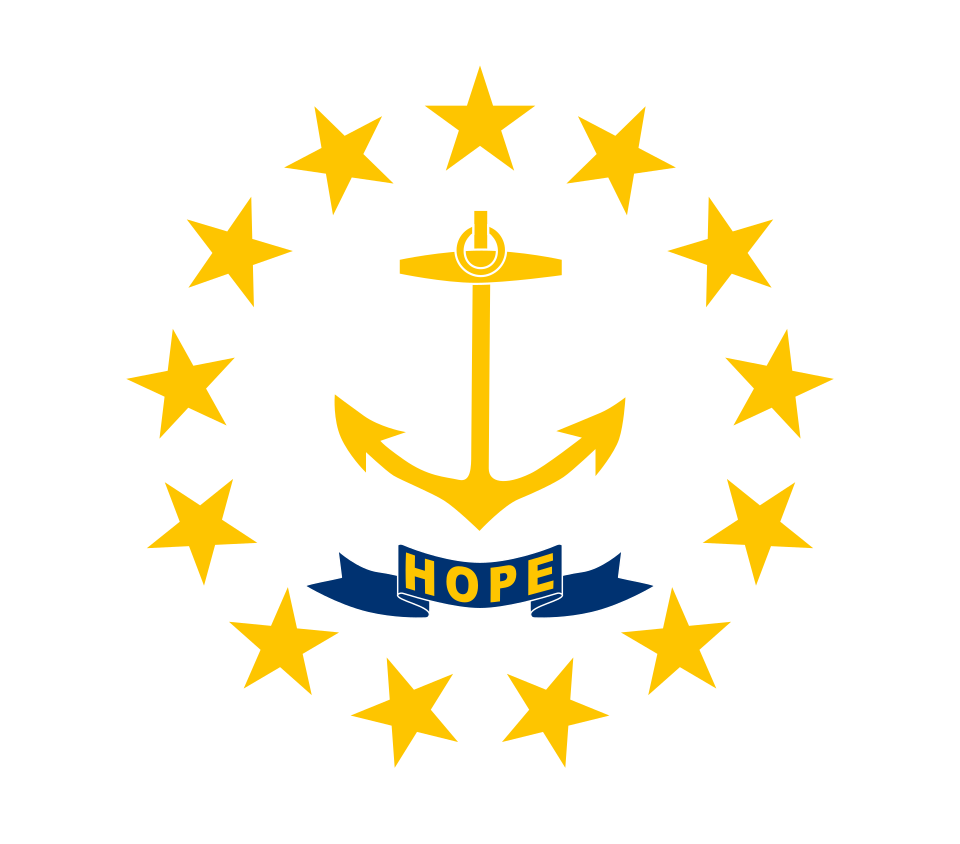
Flag of Rhode Island — Anchor and 13 stars on white, adopted 1897
The Rhode Island flag is one of the few US state flags on a white field rather than the more common blue.
A white field bears a gold anchor at center, surrounded by a ring of thirteen gold stars. Below the anchor, a blue ribbon reads “HOPE” in gold letters.
The thirteen stars represent the original thirteen colonies and the fact that Rhode Island was the 13th and last of those colonies to ratify the Constitution, on 29 May 1790 — more than a year after George Washington took office.
The current flag was adopted in 1897, replacing earlier designs. Its simplicity — white, gold, and a single word — makes it one of the most distinctive state flags in the nation.
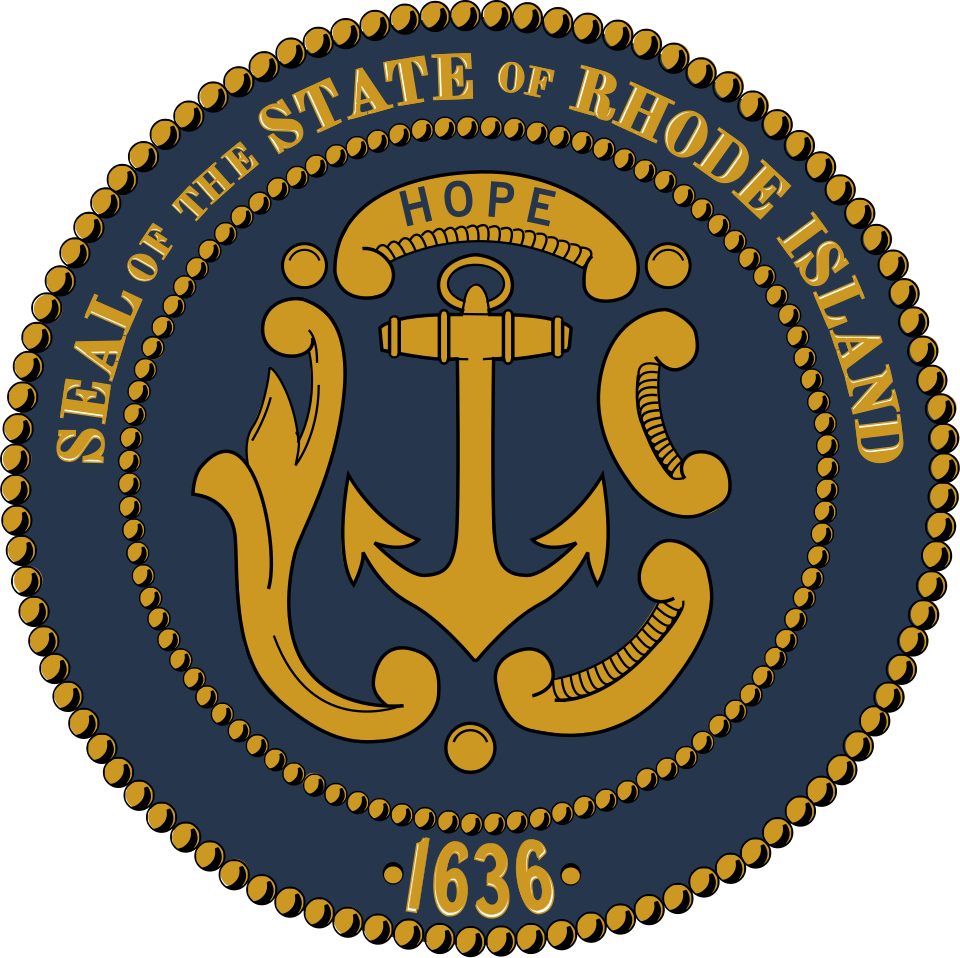
State Seal of Rhode Island — Hope — since 1664
The Rhode Island seal is one of the oldest and most elegant in the nation — a single symbol that has endured for nearly four centuries.
A golden maritime anchor on a blue field, with the word “Hope” above it. The simplicity of the design is itself remarkable — no eagles, no shields, no complex scenes, just an anchor and a word.
The anchor has been Rhode Island’s symbol since Roger Williams founded the colony in 1636. The first seal was drawn by William Dyer in 1647. In 1664, the Rhode Island General Assembly formally adopted a seal containing an anchor with the word “Hope” above it.
The anchor and “Hope” are inspired by Hebrews 6:18–19: “Which hope we have as an anchor of the soul, both sure and steadfast.” For Rhode Island’s Puritan founders, the anchor represented both their maritime economy on Narragansett Bay and their spiritual faith.
A golden anchor on a blue field with “Hope” above. First drawn by William Dyer in 1647; anchor + Hope adopted 1664.
The 13 stars represent the original colonies and Rhode Island as the 13th to ratify the Constitution (29 May 1790).
The state motto, inspired by Hebrews 6:18–19: “hope we have as an anchor of the soul.”
1897. White field, gold anchor, 13 gold stars, blue “Hope” ribbon.
As a maritime colony on Narragansett Bay, the anchor represented both the seafaring economy and the biblical metaphor of hope. Used since the colony’s founding by Roger Williams in 1636.
Last reviewed by the Emblema Mundi editorial team on 2026-06-27.