US Commonwealth
The Great Seal of Massachusetts is one of the most debated state symbols in America. It depicts an Algonquin warrior holding a bow and a downward-pointing arrow beneath a disembodied arm grasping a broadsword — a composition that critics call a glorification of colonial violence against Native Americans. The Latin motto — Ense petit placidam sub libertate quietem (“By the sword we seek peace, but peace only under liberty”) — was written by Algernon Sydney around 1659. The seal was designed in 1780, engraved by Paul Revere, and redesigned by Edmund H. Garrett in 1898. In 2024, Governor Maura Healey established a commission to design a new seal, flag, and motto — making Massachusetts one of the few US states to undertake a complete symbolic overhaul in the 21st century.

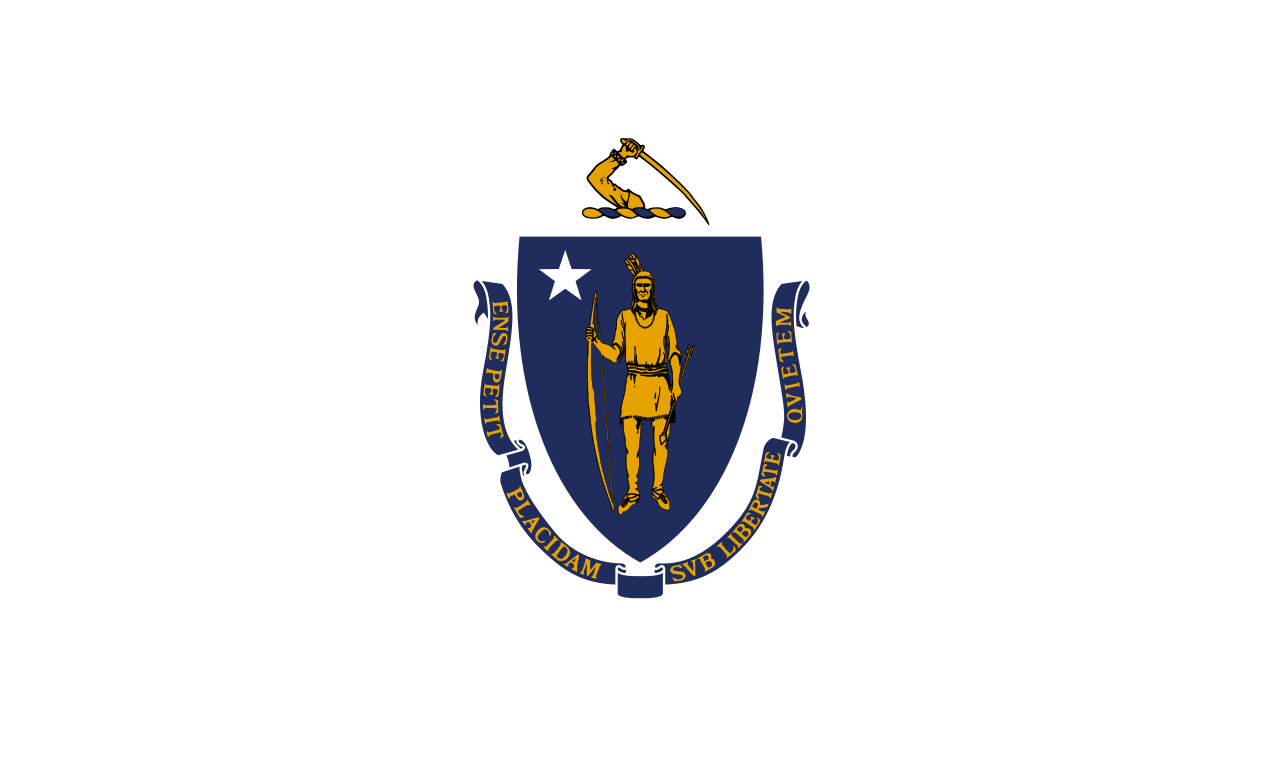
Flag
Not available
Seal
Not available
| Commonwealth | Massachusetts (6th state, ratified 6 February 1788) |
|---|---|
| State seal | Algonquin warrior, bow & arrow, broadsword arm, star |
| Seal designed | 1780 (Nathan Cushing); engraved by Paul Revere; redrawn 1898 (Edmund H. Garrett) |
| Motto | Ense petit placidam sub libertate quietem (Algernon Sydney, c. 1659) |
| State flag | White field, state coat of arms |
| Capital | Boston |
| Nickname | The Bay State |
| Redesign status | Commission established 2024 (Gov. Healey); finalists released August 2025 |
| Controversy | Broadsword above Native figure seen as glorifying colonial violence |
| Submissions received | ~1,000 flags, 300 seals, 400 mottos |
Flag of Massachusetts — White field, coat of arms — under review for redesign
The state flag is a white field bearing the coat of arms of Massachusetts on both sides. It is one of the simplest US state flags in design — and one of the most controversial in content.
The flag’s white background originally displayed the coat of arms on the front and a blue shield with a pine tree (a symbol of New England since the 17th century) on the reverse. The pine tree side was removed in 1971, leaving the coat of arms on both faces.
The Massachusetts state seal has faced growing criticism since the early 2020s. At the heart of the debate is the placement of the broadsword directly above the Native American figure — which many see as a visual endorsement of colonial violence against Indigenous peoples.
Critics — including numerous Native American advocacy groups and the Mashpee Wampanoag and Aquinnah Wampanoag tribal nations — argue that the seal glorifies the genocide and displacement of Indigenous peoples. The disembodied arm with a sword hovering above a Native figure sends an unmistakable message of domination, they say. Massachusetts is the site of some of the earliest and most devastating colonial conflicts with Indigenous peoples, including King Philip’s War (1675–1678).
Some members of Massachusetts’ Indigenous communities have argued the opposite: that the seal is a true depiction of what happened and that removing it would allow the Commonwealth to forget past atrocities. Others oppose the change on historical and traditionalist grounds, noting that the seal has served since the American Revolution.
In 2024, Governor Maura Healey signed a budget amendment establishing the Seal, Flag and Motto Advisory Committee, a 10-member commission tasked with recommending new symbols. The commission received approximately 1,000 flag submissions, 300 seal designs, and 400 motto proposals. In August 2025, three finalist designs for each symbol were released for public comment, with fall hearings planned. A final recommendation is expected after the hearing process concludes.
Great Seal of Massachusetts — The current (and controversial) design since 1898
The Great Seal of the Commonwealth of Massachusetts bears the state coat of arms, encircled by the Latin inscription Sigillum Reipublicæ Massachusettensis.
On 13 December 1780, Governor John Hancock accepted Nathan Cushing’s design for the seal, and Paul Revere — the silversmith and patriot of the midnight ride — was commissioned to engrave it. In 1898, Edmund H. Garrett redesigned the seal for greater accuracy in the depiction of the Native American figure. This is the version in use today.
The current seal depicts an Algonquin warrior beneath a disembodied arm holding a broadsword. Critics argue this glorifies colonial violence against Native Americans. Some Indigenous community members, however, argue that removing the seal would allow Massachusetts to forget past atrocities.
Yes. In 2024, Governor Maura Healey established the Seal, Flag and Motto Advisory Committee. The commission received ~1,000 flag, 300 seal, and 400 motto submissions. In August 2025, three finalist designs for each symbol were released for public comment.
Ense petit placidam sub libertate quietem translates to “By the sword we seek peace, but peace only under liberty.” Written around 1659, it is attributed to Algernon Sydney, the English republican patriot. The motto is also under review by the redesign commission.
The seal was accepted on 13 December 1780 by Governor John Hancock, based on Nathan Cushing’s design. Paul Revere engraved the first version. The current artwork by Edmund H. Garrett dates to 1898.
A blue shield with a golden Algonquin Indian holding a bow and downward arrow (peace), a silver star (6th state), and a crest of a disembodied arm grasping a broadsword. The Latin motto Ense petit placidam sub libertate quietem encircles the composition, within the inscription Sigillum Reipublicæ Massachusettensis.
Last reviewed by the Emblema Mundi editorial team on 2026-06-24.