US State
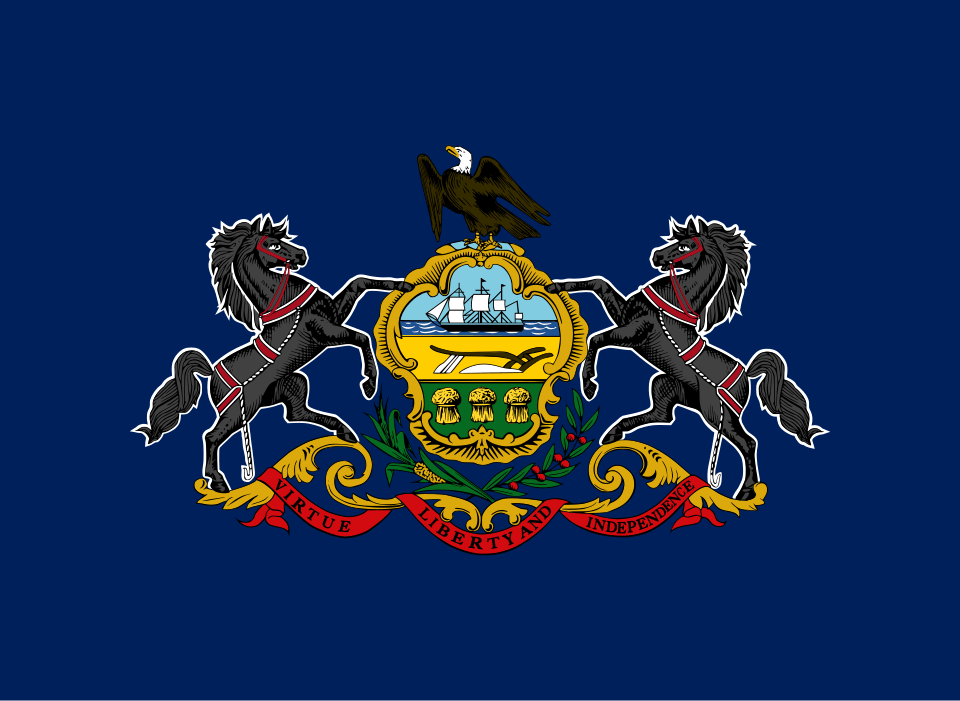
Pennsylvania — the Keystone State and one of only four US Commonwealths — carries emblems rooted in the American Revolution itself. The coat of arms, designed by Caleb Lownes of Philadelphia in 1778, features a shield bearing a ship (commerce), a plow (natural resources), and three golden sheaves of wheat (fertile fields), crested by a bald eagle and supported by two black horses, with the motto “Virtue, Liberty and Independence.” The flag, standardized on 13 June 1907, places the coat of arms on a blue field matching the national colors — a design that Pennsylvania militia units had carried in various forms since 1799.
Flag
Not available
Seal
Not available
| State | Pennsylvania (2nd state, ratified Constitution 12 December 1787) |
|---|---|
| Official title | Commonwealth of Pennsylvania |
| Coat of arms | Shield (ship, plow, wheat), eagle crest, two black horses |
| Arms designer | Caleb Lownes (Philadelphia, 1778); standardized 1875 |
| State flag | Blue field with coat of arms |
| Flag adopted | 13 June 1907 |
| Motto | “Virtue, Liberty and Independence” |
| Capital | Harrisburg |
| Nickname | The Keystone State |
| State flower | Mountain laurel (Kalmia latifolia) |
Flag of Pennsylvania — Coat of arms on blue, adopted 1907
The Pennsylvania flag carries the coat of arms on the same blue that flies in the national flag — a deliberate choice codified in the 1907 standardization.
The Pennsylvania legislature authorized the use of the coat of arms on militia flags on 9 April 1799. These early flags varied in design throughout the 19th century.
An act of the General Assembly on 13 June 1907 standardized the flag: the blue field must match the blue of “Old Glory” (the US national flag), with the coat of arms displayed at center.
A blue field bears the full coat of arms — shield with ship, plow, and wheat, eagle crest, two black horses, olive branch and cornstalk, and the motto “Virtue, Liberty and Independence.”
Coat of Arms of Pennsylvania — Virtue, Liberty and Independence — since 1778
Pennsylvania’s coat of arms is a heraldic composition that encodes the Commonwealth’s economic strengths and founding ideals.
The central shield displays three charges: a ship under full sail (representing commerce carried to all parts of the world), a clay-red plow (natural resources and labor), and three golden sheaves of wheat (fertile fields and the wealth of human endeavor). Above the shield, a bald eagle serves as the crest. Two black horses stand as heraldic supporters. An olive branch and a cornstalk cross below the shield. The motto “Virtue, Liberty and Independence” appears on a scroll.
Caleb Lownes of Philadelphia designed the coat of arms in 1778, during the Revolutionary War. Between 1778 and 1873, the design underwent numerous informal variations — particularly in the color and positioning of the supporting horses.
In 1874, the legislature noted the lack of uniformity and appointed a commission. In 1875, the commission reported that it had adopted, almost unchanged, Caleb Lownes’s original design from 96 years earlier.
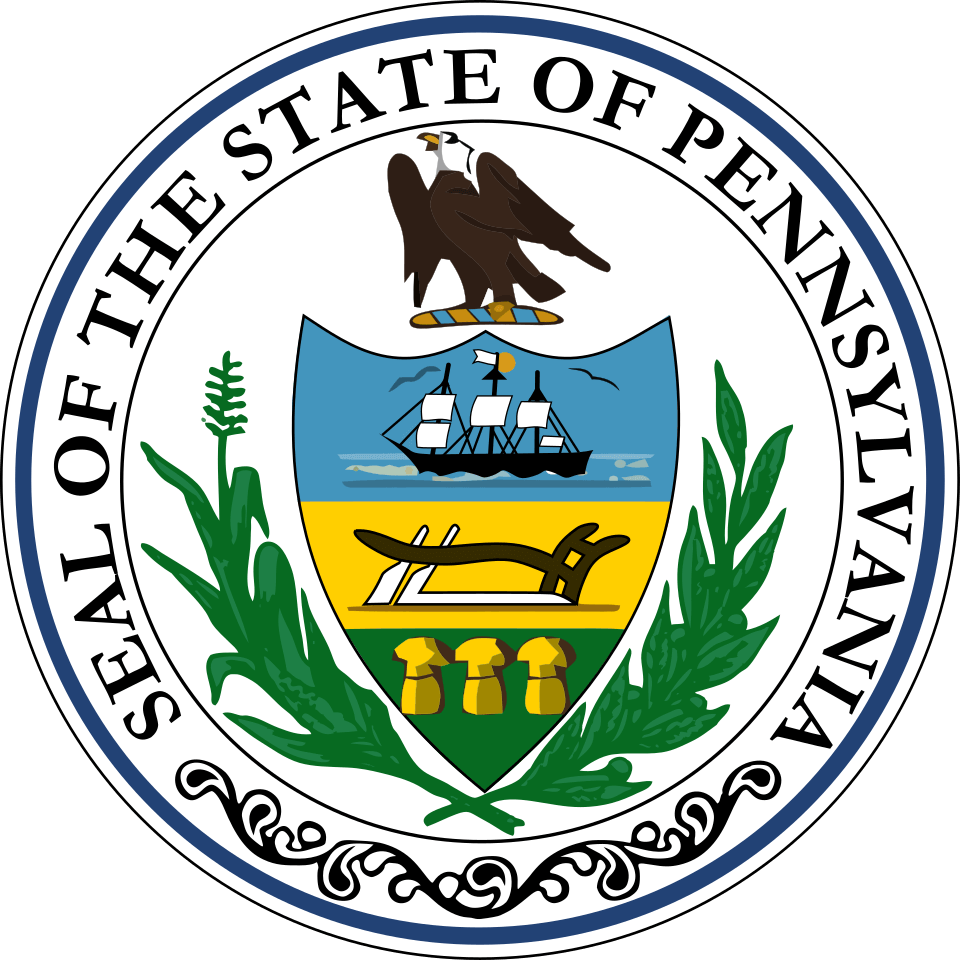
The state seal was separately authorized by the General Assembly in 1791. It incorporates the coat of arms within a circular border.
A shield with ship, plow, and three wheat sheaves. Bald eagle crest, two black horses as supporters, olive branch and cornstalk below. Motto: “Virtue, Liberty and Independence.” Designed by Caleb Lownes, 1778.
One of four US Commonwealths (with Virginia, Kentucky, Massachusetts). Reflects founder William Penn’s vision of government for the “common wealth” of all citizens.
Caleb Lownes of Philadelphia in 1778. Standardized by a legislative commission in 1875, adopting Lownes’s original almost unchanged.
Standardized 13 June 1907. Blue field matching the US flag, coat of arms at center. Militia had used coat-of-arms flags since 1799.
Pennsylvania’s motto reflects its founding principles: moral virtue (William Penn), liberty and independence (declared in Philadelphia in 1776).
Last reviewed by the Emblema Mundi editorial team on 2026-06-27.