US State
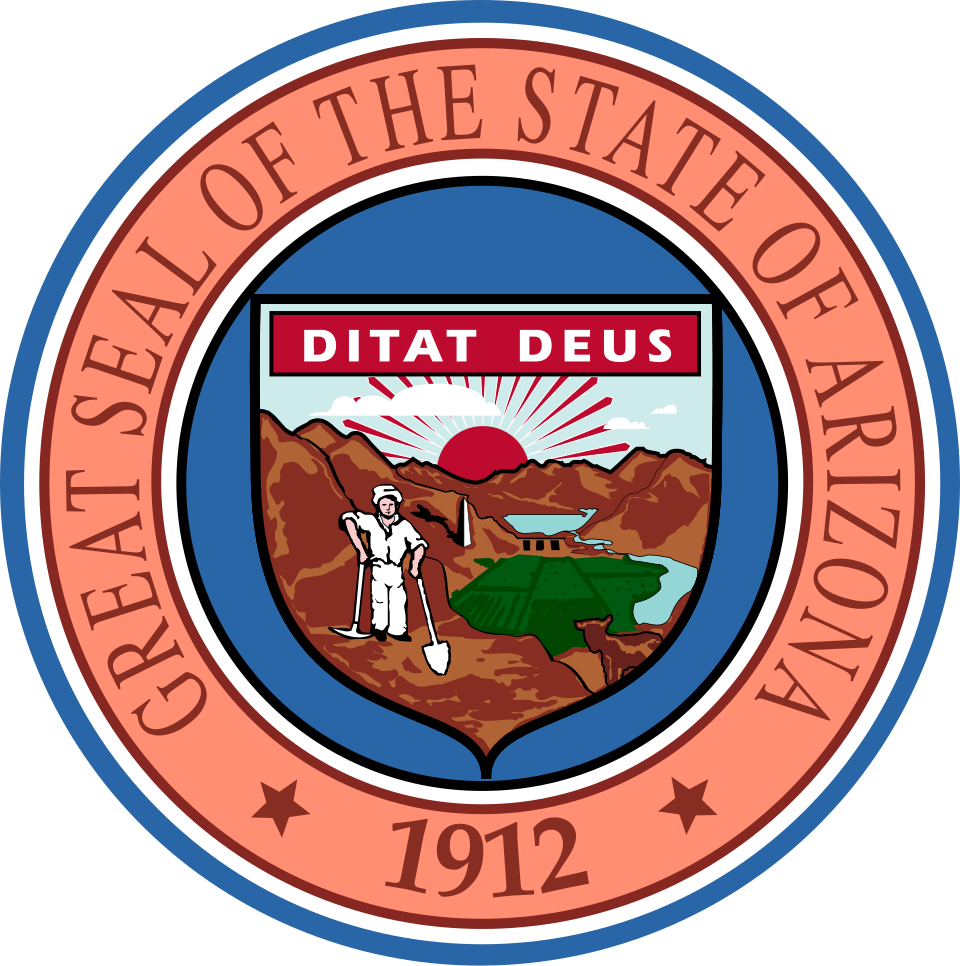
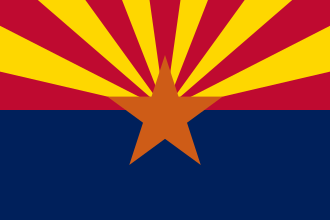
Arizona’s state emblems are a distilled portrait of the 48th state’s identity. The Great Seal, adopted on 14 February 1912 — the very day of statehood — was designed by Phoenix newspaper artist E.E. Motter and depicts a miner with a pick and shovel, a dam and irrigated fields, grazing cattle, and mountains with a rising sun, all under the Latin motto Ditat Deus (“God Enriches”). The flag, adopted on 27 February 1917, grew out of a rifle-team banner created by Colonel Charles Wilfred Harris for the 1910 competition at Camp Perry, Ohio, where Arizona was the only team without an emblem. Its 13 alternating red and gold rays evoke the original colonies and the Spanish conquistadors, while the copper star at center honors Arizona’s status as the nation’s largest copper producer.
Flag
Not available
Seal
Not available
| State | Arizona (48th state, admitted 14 February 1912) |
|---|---|
| State seal | Mountains, rising sun, dam, irrigated fields, cattle, miner, quartz mill |
| Seal designer | E.E. Motter (newspaper artist, Phoenix) |
| Seal adopted | 14 February 1912 (Constitutional Convention, 1910) |
| State flag | 13 red-and-gold rays, copper star, dark blue lower half |
| Flag adopted | 27 February 1917 (3rd Arizona Legislature) |
| Flag designer | Colonel Charles Wilfred Harris (primary), with W. R. Stewart, Rachael Berry, Carl Hayden |
| Motto | Ditat Deus (“God Enriches”) |
| Capital | Phoenix |
| Nickname | The Grand Canyon State |
| State flower | Saguaro cactus blossom (Carnegiea gigantea) |
Flag of Arizona — Copper star and sunset rays, adopted 1917
The Arizona flag is one of the most visually striking in the nation — 13 alternating red and gold rays on the upper half, a copper-colored star at center, and a dark blue lower half.
In 1910, Colonel Charles Wilfred Harris, then captain of the Arizona National Guard’s rifle team, traveled to the national competition at Camp Perry, Ohio. Arizona was the only team without an emblem of any kind. Harris designed a flag for the team — the design that would eventually become the state flag.
While Harris is credited as the primary designer, several others contributed. W. R. Stewart of Mesa worked in conjunction with Harris. Rachael Berry, Arizona’s first elected female state representative, played a role in the legislative process. Congressman Carl Hayden — Arizona’s first U.S. Representative — was involved in the design, and his wife Nan Hayden sewed the first flag.
The flag was adopted on 27 February 1917 by the 3rd Arizona Legislature. Notably, the governor never signed the bill — it became law without his signature.
Great Seal of Arizona — Ditat Deus — since 1912
The Great Seal was designed to encode Arizona’s three economic pillars — copper mining, cattle ranching, and irrigation agriculture — directly into a single image.
In the background, a range of mountains with the sun rising behind the peaks. To the right: a storage reservoir and dam with irrigated fields and orchards, and cattle grazing. To the left: a quartz mill and a miner — modeled on the legendary prospector George Warren — with a pick and shovel. The state motto Ditat Deus (“God Enriches”) is inscribed across the center.
At the Constitutional Convention of 1910, delegate M.G. Cunniff of Yavapai County submitted a design by Phoenix newspaper artist E.E. Motter. A special committee of three delegates reviewed the proposal and recommended its adoption. The seal was written into Article 22, § 20 of the Arizona Constitution.
Several territorial seals were used between 1863 and 1912. Like the current seal, these earlier versions depicted mountain landscapes and referenced the state motto, but none achieved the detailed industrial panorama of Motter’s design.
The seal was officially adopted on 14 February 1912, the same day Arizona became the 48th state of the Union.
The Great Seal depicts a mountain range with the sun rising, a dam and irrigated fields, grazing cattle, and a miner (modeled on George Warren) with a pick and shovel beside a quartz mill. The motto Ditat Deus (“God Enriches”) is inscribed across the center. It was designed by E.E. Motter and adopted on 14 February 1912, the day Arizona became the 48th state.
The flag was primarily designed by Colonel Charles Wilfred Harris, adjutant general of the Arizona National Guard. He originally created it as a rifle-team flag for the 1910 competition at Camp Perry, Ohio. Others contributed, including W. R. Stewart, Representative Rachael Berry, and Congressman Carl Hayden, whose wife Nan Hayden sewed the first flag.
The copper-colored five-pointed star represents Arizona’s status as the largest copper-producing state in the United States. Copper mining was the economic backbone of the territory and remains a major industry today.
Ditat Deus is Latin for “God Enriches.” The motto reflects the belief that Arizona’s natural wealth — its minerals, fertile irrigated land, and ranching — was a divine gift. It has been the state motto since statehood in 1912.
The 13 alternating red and gold rays represent the original 13 colonies of the United States. The red and gold colors also recall the Spanish conquistadors who explored Arizona in the 16th century. The dark blue lower half matches the shade used in the United States flag.
Last reviewed by the Emblema Mundi editorial team on 2026-06-27.