US State
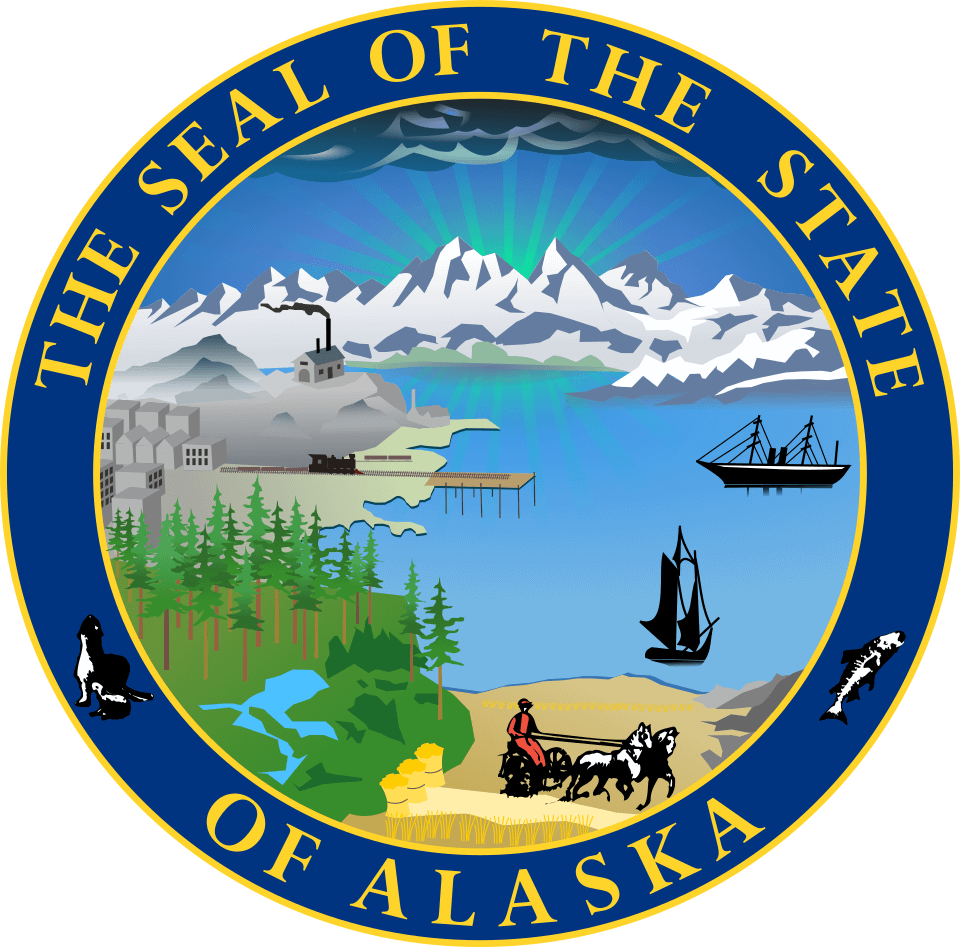
Alaska’s state emblems reflect two formative moments in its history. The state seal, adopted in 1910 for the District of Alaska, replaced an earlier design of icebergs and igloos with a panorama of northern lights, a smelter, a railroad train, ships, forests, and a farmer — a deliberate showcase of the territory’s industrial and natural wealth. The flag has an even more remarkable origin: it was designed in 1927 by Benny Benson, a 14-year-old Alaska Native living at the Jesse Lee Home for Children in Seward. His eight gold stars — the Big Dipper and Polaris on a dark blue field — won a territory-wide contest and became one of the most recognizable state flags in the nation. When Alaska joined the Union as the 49th state on 3 January 1959, both the seal and the flag were carried over without change.

Flag
Not available
Seal
Not available
| State | Alaska (49th state, admitted 3 January 1959) |
|---|---|
| State seal | Northern lights, mountains, smelter, train, ships, forests, farmer with wheat |
| Seal adopted | 1910 (District of Alaska); retained at statehood 1959 |
| Previous seal | Icebergs, northern lights, igloos, figure ice-fishing |
| State flag | Eight gold stars (Big Dipper + Polaris) on dark blue |
| Flag adopted | May 1927 (territorial); state flag from 1959 |
| Flag designer | Benny Benson (John Ben Benson Jr.), age 14 |
| Capital | Juneau |
| Nickname | The Last Frontier |
| Motto | North to the Future |
| State flower | Forget-me-not (Myosotis alpestris) |
Flag of Alaska — Big Dipper and Polaris, designed by Benny Benson, 1927
The Alaska flag is one of the most celebrated in the United States — eight gold stars on a dark blue field, forming the Big Dipper and Polaris, the North Star.
In the 1920s, Governor George Parks saw the flags of the 48 states flying outside the Post Office Building in Washington, D.C. and became convinced that Alaska needed its own flag. The Alaska Department of the American Legion sponsored a territory-wide contest for schoolchildren in grades 7 through 12. Roughly 700 submissions were received.
The winner was Benny Benson (John Ben Benson Jr.), a 14-year-old Alaska Native living at the Jesse Lee Home for Children in Seward. His entry included this description:
“The blue field is for the Alaska sky and the forget-me-not, an Alaskan flower. The North Star is for the future state of Alaska, the most northerly in the Union. The dipper is for the Great Bear — symbolizing strength.”
Benny was awarded a watch engraved with the flag emblem and a $1,000 educational scholarship, which he used to study diesel mechanics.
The seven stars of the Big Dipper form an asterism within Ursa Major, the Great Bear — an animal indigenous to Alaska. The two “pointer stars” of the Dipper lead the eye to Polaris in the upper corner, representing Alaska’s position as the most northerly state. The dark blue field evokes both the Alaskan sky and the forget-me-not, the state flower.
The Alaska Legislature adopted Benny’s design in May 1927, and the flag was first flown on 9 July 1927. When Alaska became the 49th state on 3 January 1959, the territorial flag became the state flag without modification.
State Seal of Alaska — Industrial and natural wealth, adopted 1910
The Alaska state seal is a panoramic emblem that illustrates the territory’s economic foundations — mining, transportation, timber, and agriculture — set against the backdrop of the aurora borealis.
The seal depicts rays of the northern lights above a mountain range. In the foreground: a smelter representing mining, a railroad train for land transportation, and ships for marine commerce. Trees symbolize the wealth of Alaska’s forests, while a farmer, his horse, and three shocks of wheat represent agriculture.
The first seal of the District of Alaska featured icebergs, the northern lights, igloos, and a figure ice-fishing. Governor Walter Eli Clark considered this imagery too narrowly focused on Arctic stereotypes and requested a replacement that would better represent Alaska’s diverse economy.
The new seal was adopted in 1910 for the District of Alaska. Its designer remains unknown. The seal was retained throughout the territorial period and, by adoption of the Alaska Constitution in 1956, became the official state seal when Alaska joined the Union on 3 January 1959.
The seal depicts the northern lights (aurora borealis) over mountains, a smelter representing mining, a railroad train, ships for marine transportation, forests, and a farmer with a horse and three shocks of wheat symbolizing agriculture. It was adopted in 1910 for the District of Alaska, replacing an earlier design focused on icebergs and igloos.
The flag was designed by Benny Benson (John Ben Benson Jr.), a 14-year-old Alaska Native living at the Jesse Lee Home for Children in Seward. He won a territory-wide contest in 1927, and his design was chosen from among roughly 700 submissions by schoolchildren in grades 7 through 12.
The eight gold stars form two constellations: seven stars make up the Big Dipper (part of Ursa Major, symbolizing a bear and strength), and the eighth star in the upper corner is Polaris, the North Star, representing Alaska’s position as the most northerly state. The dark blue field represents the Alaska sky and the forget-me-not, the state flower.
Governor Walter Eli Clark requested the change because the original seal — featuring icebergs, the northern lights, igloos, and a figure ice-fishing — was considered too focused on stereotypical Arctic imagery. The 1910 replacement emphasized Alaska’s industrial and natural wealth: mining, railroads, shipping, timber, and agriculture.
Benny Benson’s design was adopted as the territorial flag by the Alaska Legislature in May 1927 and first flown on 9 July 1927. When Alaska became the 49th state on 3 January 1959, the territorial flag became the official state flag without modification.
Last reviewed by the Emblema Mundi editorial team on 2026-06-27.