US State
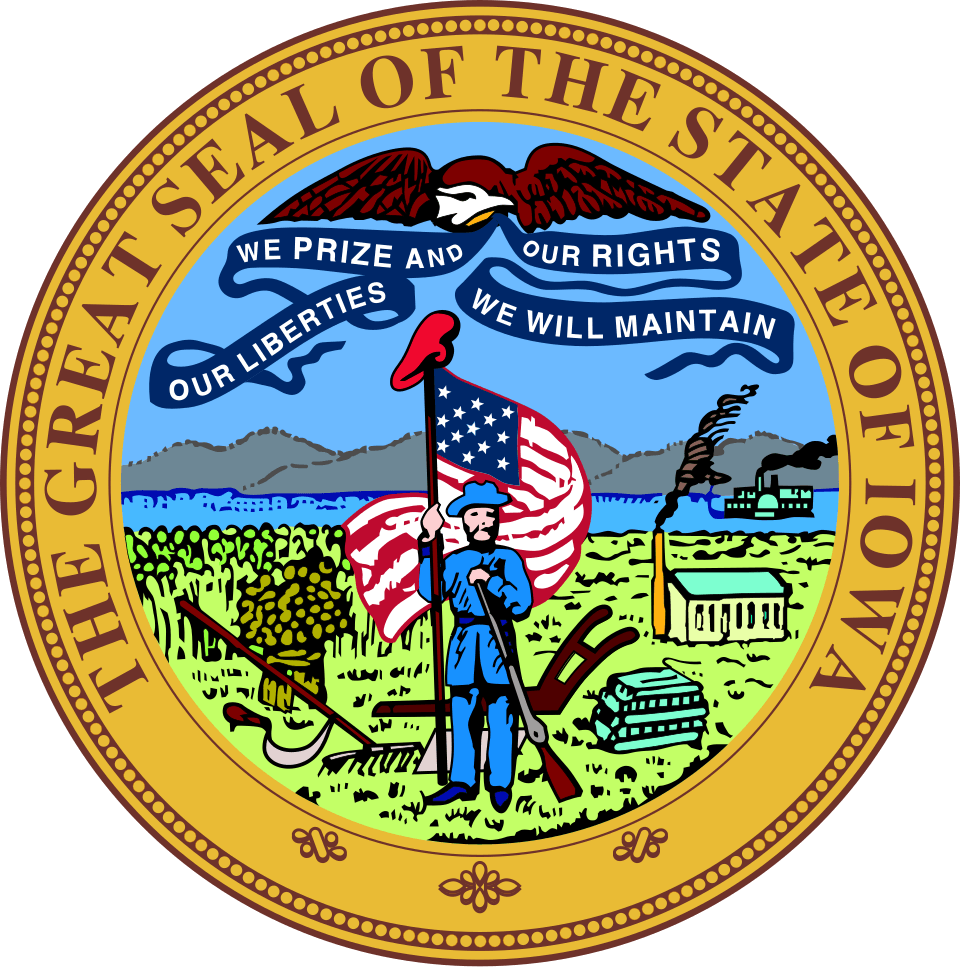
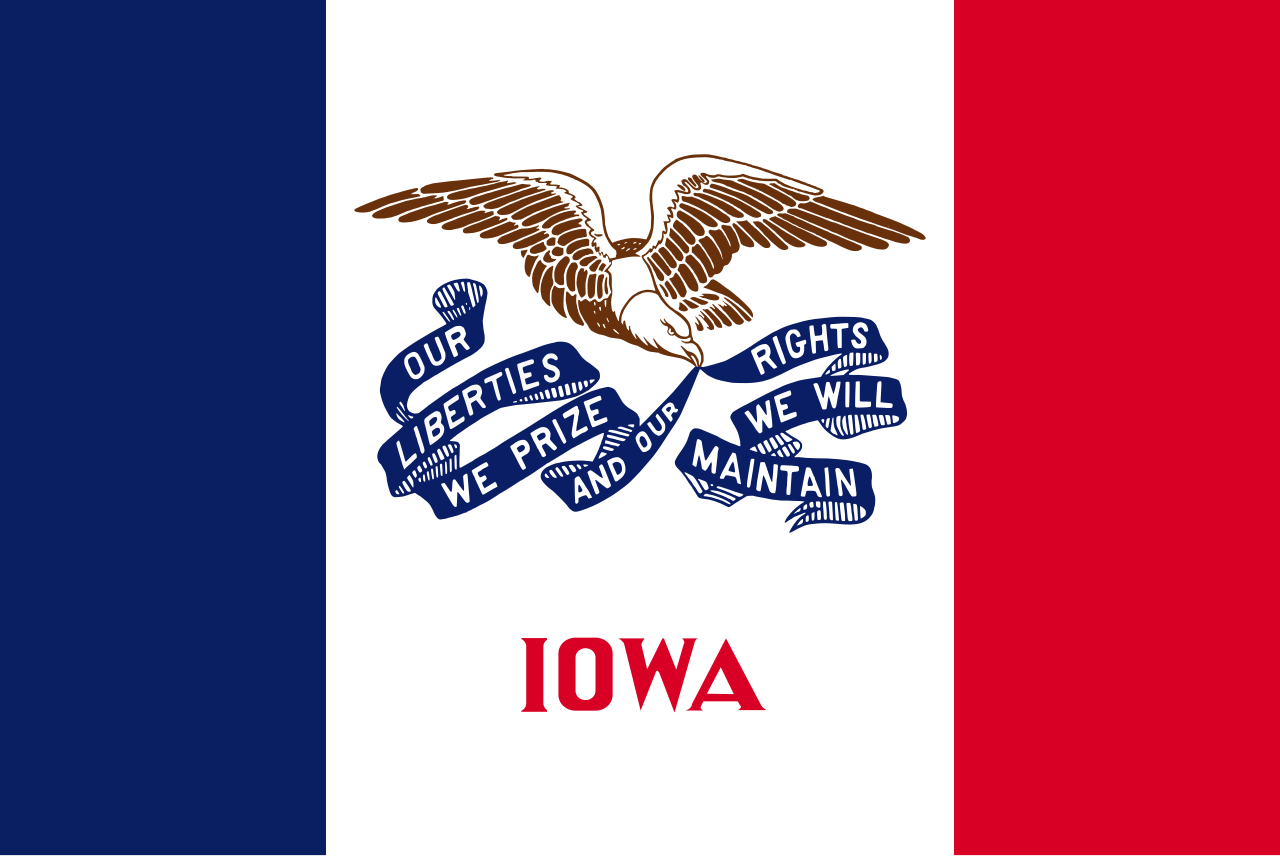
Iowa’s state emblems reflect both the Mexican-American War and the state’s French colonial past. The Great Seal, adopted on 25 February 1847 — during the war itself — depicts a citizen soldier standing in a wheat field, holding the American flag and a rifle, with a plow behind him. An eagle overhead carries the motto “Our liberties we prize, and our rights we will maintain.” The flag, designed by Dixie Cornell Gebhardt of the Daughters of the American Revolution in 1917 and officially adopted in 1921, is a vertical tricolor of blue, white, and red — a deliberate echo of the French Tricolor that flew over Iowa when it was part of French Louisiana before the Louisiana Purchase of 1803.
Flag
Not available
Seal
Not available
| State | Iowa (29th state, admitted 28 December 1846) |
|---|---|
| State seal | Citizen soldier, wheat field, farming/mining tools, steamer on Mississippi, eagle |
| Seal adopted | 25 February 1847 |
| State flag | Vertical tricolor blue-white-red, eagle with ribbon and state name |
| Flag designer | Dixie Cornell Gebhardt (DAR, Knoxville) |
| Flag adopted | March 1921 (designed 1917) |
| Motto | “Our liberties we prize, and our rights we will maintain” |
| Capital | Des Moines |
| Nickname | The Hawkeye State |
| State flower | Wild prairie rose (Rosa pratincola) |
Flag of Iowa — French tricolor design by Dixie Cornell Gebhardt, 1921
The Iowa flag is one of the most historically layered state flags — a French-inspired tricolor designed during World War I by a member of the Daughters of the American Revolution.
Dixie Cornell Gebhardt, a DAR member from Knoxville, Iowa, designed the flag in 1917 after Iowa guardsmen pointed out that the state lacked an official banner. The design was approved by the DAR flag committee in May 1917 and presented to the Iowa State Council for Defense, which accepted it on 11 May 1917.
Three vertical stripes — blue (nearest the staff), white (center), and red — recall the French Tricolor. On the white center stripe, an eagle carries a blue streaming ribbon in its beak, with the word “IOWA” in red below.
The vertical tricolor honors Iowa’s French colonial heritage. The French flag flew over the territory when it was part of French Louisiana, before the Louisiana Purchase of 1803 transferred it to the United States.
Governor William Lloyd Harding formally accepted the flag on 19 March 1918, but legislative adoption failed in 1919. The legislature finally adopted the flag officially in March 1921.
Great Seal of Iowa — Our liberties we prize — since 1847
The Iowa seal is a vivid tableau of the citizen-farmer who takes up arms to defend liberty — adopted during wartime and reflecting the state’s agrarian and industrial economy.
At center, a citizen soldier stands in a wheat field, holding the American flag and a liberty cap in his right hand, and a rifle in his left. A plow sits behind him. On the left: a sheaf of wheat with a sickle and other farming utensils. On the right: a lead furnace and a pile of pig lead, representing Iowa’s mining industry. In the background, the Mississippi River stretches across the scene, with the steamer Iowa under way. Above, an eagle holds a scroll reading “Our liberties we prize, and our rights we will maintain.”
The seal was approved by the First Iowa General Assembly on 25 February 1847, during the Mexican-American War (1846–1848). The citizen soldier with his liberty cap represents Iowa’s volunteer soldiers who served in the war.
The motto was crafted by a three-man Senate committee and incorporated into the seal at their suggestion. It became Iowa’s official state motto in 1847.
The state seal replaced the Iowa Territory seal (1838–1846), which featured a simpler design of a federal eagle holding an arrow in its mouth and a bow in its talon.
The seal depicts a citizen soldier in a wheat field holding the American flag and a rifle, with farming and mining tools around him and the steamer Iowa on the Mississippi River behind. An eagle holds a scroll reading “Our liberties we prize, and our rights we will maintain.” Adopted 25 February 1847.
Dixie Cornell Gebhardt, a DAR member from Knoxville, Iowa, designed the flag in 1917 after Iowa guardsmen lacked an official banner. It was officially adopted in March 1921.
The vertical blue, white, and red stripes recall the French Tricolor, which flew over Iowa when it was part of French Louisiana, before the Louisiana Purchase of 1803.
“Our liberties we prize, and our rights we will maintain” was created by a Senate committee in 1847 and placed on the state seal. It expresses Iowa’s commitment to individual liberty and constitutional rights.
The citizen soldier represents Iowa’s volunteer soldiers during the Mexican-American War (1846–1848). He holds the flag and a rifle, with a plow behind him — the farmer who takes up arms to defend liberty.
Last reviewed by the Emblema Mundi editorial team on 2026-06-27.