US State
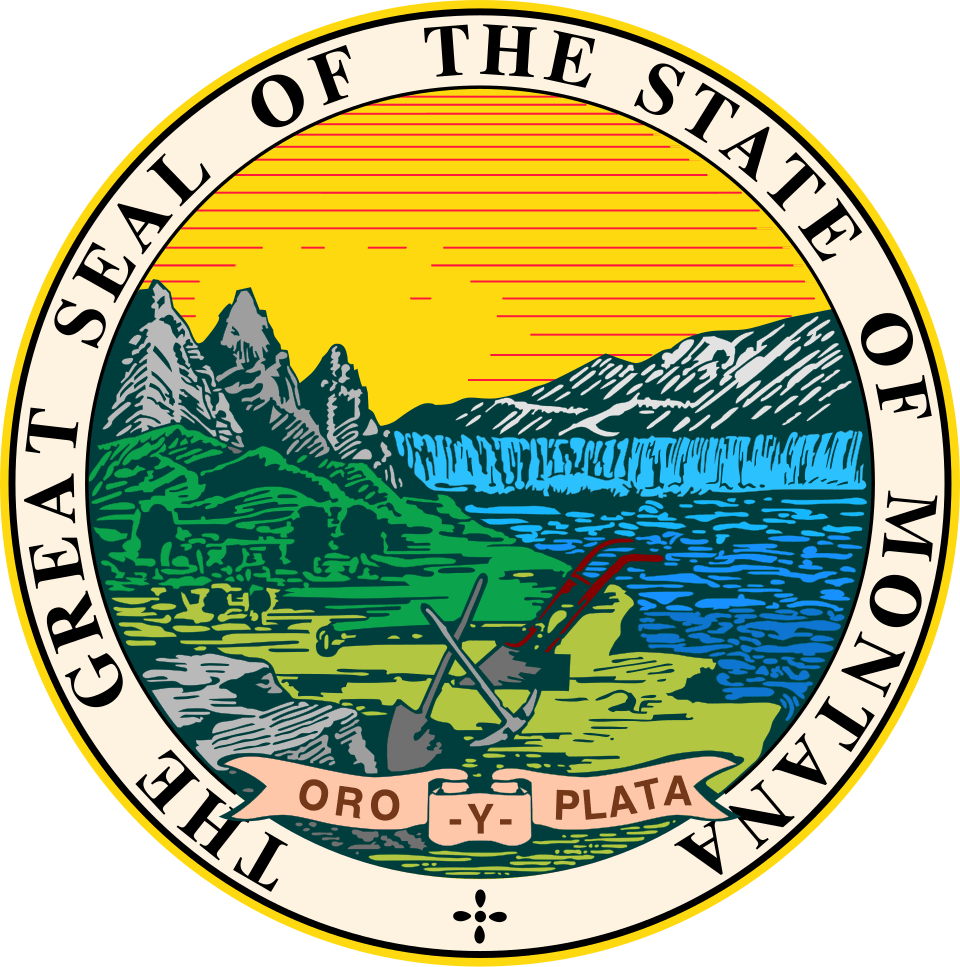
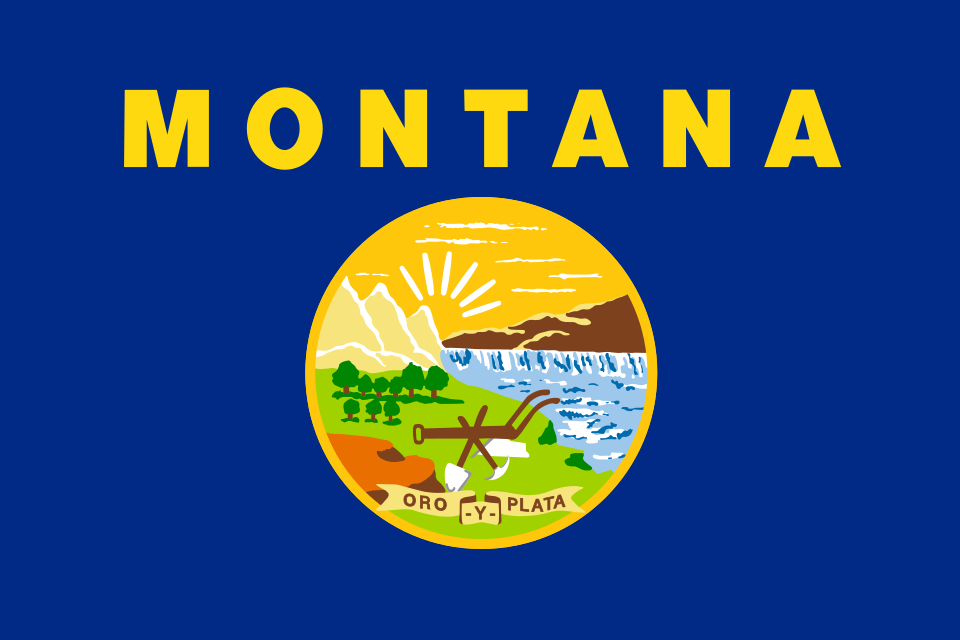
Montana’s state emblems are rooted in the gold and silver rushes of the 1860s. The Great Seal, designed by Francis McGee Thompson at the First Territorial Legislature in Bannack and adopted on 9 February 1865, depicts the Great Falls of the Missouri River — the waterfalls that dazzled Lewis and Clark — flanked by mountains, plains, and forests, with a plow and a miner’s pick and shovel representing the state’s twin economies. The Spanish motto Oro y Plata (“Gold and Silver”) gave rise to Montana’s nickname, “The Treasure State.” The flag, adopted in 1905 and based on a banner carried by the First Montana Volunteers during the Spanish-American War, places the seal on a blue field. The word “MONTANA” was added above the seal in 1981.
Flag
Not available
Seal
Not available
| State | Montana (41st state, admitted 8 November 1889) |
|---|---|
| State seal | Great Falls, mountains, plow, miner’s pick and shovel |
| Seal designer | Francis McGee Thompson (Beaverhead County) |
| Seal adopted | 9 February 1865 (territorial); retained at statehood 1889 |
| State flag | Blue field with state seal and MONTANA above |
| Flag adopted | 1905; state name added 1981; font standardized 1985 |
| Flag origin | Based on Harry Kessler’s 1895 flag for the First Montana Volunteers |
| Motto | Oro y Plata (“Gold and Silver” in Spanish) |
| Capital | Helena |
| Nickname | The Treasure State; Big Sky Country |
| State flower | Bitterroot (Lewisia rediviva) |
Flag of Montana — Blue field with seal, adopted 1905
The Montana flag traces its origin to a Spanish-American War battle banner.
In 1895, Harry Kessler created a flag for the First Montana Volunteers, placing the state seal on a blue field. The regiment carried this banner during the Spanish-American War.
The legislature adopted a flag closely resembling Kessler’s design in 1905.
As many states adopted similar “seal on blue” flags, Montana’s became hard to distinguish. In 1981, the legislature added the word “MONTANA” in gold capital letters above the seal. In 1985, the font was standardized as Helvetica Bold.
A blue field bears the state seal at center — the Great Falls, mountains, plow, and mining tools with Oro y Plata — with “MONTANA” in gold above.
Great Seal of Montana — Oro y Plata — since 1865
The Montana seal is a landscape emblem that captures the territory’s twin foundations: mining and agriculture, set against the grandeur of the Rocky Mountain frontier.
The central scene depicts the Great Falls of the Missouri River, surrounded by mountains, plains, and forests. In the foreground, a plow represents agriculture and a miner’s pick and shovel represent the mining industry. A banner below reads Oro y Plata.
The design was submitted by Francis McGee Thompson, a representative from Beaverhead County, at the First Legislative Assembly in Bannack, the territorial capital. The resolution was passed on 9 February 1865 and signed by Territorial Governor Sidney Edgerton.
Oro y Plata is Spanish for “Gold and Silver,” referring to Montana’s mineral wealth. Thompson’s original version read “Oro el Plata” — grammatically incorrect — and was later corrected to “Oro y Plata.” Spanish mining terminology was widespread in the American West during the 1860s gold rushes.
The Great Falls of the Missouri River, in present-day Great Falls, Montana, are a series of waterfalls that amazed the Lewis and Clark Expedition in 1805. Their appearance on the seal connects Montana to the era of western exploration.
The seal depicts the Great Falls of the Missouri River surrounded by mountains, with a plow and miner’s pick and shovel. The motto Oro y Plata (“Gold and Silver”) appears below. Designed by Francis McGee Thompson, adopted 9 February 1865.
Spanish for “Gold and Silver,” referring to Montana’s mineral wealth. The motto gave rise to the nickname “The Treasure State.”
Spanish was widely used in the American West during the mining era of the 1860s. Spanish mining terminology was common among prospectors from across the Americas.
Adopted in 1905, based on a flag made by Harry Kessler in 1895 for the First Montana Volunteers. “MONTANA” was added in 1981, font standardized in 1985.
The Great Falls of the Missouri River are a series of waterfalls that amazed the Lewis and Clark Expedition in 1805. They symbolize Montana’s natural grandeur and connection to western exploration.
Last reviewed by the Emblema Mundi editorial team on 2026-06-27.