US State
Texas is the only US state whose symbols were born as those of an independent nation. From 1836 to 1845, the Republic of Texas stood between Mexico and the United States as a sovereign country with its own constitution, president, currency, and diplomatic missions. The Lone Star Flag — adopted 25 January 1839 and designed by Peter Krag — and the Great Seal were both created during that brief republican period and carried over unchanged when Texas joined the Union as the 28th state. The single white star on blue — the Lone Star — became so powerful a symbol that it gave Texas its eternal nickname: the Lone Star State.

Flag
Not available
Seal
Not available
| State | Texas (28th state, admitted 29 December 1845) |
|---|---|
| State seal | Lone Star encircled by olive and live oak branches |
| Seal adopted | 1845 Constitution (based on 1839 Republic seal) |
| Reverse seal | Alamo, cannon of Gonzales, Vince’s Bridge, six flags (adopted 1961) |
| State flag | Lone Star Flag — blue stripe with white star, white and red stripes |
| Flag adopted | 25 January 1839 (Republic of Texas) |
| Flag designer | Peter Krag, introduced by Senator William H. Wharton |
| Capital | Austin |
| Nickname | The Lone Star State |
| Former sovereignty | Republic of Texas (1836–1845) |
Lone Star Flag — National flag of the Republic of Texas, 25 January 1839
The Lone Star Flag features a vertical blue stripe bearing a single white five-pointed star, alongside horizontal white and red stripes.
Legislation was introduced by Senator William H. Wharton on 28 December 1838. The flag was adopted on 25 January 1839 as the national flag of the Republic, with official art drawn by Peter Krag and approved by President Mirabeau B. Lamar. When Texas joined the Union on 29 December 1845, the national flag became the state flag.
Along with the flag of Hawaii, the Lone Star Flag is one of only two US state flags that previously served as the national flag of a sovereign country.
Few US states have a symbol as universally recognised as the Texan lone star. Beyond the flag and seal, it appears on highway signs, the State Capitol dome in Austin, every Texas Ranger badge, NASA mission patches launched from Houston, and countless commercial logos. It survives because it tells a complete story in a single shape — a star alone, just as Texas once stood alone.
Texas is the second-largest US state by both area and population, home to over 30 million people, and one of the most economically influential — accounting for nearly 10% of US GDP. The Lone Star carries that legacy of independent identity into modern American culture.
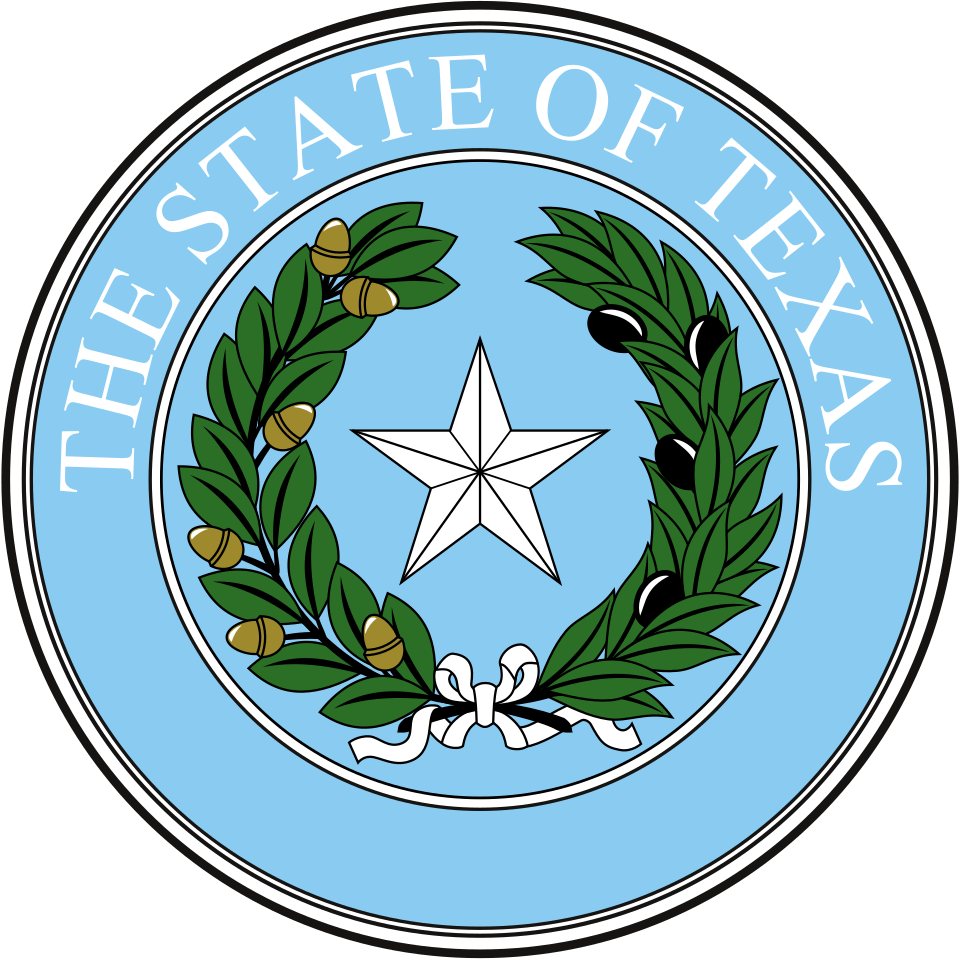
Great Seal of Texas (obverse) — Lone Star, olive and live oak branches
The obverse centres on a single five-pointed star — the Lone Star — encircled by two branches: an olive branch (peace) and a live oak branch (strength and endurance), with the inscription “the State of Texas.” The design was adopted through the 1845 Constitution when Texas joined the Union, changing only the word “Republic” to “State” from the original 1839 seal. The national arms of the Republic declared: “a white star of five points, on an azure ground, encircled by an olive and live oak branches.”
The reverse tells Texas’s history in a single composition. A shield bears three iconic scenes of the Texas Revolution: the Alamo at the top, the cannon of Gonzales (“Come and Take It”) on the lower left, and Vince’s Bridge on the lower right. The shield is encircled by the six flags that have flown over Texas — Spain, France, Mexico, the Republic of Texas, the Confederate States, and the United States. Above runs “Remember the Alamo”, beneath “Texas One and Indivisible.” Designed by Sarah R. Farnsworth, it was adopted on 26 August 1961 under Governor Price Daniel.
The obverse features a five-pointed Lone Star encircled by olive and live oak branches. The reverse shows a shield with the Alamo, the cannon of Gonzales, and Vince’s Bridge, surrounded by the six flags over Texas, with “Remember the Alamo” above and “Texas One and Indivisible” below.
The Lone Star Flag was adopted on 25 January 1839 as the national flag of the Republic of Texas, introduced by Senator William H. Wharton and designed by Peter Krag. When Texas joined the Union on 29 December 1845, it became the state flag.
Blue represents loyalty, white represents purity, and red represents bravery. The single white star — the Lone Star — symbolises Texas standing alone as an independent nation.
Yes. The Republic of Texas existed as a sovereign nation from 1836 to 1845, with its own constitution, president, currency, army, and diplomatic missions. It declared independence from Mexico on 2 March 1836 and joined the United States as the 28th state on 29 December 1845.
The six flags are: Spain (1519–1685, 1690–1821), France (1685–1690), Mexico (1821–1836), the Republic of Texas (1836–1845), the Confederate States (1861–1865), and the United States (1845–1861, 1865–present). They appear on the reverse of the Great Seal.
Last reviewed by the Emblema Mundi editorial team on 2026-06-24.