US State
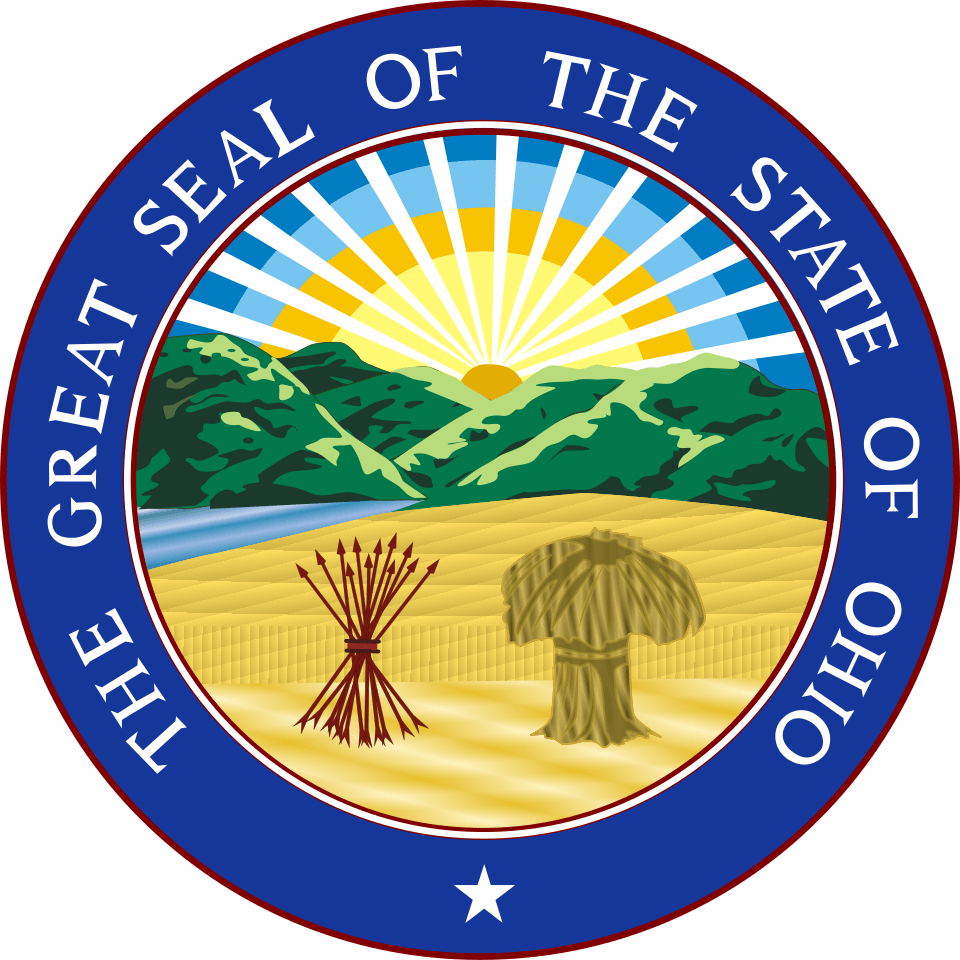
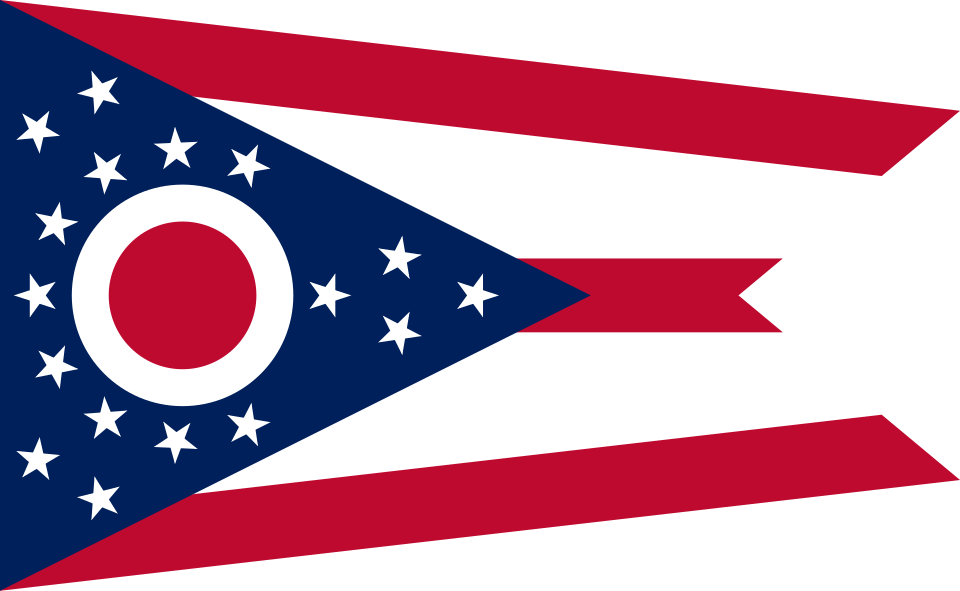
Ohio holds a unique distinction in American vexillology: it is the only US state whose flag is not rectangular. The Ohio Burgee, designed by Cleveland architect John Eisenmann for the 1901 Pan-American Exposition and adopted on 9 May 1902, is a swallowtail pennant in red, white, and blue, with 17 stars and a white “O” with a red center. The Great Seal, adopted in 1803, depicts a sunrise over Mount Logan and the Scioto River — the view from Adena, the estate of founding father Thomas Worthington — with a sheaf of wheat and a bundle of arrows symbolizing Ohio as the 17th state.
Flag
Not available
Seal
Not available
| State | Ohio (17th state, admitted 1 March 1803) |
|---|---|
| State seal | Sunrise over Mount Logan/Scioto River, wheat, arrows, cultivated fields |
| Seal adopted | 1803; standardized 1967; modified 1996 |
| State flag | Swallowtail burgee, red/white/blue, 17 stars, white O with red center |
| Flag designer | John Eisenmann (Cleveland architect) |
| Flag adopted | 9 May 1902 |
| Motto | “With God, All Things Are Possible” |
| Capital | Columbus |
| Nickname | The Buckeye State |
| State flower | Scarlet carnation (Dianthus caryophyllus) |
| Unique distinction | Only non-rectangular US state flag |
Flag of Ohio (Ohio Burgee) — The only non-rectangular US state flag, adopted 1902
The Ohio Burgee is one of the most distinctive flags in the world — the only non-rectangular state flag in the United States.
Cleveland architect John Eisenmann was chosen to design the Ohio Building for the 1901 Pan-American Exposition in Buffalo, New York. Because Ohio had no state flag, Eisenmann designed one — possibly inspired by Civil War cavalry guidons — and registered it with the US Patent Office. The flag was officially adopted on 9 May 1902.
The flag is a swallowtail burgee — a pennant shape with a V-shaped cutout at the fly end, giving it two points instead of a straight edge. This shape is unique among all 50 state flags.
Great Seal of Ohio — Sunrise over Chillicothe — since 1803
The Ohio seal captures a specific real-world view — the sunrise over Mount Logan and the Scioto River as seen from the Adena estate near Chillicothe, Ohio’s first capital.
A sun rises over a range of hills (including Mount Logan), with the Scioto River flowing between the hills and cultivated fields in the foreground. On the right, a sheaf of wheat represents agriculture. On the left, a bundle of arrows (originally 17, representing Ohio as the 17th state). The sun originally had 17 rays, changed to 13 in 1996 to represent the original colonies.
The seal was designed by Secretary of State William Creighton Jr. and adopted in 1803. It was standardized by the General Assembly in 1967 and last modified on 20 November 1996.
Ohio’s state motto, “With God, All Things Are Possible” (from Matthew 19:26), sometimes appears with the seal but is not part of the seal’s official design.
Sunrise over Mount Logan and the Scioto River, a sheaf of wheat, and a bundle of arrows. Designed by William Creighton Jr., adopted 1803, modified 1996.
It is a swallowtail burgee — a pennant shape with a V-shaped cutout. Designed by John Eisenmann in 1901 for the Pan-American Exposition. It is the only non-rectangular US state flag.
The white circle with red center forms the letter “O” for Ohio and evokes the buckeye nut.
13 stars around the O = original colonies. 4 stars at the apex = Ohio as the 17th state (total 17).
Cleveland architect John Eisenmann, for the 1901 Pan-American Exposition. Adopted 9 May 1902.
Last reviewed by the Emblema Mundi editorial team on 2026-06-27.