US State
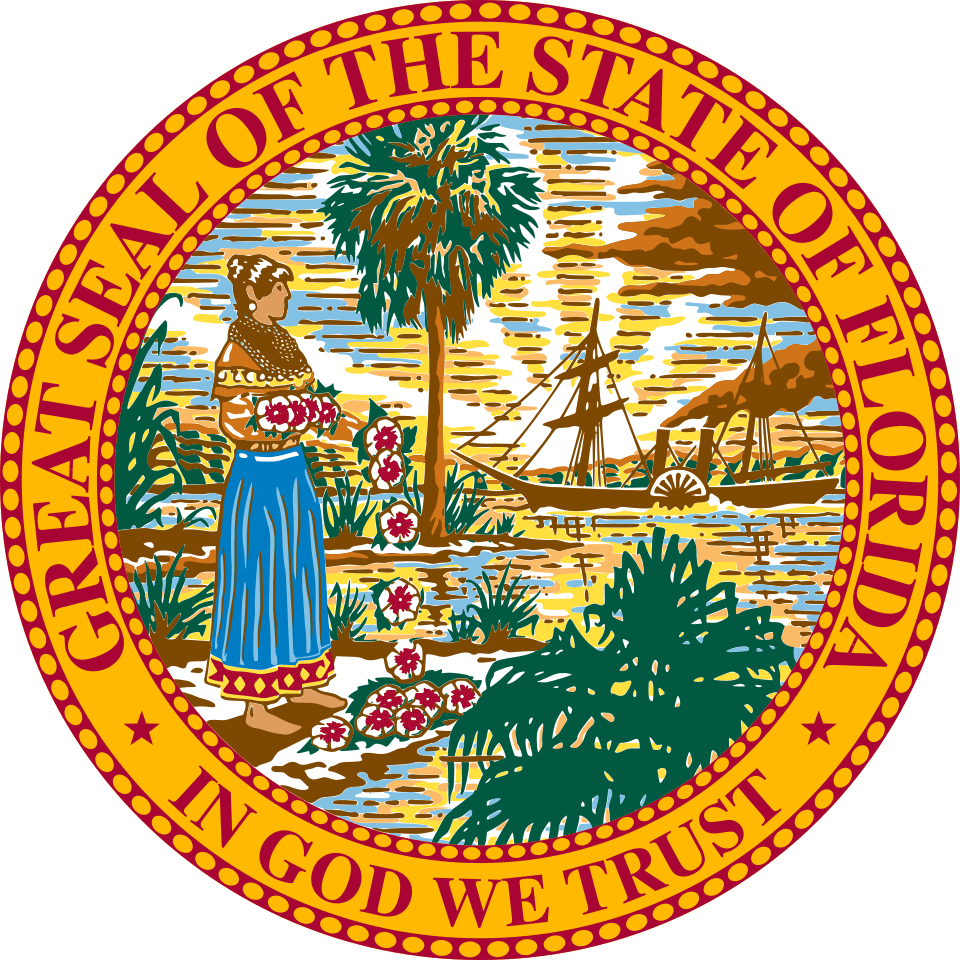
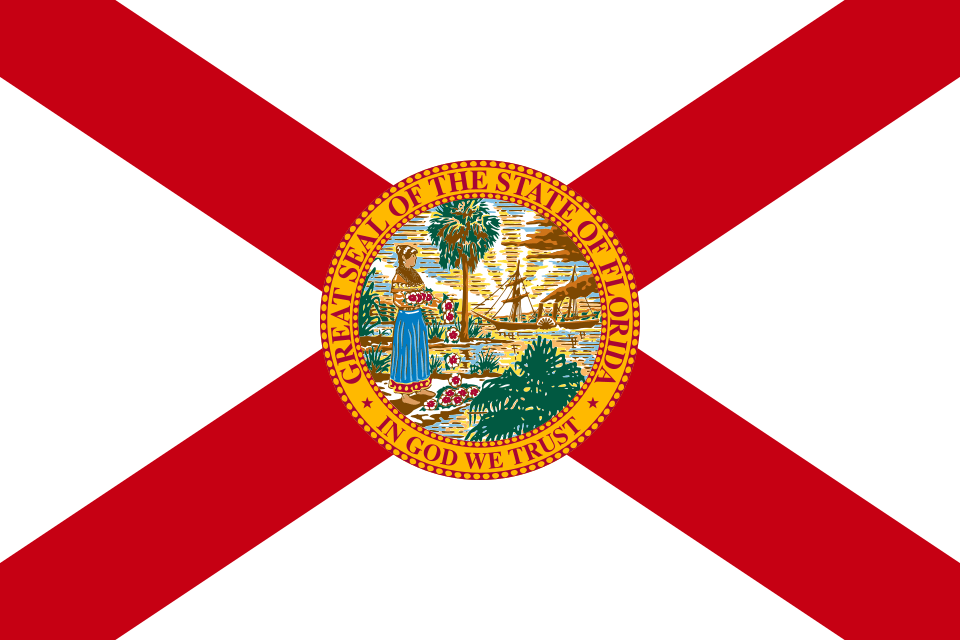
The Great Seal of Florida is a window into the Sunshine State’s layered history: a Seminole woman scattering flowers on a shoreline, a sabal palmetto palm, a steamboat sailing before sun rays breaking over the horizon — all encircled by the motto “In God We Trust”, which Florida adopted in 1868, nearly a century before it became the national motto. The state flag — a white field with a red saltire (diagonal cross) — was added in 1900 at the suggestion of Governor Francis P. Fleming, who objected that the plain white seal-on-white design looked like a flag of surrender when hanging still.
Flag
Not available
Seal
Not available
| State | Florida (27th state, admitted 3 March 1845) |
|---|---|
| State seal | Seminole woman, sabal palm, steamboat, sun rays |
| Seal established | 6 August 1868; redesigned 21 May 1985 |
| Seal redesigner | John Locastro (1985, commissioned by George Firestone) |
| Motto | In God We Trust (on seal since 1868) |
| State flag | White field, red saltire, state seal in centre |
| Red saltire added | 6 November 1900 (voter ratification) |
| Capital | Tallahassee |
| Nickname | The Sunshine State |
| European discovery | Juan Ponce de León, 1513 |
Flag of Florida — Red saltire on white, seal in centre, adopted 1900
The Florida flag is a white field bearing a red saltire (diagonal cross) with the state seal superimposed at the centre.
From 1868 to 1900, the Florida flag was simply the state seal on a plain white background. Governor Francis P. Fleming pointed out that this design looked like a white flag of truce or surrender when hanging still on a flagpole — an embarrassing situation for a proud state.
In 1899, Senator Thomas Palmer introduced a resolution to add red diagonal bars to the flag. It passed unanimously in both chambers and was ratified by Florida voters on 6 November 1900 by a vote of 5,088 to 3,819. The red saltire evokes the cross of Spanish explorers — a reference to Juan Ponce de León’s arrival in Florida in 1513, making it the oldest European-claimed territory in the continental United States.
The flag’s only change since 1900 came on 21 May 1985, when the state seal at its centre was updated to the new Locastro design. The saltire and proportions remained unchanged.
Great Seal of Florida — Seminole woman, sabal palm, steamboat, sun rays
The Great Seal was established by the Legislature on 6 August 1868, specifying “a view of the sun’s rays over a high land in the distance, a cocoa tree, a steamboat on water, and an Indian female scattering flowers in the foreground”, encircled by “Great Seal of the State of Florida: In God We Trust.”
Secretary of State George Firestone commissioned artist John Locastro to create a comprehensive update in 1985. The redesign eliminated the historically inaccurate mountains from the background, refined the steamboat for period accuracy, and reimagined the Native figure as a Seminole woman without the Western Plains Indian headdress of earlier versions. This is the seal in use today.
The Great Seal depicts a Seminole woman scattering flowers on a shoreline, with a sabal palmetto palm, a steamboat sailing on the water, and sun rays breaking over the horizon. It is encircled by “Great Seal of the State of Florida: In God We Trust.” The design was established on 6 August 1868 and redesigned by John Locastro in 1985.
The red saltire was added in 1900 at the suggestion of Governor Francis P. Fleming, who noted that the plain white flag looked like a flag of surrender when hanging still. The red cross evokes Spanish colonial heritage and Ponce de León’s arrival in 1513. Voters ratified the design on 6 November 1900.
The woman is a Seminole Indian woman in traditional garb, scattering flowers along the shore. The 1985 redesign by John Locastro replaced the generic “Indian female” of the original 1868 design with a historically accurate Seminole figure.
The Legislature established the seal on 6 August 1868. The “cocoa tree” was changed to “Sabal palmetto palm” in 1970. The current artwork was redesigned in 1985 by John Locastro, commissioned by Secretary of State George Firestone.
“In God We Trust” has been part of the Florida state seal since 1868 — predating its adoption as the official US national motto in 1956. It appears on the outer ring alongside “Great Seal of the State of Florida.”
Last reviewed by the Emblema Mundi editorial team on 2026-06-24.