Heraldic charge · Twenty-four flags
Saltire Flags of the World — the Cross of Saint Andrew and Its Kin
The saltire is the diagonal cross, the X that runs from corner to corner. It flies over Scotland and over Jamaica, over Amsterdam and Rio de Janeiro, on the ensign of the Russian navy and on the state flags of Alabama and Florida. It is the cross of Saint Andrew, and it is also one of the oldest geometric figures in heraldry — a shape that nations, cities, armies and islands have each made their own. This page gathers twenty-four flags that carry one: the twelve that fly Saint Andrew’s own cross, and twelve more that took up the same diagonal for reasons of their own.
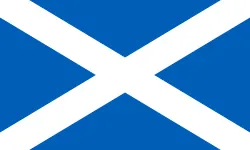 Scotland
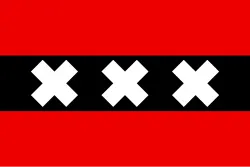 Amsterdam
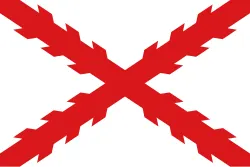 Burgundy
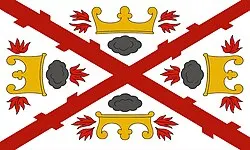 Charles the Bold
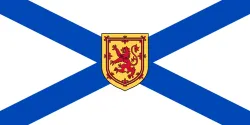 Nova Scotia
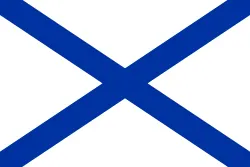 Russia
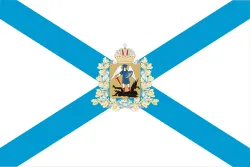 Arkhangelsk
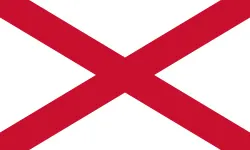 St Patrick
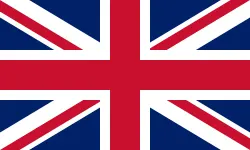 Union Jack
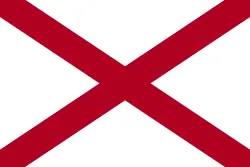 Alabama
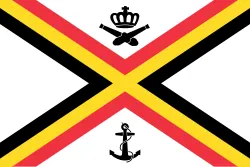 Belgian Navy
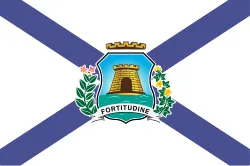 Fortaleza
 Peru
Peru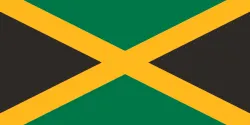 Jamaica
 Burundi
 Grenada
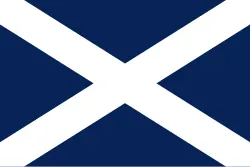 Tenerife
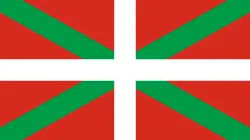 Basque Country
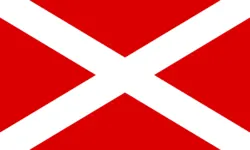 Gascony
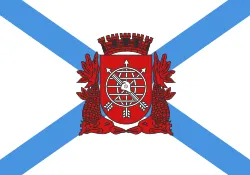 Rio de Janeiro
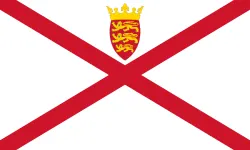 Jersey
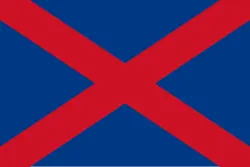 Voortrekkers
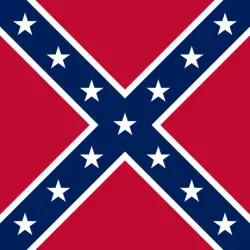 Confederate
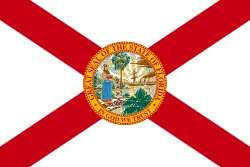 Florida
Twenty-four flags, one shape — from a Scottish seal of 1286 to the banners of nations that won their independence in the twentieth century.
What Is a Saltire?
In heraldry a saltire is one of the honourable ordinaries, the family of geometric charges that span the shield edge to edge alongside the fess, the pale, the bend and the cross. Formally it is a bend and a bend sinister of equal width conjoined into a diagonal cross. Its technical name is the crux decussata, from decussis, the Roman numeral X.
The word itself has nothing to do with saints or crosses. English saltire is attested from about 1400, from the Old French sautoir, literally a stirrup, and behind that the medieval Latin saltatorium, from salire, to leap: a crossed wooden frame you vaulted to mount a horse or cross a fence. The same root survives in the French porter en sautoir, to wear something crossed over the chest. The shape was borrowed into religion, not born there.
Three things the same X can be
Confusing these three is the commonest error made about diagonal crosses, and several flags on this page turn on the distinction.
- A saltire is a charge: a single X-shaped band laid on the field, as in Scotland — azure, a saltire argent.
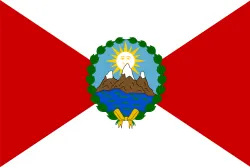
- A field per saltire is divided, not charged: the two diagonals cut it into four triangles which are then coloured separately, and nothing is laid on top. Grenada and the first flag of Peru are built this way.
- Charges in saltire or saltirewise are merely arranged in the shape. Two long objects such as swords or keys laid across each other are saltirewise; five compact charges set out in a two-one-two pattern are in saltire.
Diminutives, and why Amsterdam has three
A fillet saltire is a narrow version, and a saltorel is a saltire couped — cut short of the edges. That is not decoration but rule: three or more saltires on one shield must be couped, because a full ordinary cannot be multiplied. It is exactly why Amsterdam’s three crosses stop short of the border. The saltire also takes nearly all the decorative lines of the cross: engrailed, indented, wavy, voided and — the case that matters most here — raguly, with the stumps of lopped branches, which is what makes the Cross of Burgundy instantly recognisable.
One thing is not fixed: its width. English heraldry sets no legal proportion, and the familiar rule of thumb of one fifth of the field plain, one third when charged, is a textbook convention rather than law. Modern flag statutes do pin it down — Florida specifies one fifth of the hoist, Tenerife one fifth of the width — but the shield never did.
Saint Andrew and His Cross
Andrew was the first of the apostles to be called, a fisherman of Bethsaida and the brother of Peter. Tradition places his death at Patras in Achaea around AD 60, and tells that he was crucified on a cross set in the form of an X, having asked not to die in the same manner as his master. It is one of the most durable images in Christian art: the old man bound to two crossed timbers, preaching to the crowd for two days from the cross itself.
The cross became his signature slowly. The earliest surviving accounts of his martyrdom — the apocryphal Acts of Andrew of the second century, and the version of it known to Gregory of Tours in the sixth — describe him bound to an ordinary upright cross. The first images showing him on a crux decussata appear in the tenth century, the shape becomes his settled heraldic attribute in the fifteenth and sixteenth, and only in the seventeenth does the X become the artistic norm. The story of the humble request, told in the same terms of Saint Peter and his inverted cross, belongs to that later tradition rather than to the earliest texts.
The timing produces a striking result. Scotland was already using the saltire as a national emblem in 1286 and putting it on its soldiers’ backs in 1385, at a period when the X was not yet fixed as Andrew’s attribute across Europe. Nation and saint arrived at the same shape almost together, and the flag may have done as much to settle the iconography as the iconography did to inspire the flag.
From Scotland the cross travelled: to the dukes of Burgundy who took Andrew as their patron, and through them to the armies of Habsburg Spain; to Peter the Great, who founded an order in the apostle’s name and gave his navy the saltire; to a Scottish colony in Canada, to a chivalric order in Dublin, to the statute books of Alabama and the municipal law of a Brazilian city. Those ten flags come first, in the order they appear.
The Flags of Saint Andrew
Twelve flags in which the diagonal cross is the apostle’s own. Some name him in a blazon, a statute or their own title; others inherit his cross directly from those that do. Together they span seven centuries, from a thirteenth-century Scottish seal to a Russian oblast in 2009.
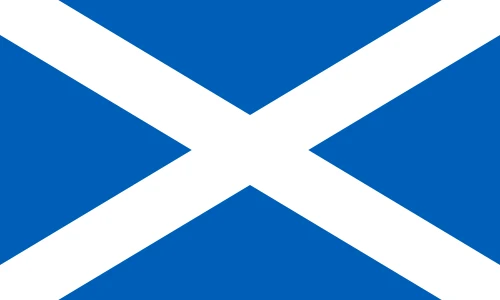
1286
Scotland — the Saltire
The Saltire is the oldest flag in this collection and the one that made the shape famous. Tradition dates it to 832, when Saint Andrew was said to have appeared to the Pictish king Óengus before a battle at Athelstaneford, a white cross forming in the sky above the field. The documents tell a slower story. The saint appears crucified on an X-shaped cross on Scottish seals from 1180; the saltire serves as a national emblem on the seal of the Guardians of Scotland in 1286; and in 1385 the Parliament of Scotland orders every soldier to wear “a white St Andrew’s Cross” front and back. It was a badge sewn to the body long before it was a flag. The white-on-blue flag itself is first recorded in 1507, aboard the great carrack Michael.
For all its age, almost nothing about the flag is fixed in law. There is no statutory ratio — three by five is usual, and the Lord Lyon has indicated four by five is equally suitable — and no statutory colour. The blue drifted with whatever dye was available until 2003, when a committee of the Scottish Parliament, advised by the Lord Lyon’s office, recommended Pantone 300. A recommendation is all it is, which is why paler sky-blue saltires still fly perfectly legitimately alongside the modern one.
On the legend: the battle at Athelstaneford is first named by Walter Bower in the 1440s, some six centuries after the event, and the vivid detail of a white cross against an azure sky — the version that so neatly explains the flag’s colours — appears in that precise form in Nigel Tranter’s 1990 novel Kenneth. The older tellings give neither the colour of the sky nor the shape of the cross.
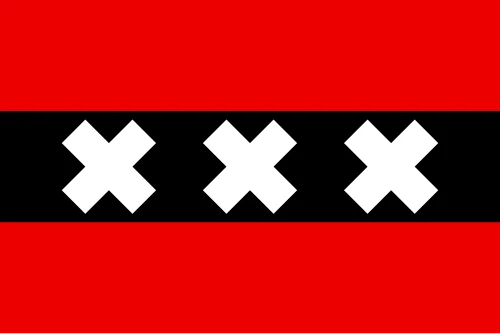
1350
Amsterdam — the three crosses
Amsterdam’s blazon names them outright: drie St. Andrieskruisen, three Saint Andrew’s crosses on a black pale between two red fields. They are couped, cut short of the edges, and heraldry explains why — three or more saltires on one shield must be shortened, because a full ordinary cannot be multiplied. The oldest surviving object bearing them is a cloth-guild stamping tong of about 1350, pulled from the mud of the Damrak during the digging of the city’s north-south metro line. They appear in documents from 1419 and on ships’ flags by about 1505.
Where they come from is most likely heraldic rather than devotional: the arms of the Persijn family, lords of Amstelledamme in the 1280s, whose neighbours at Ouder-Amstel and Amstelveen bear near-identical crosses. The black pale between them is generally read as the river Amstel itself. The city’s own historians call the Persijn connection the best explanation available while leaving it an open question. Above the shield sits the imperial crown, granted by Maximilian I in the 1480s in thanks for Amsterdam’s financial support, and below it the motto Heldhaftig, Vastberaden, Barmhartig — valiant, steadfast, compassionate — awarded by Queen Wilhelmina for the city’s resistance to the persecution of its Jews, above all the February Strike of 1941.
Two stories to set aside. The crosses do not ward off the city’s three great scourges of flood, fire and plague: the arms are older than the arrival of the Black Death in Europe. And they have no connection to “XXX” as a mark of pornography, which comes from twentieth-century American film ratings, some six hundred years later.
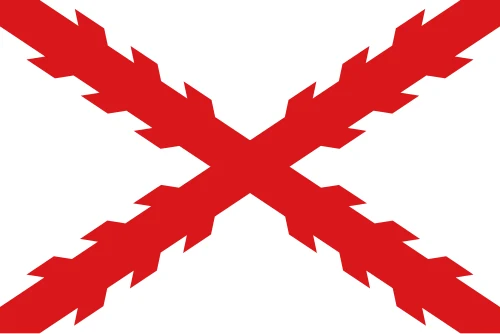
1411
The Cross of Burgundy — the ragged saltire
The Cross of Burgundy is the one saltire here you can identify at a glance: its arms are raguly, two roughly pruned branches with the stumps of lopped side-shoots still showing. It is understood as Saint Andrew’s cross in its crudest form, the rough timber of the martyrdom rendered literally, and Andrew was the dynastic patron of the Valois dukes. It began as nothing so grand. Its documented career starts as a party badge in the Armagnac–Burgundian civil war under John the Fearless, worn widely from about 1411 — a way of not being killed by the other side in the streets of Paris. Charles the Bold turned it into the standard of a professional army in his ordinances of 1472 and 1473; he did not invent it.
Through Mary of Burgundy’s marriage to Maximilian of Habsburg it passed to the Habsburgs, and it entered Spain in 1506 on the standards of Philip the Handsome’s Burgundian guard. From there it became the constant device of the Spanish tercios and the land ensign of the viceroyalties of New Spain and Peru, which is why it is loosely called the flag of the Spanish Empire. It served until Isabel II replaced all army colours in 1843 — some three and a half centuries, longer than the red-and-yellow Spanish flag has yet existed. It survives on the colours of the Spanish Legion and as the fin flash of Spanish military aircraft, and it remains contested in Spain today, having been taken up by Carlism and later by the far right.
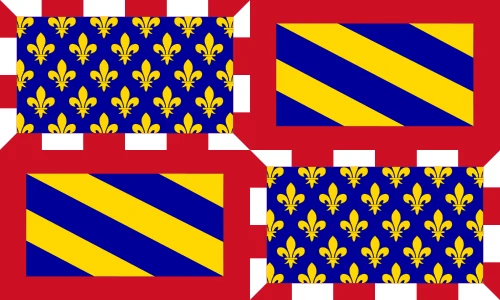
Not to be confused. The banner of the Dukes of Burgundy carries no saltire at all — it is quarterly, the Valois fleurs-de-lis with a compony border alternating with the ancient gold-and-blue bends of the duchy. One is a banner of lordship, the other a soldier’s field sign, and the two are constantly mistaken for one another.
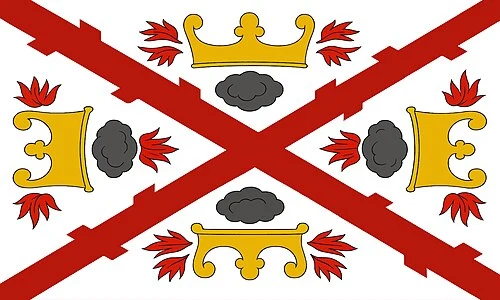
1473
The Burgundian war flag under Charles the Bold
This is the Cross of Burgundy as an army actually carried it. Charles the Bold rebuilt the Burgundian forces into standing companies by the ordinances of Bohain-en-Vermandois in 1472 and of Saint-Maximin, near Trier, in 1473, regulating liveries and standards down to the individual company. The ragged saltire was the sign every man of the ducal army bore, and around it went the badges of the house: the ducal crown, and the briquet or fire steel striking sparks from a flint — the device of the Order of the Golden Fleece, founded by Charles’s father Philip the Good in 1430.
We know the Burgundian standards largely because they were captured. The Swiss broke Charles’s army at Grandson and at Morat in 1476 and destroyed it at Nancy in January 1477, where the duke himself was killed and the Valois line of Burgundy ended with him. The banners taken as booty passed into Swiss hands and were recorded in the illustrated chronicles of the following century. Within months of Nancy, Charles’s daughter Mary married Maximilian of Habsburg, and the emblem her father’s soldiers had worn began its second career in the armies of Spain.
The image is a modern reconstruction, drawn after the description in Christoph Silberysen’s Chronicon Helvetiae, and not a photograph of a surviving standard.
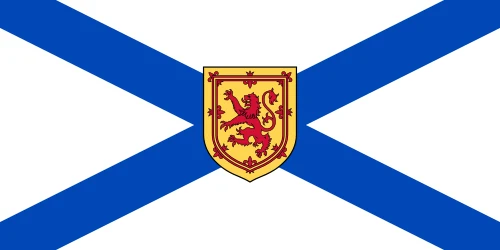
1625
Nova Scotia — Scotland reversed
Nova Scotia flies Scotland’s flag with the colours reversed — a blue saltire on white — beneath the royal arms of Scotland. The arms were granted by Charles I and first recorded at the Court of the Lord Lyon in Edinburgh on 28 May 1625, four years after James VI and I granted the territory of “New Scotland” to Sir William Alexander. The vexillologist Whitney Smith explained the reversal as a practical matter: it gives better contrast against the gold shield laid over the centre.
The flag’s history holds two oddities. From 1868 to 1929 it was not Nova Scotia’s flag at all — after Confederation the province was issued new arms showing a salmon and thistles, and recovered the saltire only by royal warrant of George V in 1929. And it went 388 years without a statute: in 2013 an eleven-year-old student from Canso, working on a school project, discovered that the flag had never been legally adopted, contacted her member of the legislature, and the Provincial Flag Act followed.
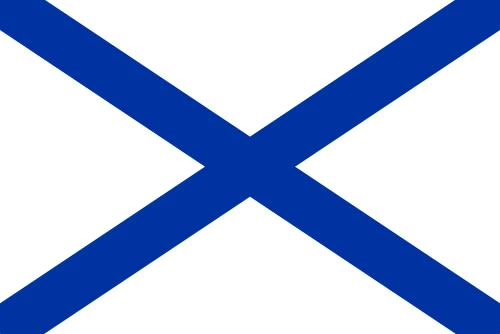
1712
Russia — the Andreyevsky ensign
The Russian naval ensign is the most literal Saint Andrew’s cross of all — it is named after him. The apostle is a patron of Russia by way of the twelfth-century Primary Chronicle, which has him travelling up the Dnieper, planting a cross on the hills where Kyiv would rise and prophesying a great Christian city there. That is a literary tradition rather than a historical record, and its purpose was to claim apostolic foundation independently of Rome. Peter the Great built on it directly: he founded the Order of Saint Andrew in 1698, sketched flag after flag in his own hand between 1692 and 1712 — eight designs survive — and settled at last on the plain version, “the flag is white, across it there is St Andrew’s blue cross.”
It flew for two centuries, and its end was slow. Abolished by decree in December 1917, it was kept aloft by the White fleet through the civil war and into exile: the last imperial St Andrew’s ensign came down not in Russia but in Tunisia, aboard the Russian squadron interned at Bizerte, on 29 October 1924, when France recognised the Soviet Union. It stayed furled for sixty-eight years, and was restored by presidential decree on 21 July 1992.
Two claims often attached to it do not hold. The four arms are sometimes said to stand for Russia’s four seas, a reading that appears only in the Soviet era and finds no support in Peter’s own papers. And the ensign has in fact been struck in surrender, despite the tradition that it never was.
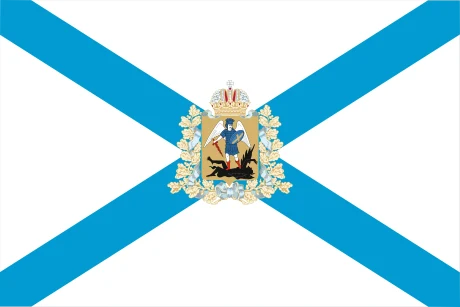
2009
Arkhangelsk Oblast — the navy’s cross, borrowed
Arkhangelsk took the fleet’s flag and set its arms in the middle of it. The oblast law of 23 September 2009 prescribes a white cloth bearing an azure diagonal cross one tenth of the flag’s length in width, with the regional arms in full colour at the crossing: the Archangel Michael in armour, treading down the devil — the saint who gave both the city and the region their name.
There is a certain logic to a Saint Andrew’s cross flying over this particular region. Arkhangelsk was Russia’s first seaport, founded in 1584, and for more than a century her only maritime window on the world; Peter the Great built ships at its Solombala yard a decade before Saint Petersburg existed. But the law itself makes no such claim. It gives the geometry, the ratio and the colour, and not a word about what the diagonal means — no apostle, no navy, no Peter.
The flag has never been approved by the Heraldic Council attached to the President of Russia, which found it did not meet its guidelines, and Russian vexillologists have objected that it appropriates the Andreyevsky cross, an emblem reserved to the navy. A further irony: the region is named for the Archangel Michael, whose traditional attribute is a cross of quite another form.
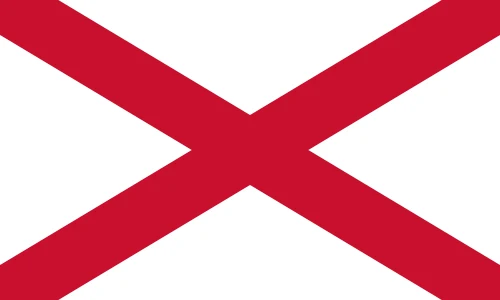
1783
Saint Patrick’s Saltire — Andrew’s cross renamed
The red saltire on white is the strangest object in this family: a Saint Andrew’s cross renamed for another saint. It has no medieval pedigree as an Irish emblem. Red saltires do appear in earlier Irish contexts — on coins struck under the Great Earl of Kildare around 1480, on a map of 1576, on Confederate Irish ensigns in the 1640s — but nothing ties any of them to Saint Patrick. The name arrives with the letters patent of George III instituting the Order of Saint Patrick on 5 February 1783, which take a red saltire on white as the order’s emblem and call it, apparently for the first time, the Cross of Saint Patrick.
Where the design came from is unsettled. The most repeated explanation is the arms of the FitzGeralds, argent a saltire gules, a family then dominant in Dublin politics; another holds that the Lord Lieutenant, pressed for time, modelled the insignia on the Order of the Garter and simply turned Saint George’s cross through forty-five degrees. Contemporaries noticed the problem immediately. A complaint printed in February 1783 objected that the breasts of Irishmen were to be decorated with “the bloody Cross of St Andrew”, and not that of their own patron saint. Ireland has never officially adopted it; it entered the Union Flag in 1801 representing the whole island, 120 years before partition.
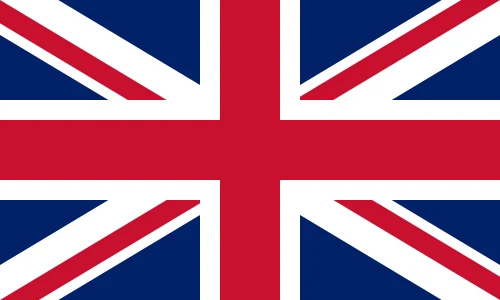
1801
The Union Jack — two saltires and a cross
The Union Flag is the only flag in the world built by laying one saint’s cross over two others. James VI and I began it in 1606, ordering ships to wear Saint George’s cross and Saint Andrew’s “joyned together”. Scottish shipowners objected at once that the English cross sat on top, obscuring theirs, and an unofficial Scottish version with the saltire uppermost was still being flown in the 1690s. They lost the argument twice, in 1606 and again in 1707. Saint Patrick’s red saltire was added on 1 January 1801, and the design has not changed since.
The two saltires are not stacked but counterchanged, each taking half of every diagonal arm, with Saint Patrick’s shifted anti-clockwise by a thirtieth of the flag’s height. That offset is why the flag has a right way up: the broad white band of Saint Andrew must sit uppermost beside the hoist. The white is also doing double duty, since heraldry forbids laying colour directly on colour — it is at once Scotland’s saltire and the fimbriation separating Ireland’s red from the blue field. And no statute ever made this the national flag; it holds the position by proclamation, Admiralty regulation and long habit.
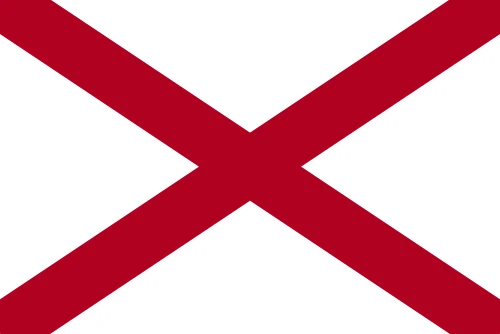
1895
Alabama — the saint named in law
Alabama is the only flag here whose founding law names the saint. Act No. 383 of 16 February 1895 prescribes “a crimson cross of St. Andrew on a field of white”, with bars not less than six inches broad running diagonally from side to side. What the act does not give is a ratio, an overall size, a shade of crimson or a maximum bar width — and nearly everything disputed about this flag flows from that silence. Alabama is arguably the only American state whose flag has never had its shape settled: the state’s first archivist read the statute as prescribing a square, by analogy with Confederate battle-flag regulations, while a 1987 attorney general’s opinion concluded it was rectangular because that is how it had been printed since 1896. An opinion is not an amendment, and square Alabama flags are still made and still flown officially.
Where the design came from is genuinely unresolved. One account traces it to the Confederate battle flag and rests on a statement written in 1915, twenty years after the fact, by the archivist Thomas Owen. Another traces it to the Cross of Burgundy, the Spanish military standard that flew over the Gulf South for two centuries, and rests on resemblance alone. No record of the legislature’s intent survives. The present director of the Alabama Department of Archives and History is openly sceptical of the Confederate reading, noting that had they wanted to evoke the battle flag they would have been more explicit. Note too that the battle flag was square while the Confederate national flags were not, which is why the question of shape is not trivia but part of the argument itself.
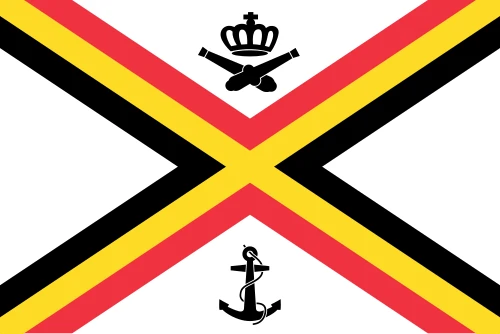
1950
The Belgian naval ensign
Belgium’s naval ensign is a white flag crossed by a saltire in the national colours — black on the hoist and fly arms, red above and below, yellow at the core — with a crowned pair of crossed cannon in the upper triangle and an anchor in the lower. It was prescribed by decree of 23 February 1950, signed by Prince Charles as Regent, and first hoisted on 2 March aboard the Georges Lecointe.
Both halves of the design are borrowed, and both borrowings are acknowledged. The white field is a deliberate echo of the Royal Navy’s White Ensign: Belgian sailors had served as a section of the Royal Navy through the Second World War, and the rebuilt Belgian navy paid the debt in its flag. The saltire is officially said to descend from the Cross of Burgundy, which flew on ships of the Low Countries under Burgundian rule — best treated as the navy’s stated inspiration rather than proven descent, since Belgium itself dates only from 1830. The practical virtue is real, though: a saltire carries all three national colours in a form that stays legible at sea, which the vertical tricolour does not.
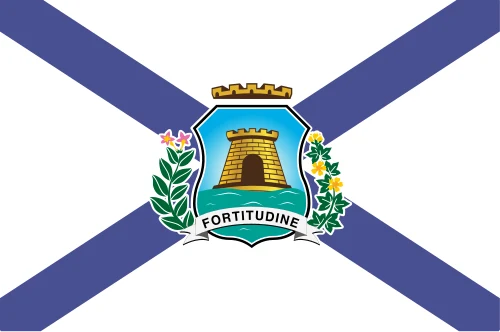
1958
Fortaleza — a saint written into the statute
The Brazilian city of Fortaleza flies a blue saltire on white with its arms at the crossing, and its founding law is unusually explicit: Municipal Law No. 1,316 of 11 November 1958 calls the device a Cruz de Santo André. The flag was drawn by Isaac Correia do Amaral and the arms by Tristão de Alencar Araripe, and the blue is specified as the blue of the Brazilian national flag.
The arms are canting — they say the city’s name aloud. A gold castle rises from waves beneath a mural crown, flanked by branches of tobacco and cotton over the motto FORTITUDINE: the fortress that gave Fortaleza its name. The law is prescriptive to the millimetre about the geometry of the saltire, specifying the bands in modules, and completely silent about what it means. No official symbolism has ever been recorded for the cross or the white field, and none should be invented for them.
Saltires of New Nations
Four flags raised by states at the moment they became themselves. Here the diagonal is a designer’s decision — a way of dividing a field into four, or of keeping a new flag clear of another nation’s.
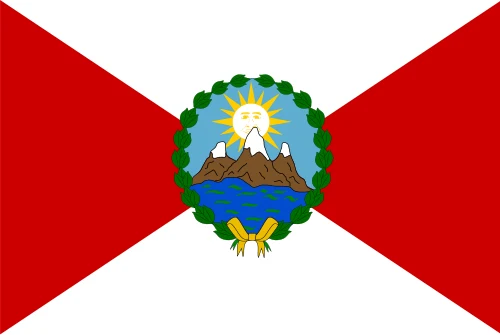
1820
Peru — divided, not charged
San Martín’s first Peruvian flag, decreed at Pisco on 21 October 1820, is the clearest illustration of a distinction worth learning. It carries no saltire. The X is not laid on the field: the field is cut by it into four triangles, white above and below, red at the hoist and fly, with a rising sun over mountains and sea in a laurel wreath at the centre. Heraldry calls this a division of the field — party per saltire — and it is a different thing from a saltire charge.
It lasted about seventeen months, and it fell for industrial rather than political reasons: with no standard measurements the diagonals were hard to cut and sew consistently, and the elaborate central device compounded the problem. The horizontal replacement of March 1822 proved too easy to confuse with the Spanish flag, and the vertical red-white-red of May 1822 has stood ever since. The story that San Martín took the colours from a flock of red-and-white flamingos is charming and late: it was first published by the writer Abraham Valdelomar in 1917, nearly a century after the event.
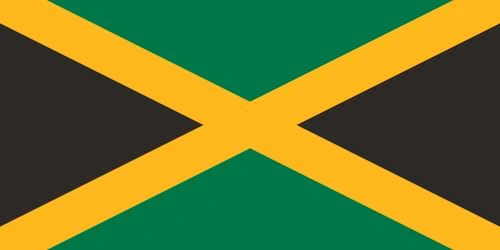
1962
Jamaica — a tricolour turned on its side
Jamaica’s gold saltire is the most widely recognised in the world after Scotland’s, and it is a saltire by accident. A national design competition in 1961 drew over 360 entries and produced no winner, so a bipartisan parliamentary committee took the job on and settled on horizontal stripes: black between gold, with green at top and bottom. That was judged too close to the flag of Tanganyika as it then stood, and the stripes were rotated through forty-five degrees. Jamaica’s flag is a horizontal tricolour turned on its side.
It is the only national flag containing neither red, white nor blue — but only since 2017, when Mauritania added two red stripes to its green-and-gold flag; before that there were two. The colours were officially reinterpreted in 1996. The original reading, “hardships there are, but the land is green and the sun shineth”, made black the colour of hardship; the revision made it the strength and creativity of the people, gold the natural wealth and sunlight, green hope and agriculture. Not a pixel of the design changed.
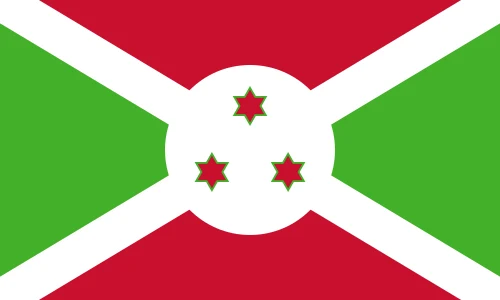
1967
Burundi — geometry, and a vanished drum
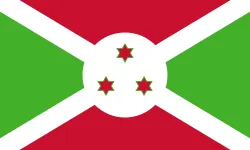
Burundi’s flag is cut by a white saltire into red and green fields, with three red six-pointed stars in a white disc at the centre. The saltire here is pure geometry. Neither the reference literature nor the constitution that prescribes it mentions Saint Andrew: Article 8 spells the design out in near-heraldic terms, down to the three stars set in an imaginary equilateral triangle inscribed in an imaginary circle, an unusually exact piece of constitutional drafting. The layout dates from independence in 1962; the stars do not.
What stood in the disc before them was the karyenda, the sacred royal drum whose beats only the mwami, the king, could interpret into law. When the monarchy fell in November 1966 the drum was struck from the flag within days, leaving a lone sorghum plant for some seven months until the three stars replaced it on 28 June 1967. Officially the stars answer to the three words of the national motto, Unité, Travail, Progrès, though they are near-universally read as the three peoples of Burundi: Hutu, Tutsi and Twa. White is taken for peace, green for hope and red for the suffering of the struggle for independence.
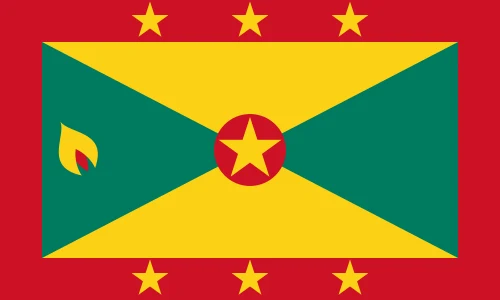
1974
Grenada — the saltire that isn’t drawn
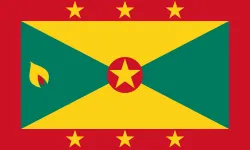
Grenada is the purest case on this page of a saltire that is not there. Its field is genuinely divided per saltire — the two diagonals cut it into four triangles, yellow above and below, green at the hoist and fly — but no cross is drawn at all. The X exists only as the boundary between colours. A red border carries six of the seven stars; the seventh sits on a disc at the centre, beside the nutmeg that stands for the island’s one great export.
The flag was drawn by the Grenadian artist Anthony C. George and first hoisted at midnight on 6 February 1974, at independence. The seven stars stand for the country’s seven parochial divisions, though which one the central star denotes has been disputed — the capital, Saint George’s, or the dependency of Carriacou and Petite Martinique — and the argument has carried real political heat. As for Saint Andrew, he appears here only as a place name: one of the six border stars is the parish of Saint Andrew, and by pure coincidence it is the parish the designer came from.
Saltires of Regions, Islands and Cities
Five saltires flown to say where you are from: an Atlantic island, a Basque province, a Gascon country with no borders on any map, a Brazilian capital and a Channel bailiwick.
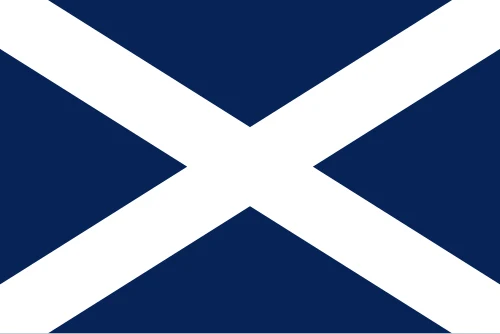
1845
Tenerife — a shipping signal that became a flag
Tenerife’s flag began life as a piece of maritime administration. A Spanish royal order of 1845 assigned distinguishing flags to the maritime provinces of the kingdom, and the white saltire on navy blue went to the Maritime Province of Canarias, to be flown by its merchant shipping. When the province was divided in 1867 the design stayed with Tenerife, and there it remained — a working signal flag, flown from mastheads, belonging to nobody in particular.
It took 144 years to become an emblem. The Cabildo Insular proposed it as the island’s own flag and the government of the Canary Islands adopted it by order of 9 May 1989. No official meaning has ever been assigned to the colours, but the islanders supply one readily enough: the blue is the Atlantic and the white is the snow on Teide, the volcano that dominates the island. The name says the same thing — Tenerife is generally glossed from the language of neighbouring La Palma as the white mountain, and the Romans called the island Nivaria, from nix, snow.
Two island legends explain the resemblance to Scotland’s flag: that it honours Scottish sailors at the Battle of Santa Cruz in 1797, where Nelson lost his right arm, or that Canarian politicians of a Scottish-rite masonic lodge chose it. Spanish scholarship treats both as urban legend, and the 1845 order predates any such account. The two flags are also officially distinct in colour: Tenerife’s navy is Pantone 280, Scotland’s brighter blue is Pantone 300.
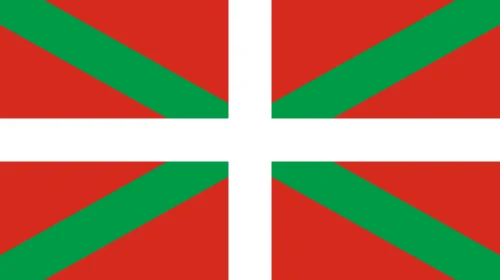
1894
The Basque Ikurriña
The Basque flag lays a white cross over a green saltire on a red field, and the green saltire is often called the cross of Saint Andrew on the grounds that the legendary Battle of Padura was won on his feast day. The battle’s own historicity is doubtful and the association is retrofitted. The saltire’s documented meaning is the Oak of Gernika, symbol of the old Biscayan fueros; the red field stands for the Basque people and the white cross for the Catholic faith, following Sabino Arana’s motto “God and the Old Law”.
It was designed in 1894 by Sabino and Luis Arana Goiri, founders of Basque nationalism — Luis appears to have done the actual drawing, though Sabino is usually credited — and first hoisted in Bilbao that July. It was made for Biscay alone, one of seven provincial flags the brothers drew, and became the flag of the whole Basque Country in the 1930s over Luis’s objections. Whether the Aranas took the layered cross-over-saltire from the Union Jack is genuinely debated: Bilbao’s commercial ties with Britain were intense, and a historian at the University of the Basque Country holds that they partly copied it. Banned by the Franco regime in 1938, it was legalised in 1977. The word ikurriña is itself a coinage of Sabino Arana’s, from ikur, a sign.
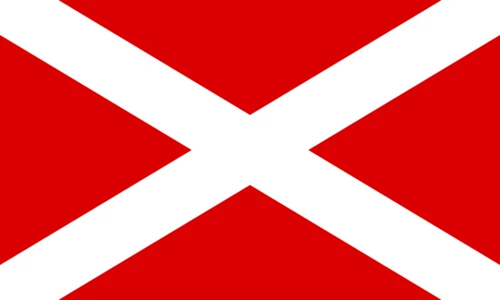
modern
Gascony — a flag for a country with no borders
Gascony is not a region of France. It has no prefecture, no council and no line on any administrative map: it is a country in the older sense, defined by a language and by the people who still speak it, spread across the Landes, the Gers, Béarn and the edges of half a dozen departments. Its flag — a white saltire on red, known as the Union Gascona or simply Lo Sautèr, the saltire — is flown at festivals and férias across that country, and carries no legal status of any kind. It is an emblem people choose, not one an authority grants.
Its origins are correspondingly hard to pin down. The explanation most often given is that Saint Andrew is the patron of Bordeaux, the Gascon metropolis; others point to the red of English Aquitaine, held by the kings of England for three centuries, or to the arms of a thirteenth-century seneschal of Gascony. None of these is documented, and the honest position is that nobody knows. Gascony also has a second, quite different flag — a quartered banner with a silver lion and gold wheatsheaves — but that one was invented at Versailles around 1700 by royal officials who needed arms for a province that had never borne any.
Two claims to treat with caution. The tradition that the cross was granted by Pope Clement III during the Third Crusade is not supported by the chronicle usually cited, which mentions only the French, English and Flemish crusader crosses. And the adoption date of 13 January 1903, repeated on many sites, traces back to an unsourced forum message. Note also that this is not a Cross of Burgundy: its arms are smooth, without the branch knots that define the Burgundian version.
1908
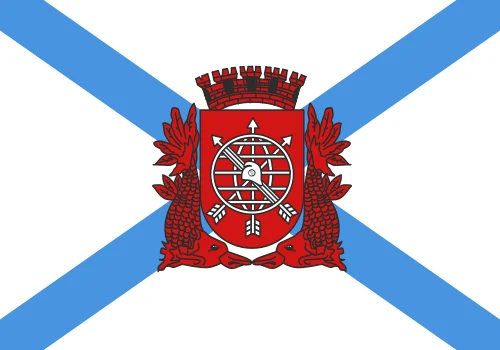
Rio de Janeiro — the city, not the state
The city of Rio de Janeiro — not the state, whose flag is quartered by an upright cross and is constantly confused with it — flies a blue saltire on white with the municipal arms in red at the centre. The design was made official by decree of 8 July 1908, a date now marked as the City Flag Day.
Its saltire owes nothing to Saint Andrew. The blue and white are the traditional colours of the Portuguese monarchy, in use since the County of Portugal and Portugal’s own national colours until the republican revolution of 1910 — so Rio adopted the colours of a foreign monarchy two years before that monarchy abandoned them. The red stands for blood shed by the city’s patron, Saint Sebastian, and by its founder Estácio de Sá. The flag was adopted while Rio was the national capital, and has outlived the move to Brasília, the State of Guanabara and the merger of 1975.
1981
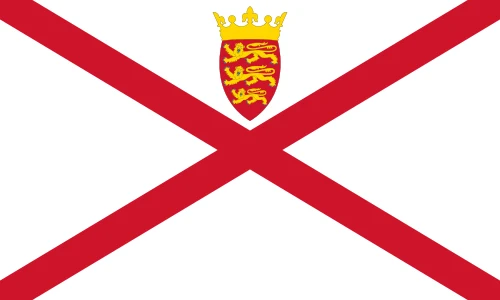
Jersey — the saltire nobody can explain
Jersey’s red saltire on white carries the island’s badge — the three leopards of England beneath a Plantagenet crown — added in 1981. Before that the plain saltire had been flown for roughly a century with no official status whatever, and where it came from is unknown. The most entertaining theory, proposed in 1951, holds that a Dutch flag chart labelled a red saltire Ierse, Dutch for Irish, which an English compiler misread as “Jersey”, so that the island adopted Saint Patrick’s cross in good faith. The theory is weakened by French Admiralty charts showing Jersey using the saltire before the English book that supposedly caused the error, and one historian argues the mistake ran the other way entirely.
A neater possibility is that the two saltires are cousins. Saint Patrick’s cross is commonly identified with the FitzGerald arms, and the FitzGeralds held land in Jersey as well as in Ireland. The 1981 redesign had three documented motives, and one of them was navigational: a plain red saltire on white is the international code flag V, meaning “I require assistance”. The new flag was approved by the States in 1979 by all but two votes, proclaimed by the Queen in December 1980, and first hoisted on 7 April 1981, in the bicentenary year of the Battle of Jersey.
Saltires of War and Memory
Three diagonals born of conflict, and the group that still provokes argument today. One was chosen precisely so that a flag would look less religious.
c. 1836
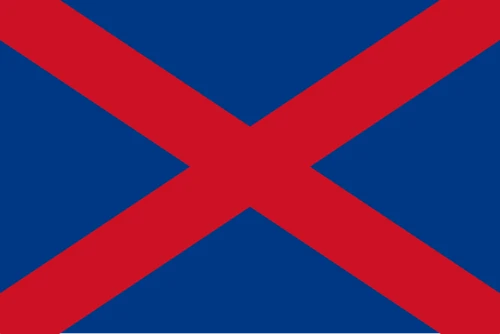
The Voortrekker Kruisvlag
The Voortrekker flag — the Kruisvlag, or Potgieter flag — is a red saltire on blue, associated with the parties who followed commandant-general Andries Hendrik Potgieter during the Great Trek. That association is received tradition rather than documented fact: the standard sources hedge, no surviving original is cited, and no contemporary depiction from the 1830s is produced. No authoritative explanation of its colours exists either, and the readings usually offered — blood, loyalty, Christian faith — are retrospective inventions.
It had one brush with official status. When Britain recognised the South African Republic in 1852 the new state had neither arms nor flag; the Vierkleur filled the gap in 1857. In October 1874 the Volksraad voted to replace it with a version of the old Voortrekker saltire, fimbriated white, then reversed the decision in May 1875 — partly because the result was felt to look too much like the Union Jack, an awkward resemblance for a republic founded on escaping British rule.
One point must be stated precisely. The flag ruled by a South African court in 2019 to constitute hate speech when displayed gratuitously is the national flag of 1928–1994, which contains no saltire. The Kruisvlag was not covered by that judgment.
1861
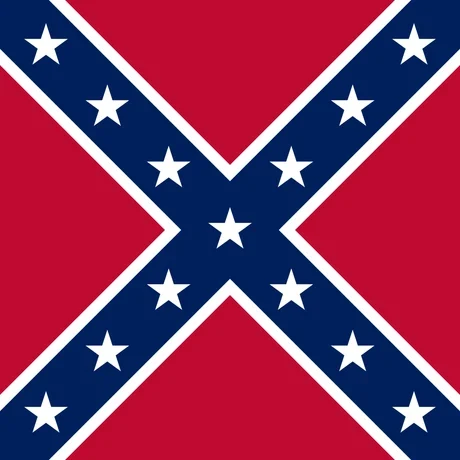
The Confederate battle flag — chosen to be less Christian
The Confederate battle flag is the sharpest irony in the whole subject: its saltire was chosen precisely in order to be less Christian, and later generations turned it into a saint’s cross. The design began as William Porcher Miles’s proposal for a national flag, an upright blue cross on red. Charles Moise, a South Carolinian who described himself as a southerner of the Jewish persuasion, wrote asking that the symbol of one religion not be made the symbol of a nation. Miles revised the design, tilting the cross to a diagonal. Congress rejected it anyway and adopted the Stars and Bars; the saltire reached the field only after the confusion of First Manassas, when Beauregard needed a flag his troops could tell apart in the smoke.
Miles set out his reasoning in a letter to Beauregard of 27 August 1861. The diagonal avoided the religious objection “from the Jews & many Protestant sects” because it did not stand out so conspicuously, and it was “more Heraldric than Ecclesiastical, it being the ‘saltire’ of Heraldry”. He even reached for the etymology, deriving it from the Latin salto, to leap — the right root, though “significant of strength and progress” was his own invention. Saint Andrew he never mentioned. The historian John Coski, the flag’s leading scholar, concludes that few Confederates saw a Saint Andrew’s cross in it at the time, and that its religious meaning was imposed by later generations.
Two further points are worth stating plainly. The square battle flag was never a national flag of the Confederacy: it served as the canton of the second and third national flags, and the rectangular version flown today derives from the naval jack. And it is not the “Stars and Bars”, which is the quite different first national flag that beat Miles’s design in 1861. The flag carries a heavy and contested modern history, having been taken up by segregationist and later white-supremacist movements; Georgia removed it from its state flag in 2003 and Mississippi in 2020.
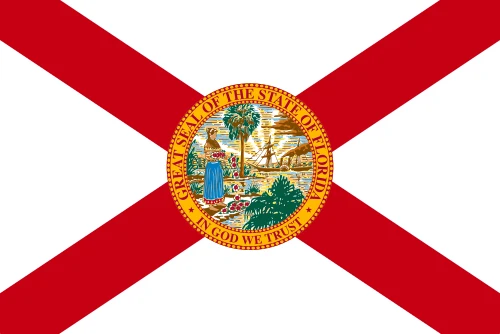
1900
Florida — a saltire with no paper trail
Florida’s red saltire was added to a plain white flag bearing the state seal by a constitutional amendment that passed the legislature unanimously in 1899 and was ratified by the voters on 6 November 1900, by 5,088 votes to 3,819. The statute is precise about geometry — bars one-fifth of the hoist, running from each corner to the rim of the seal, which strictly makes it a saltire interrupted rather than a continuous X — and silent about meaning.
The best-known explanation is that former governor Francis P. Fleming urged the bars so the banner would not resemble a white flag of surrender when hanging limp. It is a good story with a thin evidential base: it comes from a 1936 letter by an attorney who reached the conclusion by asking around, thirty-seven years after the fact, and no Fleming papers confirm it. Florida did not preserve legislative documents created before 1969, so the ordinary tools for establishing intent simply do not exist. Historians divide. One notes that the change coincided with the disenfranchisement of African Americans and new segregation laws, and that other ex-Confederate states adopted new flags in the same years; specialists in Florida history reply that they have seen no specific evidence linking this flag to the Confederate one. As with Alabama, the Spanish Cross of Burgundy is a third candidate, resting on resemblance alone.
Frequently Asked Questions
What is a saltire?
A saltire is a diagonal cross, shaped like the letter X, running from corner to corner. In heraldry it is one of the honourable ordinaries, formed by a bend and a bend sinister of equal width conjoined. Its technical name is a crux decussata, and it is also called the Cross of Saint Andrew. The word comes from the Old French sautoir, meaning a stirrup or a crossed frame for vaulting a horse, from Latin saltatorium - nothing to do with Christianity in origin.
Is the saltire the same thing as St Andrew's cross?
Not always. The two names are used interchangeably in everyday speech, but the saltire is a geometric shape far older than its association with the apostle, and it was in use as a heraldic ordinary before it was firmly his attribute. Twelve of the twenty-four flags gathered here carry Saint Andrew's cross proper, whether by blazon, by statute or by direct inheritance. The other twelve took up the same diagonal for reasons of their own: dividing a field into four, distinguishing a new nation's flag, marking a region, or - in one case - making a banner look less religious.
Was Saint Andrew really crucified on an X-shaped cross?
Almost certainly not. The earliest surviving accounts, including the version of the Acts of Andrew known to Gregory of Tours in the sixth century, describe him as bound, not nailed, to an ordinary Latin cross. The first depictions of an X-shaped cross appear only in the tenth century, the saltire becomes his fixed heraldic attribute in the fifteenth and sixteenth, and the X becomes the artistic standard only in the seventeenth. The explanation that he asked for a different cross because he felt unworthy to die as Jesus did is a late gloss, not an early source statement.
What is the difference between a saltire and a field divided per saltire?
A saltire is a charge laid on the field, like Scotland's white cross on blue. A field divided per saltire has no cross drawn on it at all: the two diagonals cut the field into four triangles which are then coloured separately. Grenada and the first flag of Peru are divided per saltire. Jamaica and Burundi, by contrast, carry a genuine saltire band. A third case, charges arranged in saltire, means objects such as swords or keys laid crosswise.
Which national flags have a saltire?
Among sovereign states, Jamaica has a gold saltire, Burundi a white one, and Grenada has a field divided per saltire. The United Kingdom's Union Flag contains two: Saint Andrew's white saltire for Scotland and Saint Patrick's red saltire for Ireland. Beyond national flags the saltire is common at every other level, from Scotland and Nova Scotia to Alabama, Florida, Amsterdam, Rio de Janeiro, Tenerife and Jersey.
Why does the Confederate battle flag use a diagonal cross?
Because its designer wanted it to look less religious. William Porcher Miles first proposed an upright cross, then tilted it to a diagonal after Charles Moise, a Jewish South Carolinian, objected to making the symbol of one religion the symbol of a nation. Miles explained in a letter of 27 August 1861 that the diagonal was more heraldic than ecclesiastical. He never mentioned Saint Andrew; that reading was attached to the flag by later generations.
Do the three crosses on Amsterdam's flag mean anything rude?
No. The three saltires are documented from about 1350, roughly six centuries before XXX came to mean pornography through twentieth-century American film ratings. The two are entirely unconnected. The crosses most likely derive from the arms of the Persijn family, lords of Amsterdam in the 1280s. The other popular story, that they ward off flood, fire and plague, is also false: the arms are older than the arrival of the Black Death in Europe.
Sources & Further Reading
- Parker, J., A Glossary of Terms Used in Heraldry — the saltire, its diminutives and the rule on couping
- Coski, J. M., The Confederate Battle Flag: America’s Most Embattled Emblem, Harvard University Press, 2005 — the Miles correspondence and the Moise objection
- Flags of the World (FOTW) / CRW Flags — Gascony, Jersey, Tenerife, the Voortrekker flags, the Belgian naval ensign
- The Flag Institute, UK Flag Registry — Scotland, the Union Flag, Saint Patrick’s saltire
- Hoge Raad van Adel — the arms and flag of Amsterdam
- Alabama Act No. 383 (1895); Florida Statutes § 15.012; Fortaleza Municipal Law No. 1,316 (1958); Constitution of Burundi, Article 8
- Government of Grenada, National Symbols; Jamaica Information Service, the National Flag
- Bower, W., Scotichronicon (1440s), and the St Andrews foundation legends — on the Athelstaneford tradition
Flag images are in the public domain except two, reproduced under Creative Commons Attribution-ShareAlike licences: the banner of the Dukes of Burgundy (Oren neu dag) and the Basque Ikurriña (Daniele Schirmo).
Last reviewed by the Emblema Mundi editorial team on 19 July 2026.