Ceremonial county of England · Celtic nation
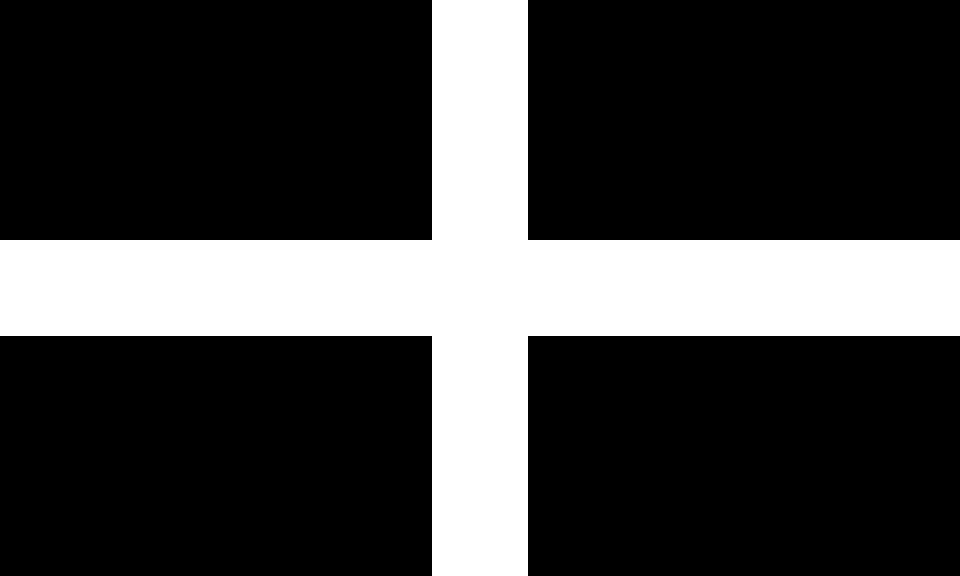
The flag of Cornwall (Cornish: Kernow) is Saint Piran’s Flag — a plain white cross on a black field, one of the most recognisable regional banners in Britain. It is named for Saint Piran, the patron saint of Cornish tin miners, and its colours are traditionally read as the white metal of tin shining out of the black ore — the mining that made Cornwall. First set down in writing in 1838, the flag became, over the 20th century, the emblem of a people who count themselves a Celtic nation alongside their cousins in Brittany and Wales. Cornwall’s older heraldry — the fifteen gold bezants of the Duchy — tells a parallel story of princes and tin revenue.
Click on a country to learn more
| Territory | Cornwall (Cornish: Kernow) |
|---|---|
| Status | Ceremonial county of England; the Cornish recognised as a national minority (2014) |
| Flag | Saint Piran’s Flag (Baner Peran) — white cross on black |
| Blazon | Sable, a cross Argent |
| Proportion | 3:5 |
| First recorded | Davies Gilbert, The Parochial History of Cornwall, 1838 |
| Attributed to | Saint Piran (Peran), 5th–6th-century abbot, patron of tin miners |
| Flag day | St Piran’s Day, 5 March |
| Motto | Onen hag Oll (“One and All”) |
| Historic arms | Sable, fifteen bezants (Duchy of Cornwall) |
| Celtic nation | One of six, with Brittany, Wales, Scotland, Ireland and the Isle of Man |
Saint Piran’s Flag — Sable, a cross Argent: a white cross throughout on black. The banner of the tin miners and the flag of Cornwall.
Sable, a cross Argent — a white cross throughout on a black field, in the proportion 3:5.
The design is one of the simplest in the British Isles: a single white cross reaching the edges of a black flag. Its power lies less in its heraldry than in what the Cornish read into the two colours.
| Colour | Heraldic name | Element | Traditional reading |
|---|---|---|---|
| Black | Sable | The field | The dark ore and rock of the mine; the earth from which tin is drawn |
| White / silver | Argent | The cross | The white metal of tin; the Christian cross of Saint Piran |
The reading was recorded by Davies Gilbert in The Parochial History of Cornwall (1838), the flag’s earliest documented mention: “a white cross on a black ground [that] was formerly the banner of St Perran and the Standard of Cornwall; probably with some allusion to the black ore and the white metal of tin.” Gilbert wrote from recollection, without an older source, so the tin symbolism is tradition rather than proven origin — but it has been inseparable from the flag ever since.
Saint Piran (Cornish Peran) was a 5th–6th-century abbot, held by tradition to have come from Ireland and to have crossed the sea to settle in the dunes of Perranzabuloe (“St Piran-in-the-Sands”) on Cornwall’s north coast, where the remains of his ancient oratory still lie beneath the sand. He is the patron saint of Cornwall and, above all, of its tin miners.
The founding legend ties the saint directly to the flag: heating his black hearth-stone — which happened to be rich in tin ore — Piran saw a white cross of molten tin run out across the black rock. He is said thereby to have “rediscovered” the smelting of tin, the trade on which Cornwall’s wealth was built, and to have given the county its black-and-white cross.
Saint Piran’s Flag is the exact colour negative of the old Breton Kroaz Du — a black cross on a white field. The kinship is not a coincidence: the Cornish and the Bretons are both Brittonic Celtic peoples, and the Saint-Pezran family of Cornouaille in Brittany bore matching arms — a white cross on black — recorded from the 15th century. The two banners face each other across the Channel like a photographic plate and its print.
Though the tradition is old, the flag’s rise as a modern national symbol belongs to the 20th century, carried by the Cornish cultural revival and by the party Mebyon Kernow (“Sons of Cornwall”, founded 1951). Today the flag is flown from Cornwall Council buildings, appears at Cornish gatherings worldwide, and is entered on the Flag Institute’s registry of United Kingdom flags. A stained-glass window in Westminster Abbey, unveiled in 1888 in memory of the Cornish engineer Richard Trevithick, already showed Saint Piran holding his cross.
St Piran’s Day (Gool Peran), on 5 March, is Cornwall’s national day. Thousands walk across the dunes to the saint’s oratory, a play of his life is performed, and the black-and-white flag is everywhere; the week before is fondly called Perrantide.
Alongside the flag, Cornwall carries an ancient coat of arms: Sable, fifteen bezants — fifteen gold roundels on a black shield, arranged as a descending triangle (5, 4, 3, 2, 1). The bezants (named for the gold coins of Byzantium) derive from the 13th-century arms of Richard, Earl of Cornwall (1209–1272), brother of Henry III and elected King of the Romans; one scholarly reading takes them as a pun on the French pois (peas) for Poitou, of which he was count.
When Edward III created the Duchy of Cornwall in 1337 — the first duchy in England, endowed on his son the Black Prince and ever since the title of the heir to the throne — the fifteen bezants became its arms. The same gold discs run through Cornish civic heraldry and stand behind the county motto Onen hag Oll, “One and All.” Popular legend prefers other tales — fifteen ransomed knights, or the balls of Cornish pawnbrokers — but the coins-of-Poitou reading is the one heralds favour.
Cornwall is administratively a ceremonial county of England, but its identity reaches back to the Britons who held the south-west after the Anglo-Saxon settlement of England. Its language, Cornish (Kernewek), is a Brittonic tongue close to Breton and Welsh; it fell out of everyday use around 1800 and has since been revived. Cornwall is counted as one of the six Celtic nations, with Brittany, Wales, Scotland, Ireland and the Isle of Man.
On 24 April 2014 the UK government recognised the Cornish as a national minority under the Council of Europe’s Framework Convention for the Protection of National Minorities — the same standing accorded to the Scots, Welsh and Irish. Against that background, Saint Piran’s black-and-white cross is flown not merely as a county badge but as the banner of a distinct people.
Saint Piran’s Flag is a white cross on a black field, attributed to Saint Piran, the patron saint of Cornish tin miners. The traditional reading, first written down by Davies Gilbert in 1838, is that the white cross stands for the white metal of tin and the black field for the dark ore from which it is smelted — the mining that shaped Cornwall.
Saint Piran (Cornish Peran) was a 5th–6th-century abbot, by tradition of Irish origin, who settled at Perranzabuloe on Cornwall’s north coast. He is the patron saint of Cornwall and of tin miners; legend says he rediscovered tin-smelting when a white cross of molten metal ran from the black stone of his hearth.
St Piran’s Day falls on 5 March, the Cornish national day, marked by parades and the flying of the flag. The week before is nicknamed “Perrantide.”
Saint Piran’s Flag (white cross on black) is the colour negative of the old Breton Kroaz Du (black cross on white). The Cornish and the Bretons are both Brittonic Celtic peoples, and the Saint-Pezran family of Cornouaille in Brittany bore a matching white-cross-on-black from the 15th century.
They are the fifteen bezants — gold roundels — blazoned Sable, fifteen bezants. They come from the 13th-century arms of Richard, Earl of Cornwall, and became the arms of the Duchy of Cornwall, created in 1337. They are tied to the Cornish motto Onen hag Oll, “One and All.”
Yes — Cornwall is counted as one of the six Celtic nations, with Brittany, Wales, Scotland, Ireland and the Isle of Man, and has its own Brittonic language, Cornish. In 2014 the UK recognised the Cornish as a national minority. Administratively it is a ceremonial county of England.
Last reviewed by the Emblema Mundi editorial team on 12 July 2026.