Region
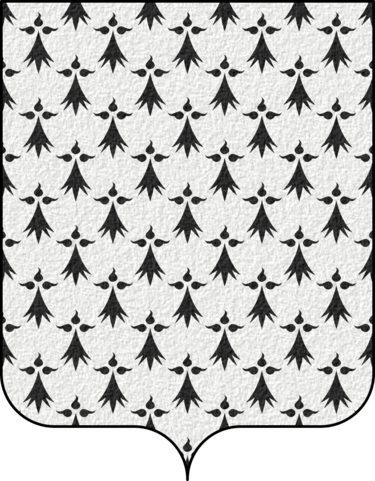
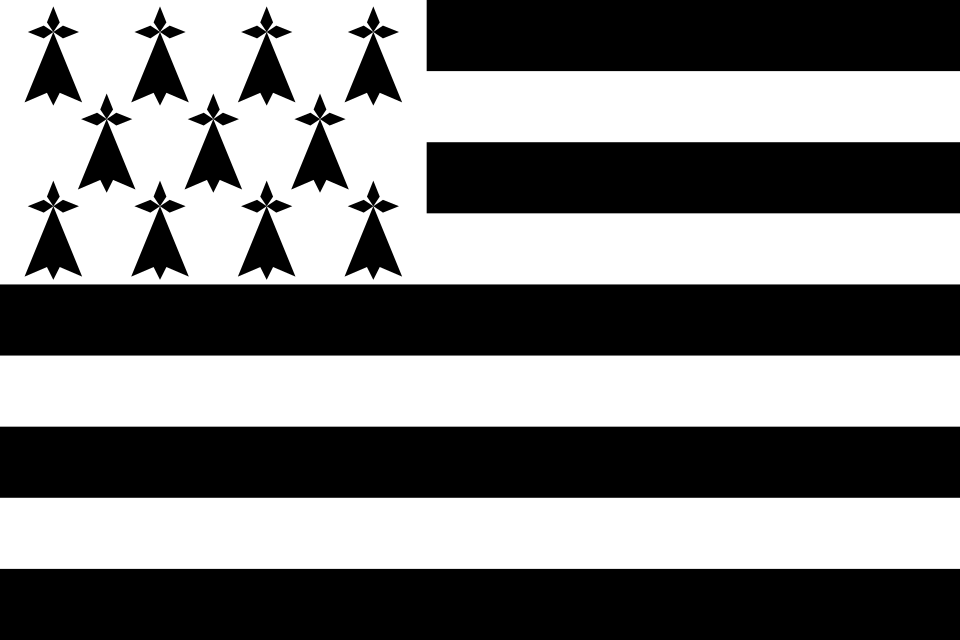
The coat of arms of Brittany — Ermine plain — is one of the shortest blazons in European heraldry and one of its most instantly recognisable. Paired with the Gwenn-ha-Du flag of 1923, it forms a visual identity that has survived the duchy, the kingdom of France, and the Republic without modification.
Flag
Not available
Coat of Arms
Not available
| Region | Brittany (Bretagne / Breizh), France |
|---|---|
| Coat of arms adopted | 1316, under Duke Jean III « le Bon » |
| Flag adopted | 1923, designed by Morvan Marchal |
| Blazon | Ermine plain |
| Tinctures | Argent, Sable (fur of ermine) |
| Motto (Latin) | Potius mori quam foedari |
| Motto (Breton) | Kentoc'h mervel eget bezañ saotret |
| Translation | "Rather death than dishonour" |
Coat of Arms — Ermine plain.
Plain Ermine.
The arms of medieval Brittany consisted entirely of the heraldic fur ermine: a white field semé of black mouchetures representing the tails of stoats in their winter coat. The blazon required no additional charge, partition, or ornament.
Within the heraldic tradition, where arms were typically built from combinations of colours, metals, and figures, Brittany's choice was exceptional. Rather than using ermine as a decorative element, the duchy made the fur itself its complete sovereign emblem.
Few medieval arms achieved such simplicity while remaining so immediately identifiable. The ermine shield became inseparable from Breton identity and remains one of the most enduring symbols of Brittany today.
Before 1213 — The House of Dreux. The early dukes of Brittany were Capetian cadets of the House of Dreux, whose arms were Checky Or and Azure, a bordure Gules.
1213 — Pierre « Mauclerc » and the canton of ermine. When Pierre de Dreux (« Mauclerc ») married Alix, heiress of Brittany, and took the ducal title, he adopted the Dreux arms with a canton of ermine (franc-quartier d'hermine) in the dexter chief — a heraldic difference marking his accession to a new dignity. The canton was the first appearance of the fur on Breton heraldry.
1316 — Jean III and the ermine plain. Under Duke Jean III « le Bon », the Dreux quarters disappear entirely. The shield becomes ermine plain: nothing but the fur. This simplification was probably political — a visual claim to Brittany's independence from any Capetian filiation.
1532 — Union with France. The Edict of Vannes united the Duchy of Brittany to the French Crown. Unlike many absorbed provinces, Brittany kept its arms unchanged. The ermine continued to appear on royal acts concerning the province until 1789.
1789–today — Republic and Region. Abolished as an official emblem in 1790, the ermine returned informally throughout the 19th century, was revived by the Breton cultural movement, and is today the heraldic emblem of the Région Bretagne and of countless Breton communes, schools, and sports clubs.
Two narratives circulate, and they should not be confused:
The legend is romantic and almost certainly post-medieval invention. But it crystallised the ermine's symbolism: purity, integrity, resistance — values still claimed by Breton identity today.
Flag — the Gwenn-ha-Du — Nine bands sable and argent, a canton ermine.
Designed in 1923 by the architect and Breton nationalist Morvan Marchal, the Gwenn-ha-Du ("white-and-black" in Breton) was deliberately modelled on the flag of the United States — Marchal saw the US flag as the universal modern emblem of a federation of peoples.
| Element | Meaning |
|---|---|
| 9 horizontal bands | The nine historic bishoprics of Brittany |
| 5 black bands | The Romance-speaking (Gallo) dioceses: Dol, Nantes, Rennes, Saint-Brieuc, Saint-Malo |
| 4 white bands | The Breton-speaking dioceses: Cornouaille, Léon, Trégor, Vannetais |
| Canton | Argent semé of 11 ermine spots — the historic ducal arms |
| Ratio | Variable; commonly 3:5 |
The flag was banned during Vichy and discouraged after 1945, but spread through Breton festivals from the 1960s. Since the 2000s, it flies officially on the Région Bretagne's buildings and, since 2014, on the Préfecture de Région. It now appears on regional licence plates, school crests, sports clubs, and the French Navy's Frégate Bretagne.
The modern Région Bretagne comprises four departments, each with its own heraldry incorporating elements of the ducal arms:
For the historic Breton-speaking pays (bro) — the cultural rather than administrative subdivisions, each with its own emblem — see the dedicated Breizh historical atlas.
Because it is ermine, a heraldic fur, not a colour pattern. It represents the winter coat of the stoat, whose tail-tips remain black. Brittany is the only European sovereign polity to bear arms wholly composed of a fur.
Morvan Marchal, a Breton architect and nationalist, in 1923. He explicitly modelled it on the flag of the United States, replacing the stars with ermine spots and the stripes' colours with the diocesan symbolism.
The five black stripes represent the historic French-speaking (Gallo) dioceses of Brittany — Dol, Nantes, Rennes, Saint-Brieuc, Saint-Malo. The four white stripes represent the Breton-speaking dioceses — Cornouaille, Léon, Trégor, Vannetais.
Almost certainly not. The story appears only from the 16th century, well after Anne's lifetime, and shows the structure of a moralising fable. The ermine had been Brittany's emblem for over a century before Anne was born — since 1316. The legend is a post-medieval reading of an older symbol, not its origin.
The Edict of Vannes (1532) formally united the Duchy of Brittany to the French Crown. The arms were retained, an unusual privilege among incorporated provinces.
Last reviewed by the Emblema Mundi editorial team on 14 June 2026.
Brittany is the only Celtic nation outside the British Isles — see the Gwenn-ha-Du and the ermine beside the emblems of Wales, Scotland, Ireland, Cornwall and the Isle of Man.