Crown Dependency
The national emblems of the Isle of Man compress one of the oldest continuously-used devices in Europe into a single graphic idea. The Three Legs of Man (tre cassyn, a triskelion of armoured legs conjoined at the thigh) has been the mark of the island since the mid-13th century, when it replaced the Norse galley on the seals of the Kingdom of Mann and the Isles. The flag is simply the shield of arms, hoisted as a banner. Both were fixed in their present form by royal warrant of Queen Elizabeth II on 12 July 1996. The Isle of Man is not part of the United Kingdom but a self-governing Crown Dependency, home to Tynwald, which is often described as the oldest continuously-functioning parliament in the world.
Flag
Not available
Coat of Arms
Not available
| Territory | Isle of Man (Ellan Vannin / Mannin) |
|---|---|
| Status | Self-governing Crown Dependency — not part of the United Kingdom, never part of the European Union |
| Head of state | The British monarch, in the capacity of Lord of Mann |
| Parliament | Tynwald — traditionally founded c. 979; open-air ceremony each 5 July at Tynwald Hill |
| Coat of arms & flag | Royal warrant of 12 July 1996; earlier warrants 1932 and 1971 |
| Central charge | Three armoured legs Argent, conjoined at the thigh, in a triskelion |
| Motto | Quocunque Jeceris Stabit — “Wheresoever you throw it, it will stand” |
| Tinctures | Gules, Argent, Or |
| Flag ratio | 1:2 |
| Subdivisions | 6 historic sheadings + 17 modern parishes |
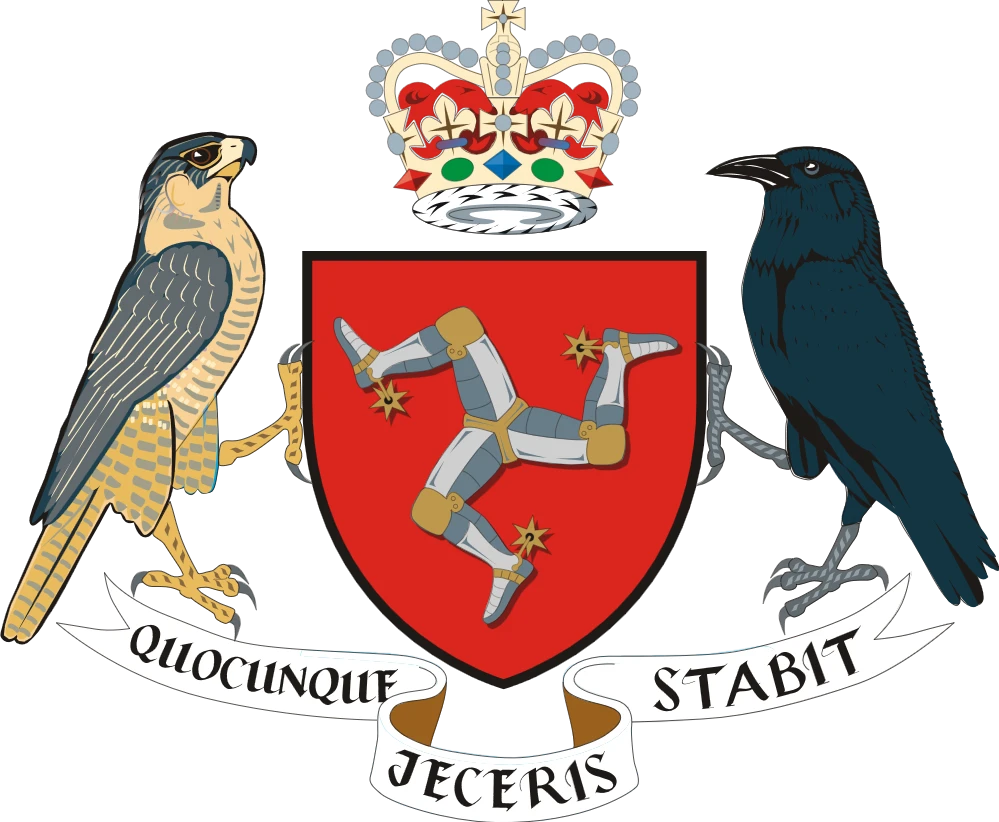
Coat of Arms of the Isle of Man — Gules, three armoured legs Argent conjoined in a triskelion; supported by a peregrine falcon and a raven; motto Quocunque Jeceris Stabit. Royal warrant of 12 July 1996.
Gules, three legs Argent conjoined in the fesse point at the upper part of the thighs, flexed in triangle, garnished and spurred Or. Supporters: to the dexter, a peregrine falcon; to the sinister, a raven, both proper. Above the shield, an imperial crown proper. Motto: Quocunque Jeceris Stabit.
The composition is one of the most distinctive in European heraldry. Unlike the lion, eagle or cross that dominate national arms, the Manx charge is a triskelion of human legs — a pre-heraldic solar motif absorbed into heraldic vocabulary in the late medieval period.
| Colour | Heraldic name | Element | Traditional symbolism |
|---|---|---|---|
| Red | Gules | Field | The colour of the seal wax on the earliest surviving Manx impressions |
| Silver | Argent | Armour of the legs | Steel; sovereignty of the medieval Kings of Mann |
| Gold | Or | Spurs, garnishing, crown | Nobility; the tinsel of chivalric equipment |
The three-legged triskelion is not a medieval invention. It appears on Iron Age Celtic and Mycenaean-era artefacts, on Greek coinage of the 6th century BCE (notably at Aspendos in Pamphylia), and on the classical Sicilian trinacria, whose composition is visually identical to the Manx device.
Two hypotheses coexist for its arrival on Mann:
The scholarly consensus favours the first: independent adoption. The Sicilian and Manx traditions share a common iconographic ancestor rather than a direct genealogy.
9th–13th centuries — The Norse Kingdom. The Kingdom of Mann and the Isles is founded by Norse settlers. Earlier Manx seals show the drakkar galley of the Sudreys — the ship of the Norse-Gaelic sea-kings.
Mid-13th century — The Change of Charge. The galley is replaced by the three-legged triskelion. The earliest surviving instance is on the Manx Sword of State, held at the Tynwald ceremony, whose scabbard bears the earliest known depiction of the modern arms. The date is disputed; most authorities place it between 1250 and 1270, during the last decades of Norse rule.
1266 — Treaty of Perth: Norway cedes the Isles to the Kingdom of Scotland. The three legs are retained.
1333 — The lordship is granted to William Montagu, Earl of Salisbury; the three legs enter English aristocratic heraldry.
1405–1765 — The Stanley Period. Sir John Stanley and his heirs, later Earls of Derby, hold the Isle of Man as Lords of Mann. The arms are quartered with the Stanley eagle-and-child on Stanley personal usage; the plain triskelion remains the Manx state arms.
c. 1668 — The Motto. The motto Quocunque Jeceris Stabit appears on Manx coinage under Charles Stanley, 8th Earl of Derby — a play on the design: however you throw the three legs, they land upright.
1765 — The Isle of Man Purchase Act. Charlotte, Duchess of Atholl, sells sovereign rights to the British Crown; the arms are retained.
1866 — Home Rule restored to Tynwald.
1932, 1971 — Successive royal warrants confirm the arms and flag.
12 July 1996 — Royal warrant of Queen Elizabeth II fixes the modern composition: shield, crown, falcon and raven supporters, motto.
The 1996 warrant introduces two bird supporters:
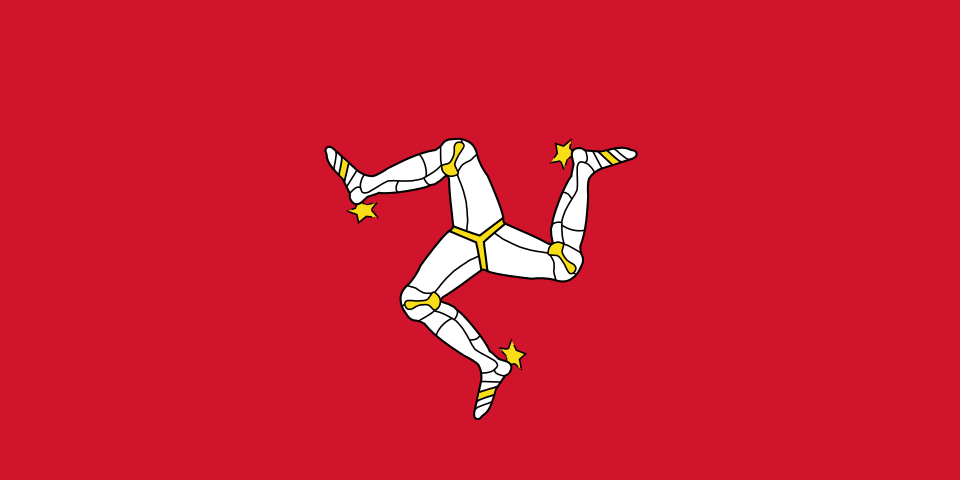
Flag of the Isle of Man — Gules, three armoured legs Argent conjoined in a triskelion. Ratio 1:2. Royal warrant of 12 July 1996.
The flag is a banner-of-arms — the shield of the coat of arms displayed on a rectangular ground. This form of derivation is common in medieval heraldry and is shared by, for example, the arms and flag of Austria and of Latvia.
The flag has been in continuous informal use for centuries. The 1932 royal warrant formalised it as a maritime ensign, and the 1971 warrant extended it to state use. The 1996 warrant confirmed both flag and arms in their present form. Tynwald’s Flags Act (Isle of Man) governs civil usage.
| Flag | Charge | Field | Note |
|---|---|---|---|
| Isle of Man | Triskelion of armoured legs | Gules | 13th c.; sole modern national flag with this charge |
| Sicily (regional) | Trinacria (three legs + Gorgoneion) | Or / Gules | Ancient Sicilian; parallel independent tradition |
| Brittany (Gwenn-ha-Du) — see also Brittany | Ermines | Argent, Sable | Distinct heraldic vocabulary |
The triskeles is one of the most widely-distributed pre-heraldic symbols in Europe. The Manx and Sicilian instances are the two surviving state emblems, but the motif appears in many other contexts:
| Tradition | Form | Period | Referent |
|---|---|---|---|
| Mycenaean Greece | Three-legged solar spiral | c. 1400 BCE | Solar deity |
| Iron Age Celtic (La Tène) | Triskeles of spirals or legs | c. 500 BCE–100 CE | Cosmological/solar motif |
| Aspendos (Pamphylia) | Three-legged triskelion on coinage | 6th c. BCE | Civic emblem |
| Sicilian trinacria | Three legs radiating from a Gorgoneion | Antique; state emblem since 1990 | Three capes of Sicily |
| Isle of Man | Three armoured legs, plain | Mid-13th c. onward | State charge of the Kingdom of Mann |
The Isle of Man is divided into six historic sheadings (from Old Norse skeið, an administrative district) and, since 1796, seventeen parishes. The sheadings are:
Sheading-level heraldry is largely modern and administrative rather than medieval. The parishes and towns carry a rich secondary heraldry: Douglas, Peel, Ramsey and Castletown each have distinct municipal arms granted by Manx authority.
The triskelion is a pre-heraldic solar symbol adopted by the medieval Kingdom of Mann and the Isles. It replaced an earlier Norse galley on Manx heraldry around the mid-13th century. The three-legged form is identical to the ancient Sicilian trinacria, but the two traditions almost certainly emerged independently from the wider triskeles common to pre-Christian European art.
The three legs appear on the Manx Sword of State from the mid-13th century and on the seals of the Kings of Mann. They were used continuously through the Stanley (Lords of Mann, 1405–1765) and Atholl periods. The modern form was formally granted by royal warrant of Queen Elizabeth II on 12 July 1996.
No. The Isle of Man is a self-governing Crown Dependency, in personal union with the British monarch in the capacity of Lord of Mann. It is not part of the United Kingdom, has never been part of the European Union, and has its own parliament, currency (the Manx pound) and laws.
It is Latin for “Wheresoever you throw it, it will stand” — a reference to the design of the triskelion, whose three legs always land in an upright position however the emblem is rotated. The motto appears on Manx coinage from around 1668 during the tenure of the Stanley Earls of Derby as Lords of Mann.
Tynwald is the parliament of the Isle of Man. Its name derives from Old Norse þingvöllr (assembly field), and it traces its origin to the Norse Kingdom of Mann around 979. It claims to be the oldest continuously-functioning parliament in the world; its open-air ceremony each 5 July at Tynwald Hill in St John’s has taken place for over a millennium.
Last reviewed by the Emblema Mundi editorial team on 5 July 2026.
The Isle of Man is one of the six Celtic nations — see the Three Legs of Man beside the emblems of Scotland, Wales, Ireland, Brittany and Cornwall.