Country
The national emblems of Greece reduce two millennia of civic and religious imagery to a single graphic idea: a plain white cross on an azure field. The coat of arms encloses the cross in a laurel wreath, the classical crown of civic honour; the flag multiplies the same tinctures into nine blue-and-white stripes with the cross on a canton. Both trace directly to the acts of the First National Assembly at Epidaurus in January 1822, in the second year of the Greek War of Independence.
Flag
Not available
Coat of Arms
Not available
| Country | Hellenic Republic (Ελληνική Δημοκρατία) |
|---|---|
| Coat of arms adopted | 7 June 1975 (Law 48/1975) — current form; heraldic root at Epidaurus, 1822 |
| Flag adopted | 13 January 1822 (Epidaurus); current unified design fixed by Law 851/1978 |
| Flag ratio | 2:3 |
| Tinctures | Azure and Argent |
| Central charge | Greek Cross Argent on an azure field, within a laurel wreath |
| Colloquial name (flag) | Kyanolefki (“Blue-and-White”) |
| Number of stripes | 9 — traditionally read as the syllables of Eleftheria i Thanatos |
| Subdivisions | 13 administrative regions + Mount Athos (autonomous monastic state) |
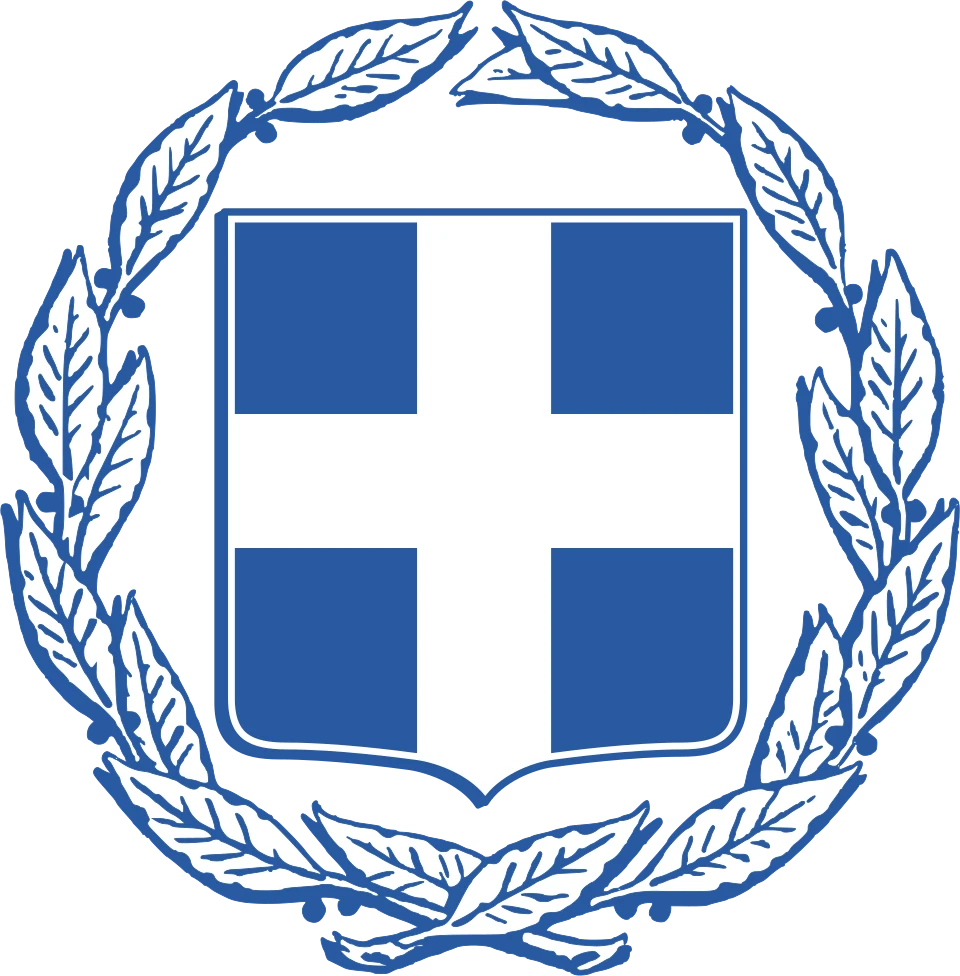
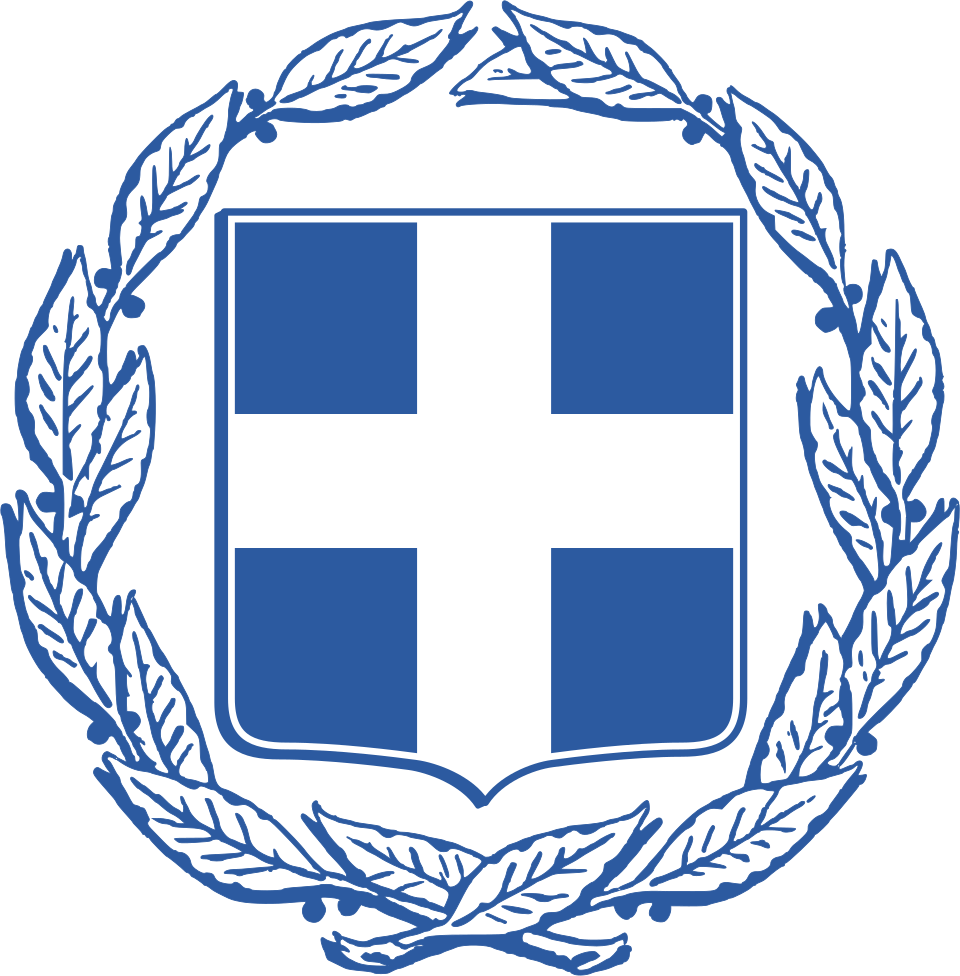
Coat of Arms of Greece — Azure, a Greek cross Argent, the shield surrounded by two laurel branches Vert. Adopted 7 June 1975 (Law 48/1975).
Azure, a Greek cross Argent, the shield of the same form and tincture as the national flag’s canton, surrounded by two branches of laurel Vert bound in base.
The composition is deliberately stripped-down. No crown, no supporters, no chief of augmentation. The shield reproduces exactly the canton of the flag, and the wreath is the only concession to external ornament — a design decision that stakes out a distinctly republican and civic identity in contrast to the monarchical arms it replaced.
| Colour | Heraldic name | Element | Traditional symbolism |
|---|---|---|---|
| Blue | Azure | Field | The sea and sky of the Aegean and Ionian; continuity with the shield fixed at Epidaurus |
| White | Argent | Greek cross | Eastern Orthodox Christianity, the prevailing religion under Article 3 of the Constitution |
| Green | Vert | Laurel branches | Civic honour, victory; the Pythian crown of classical antiquity |
13 January 1822 — Epidaurus. The First National Assembly of the emerging Greek state adopts a shield with a white cross on a blue field. This is the direct ancestor of every subsequent Greek arms.
30 April 1832 — The Wittelsbach Arms. Following the London Conference, Otto of Bavaria is installed as first King of the Hellenes. The royal arms combine the Bavarian lozenges (Argent and Azure, lozengy) with the Greek cross on an inescutcheon — a compromise between dynastic origin and national symbol.
1863 — The Danish Successor. Under George I, the Wittelsbach lozenges are replaced by the Danish arms of the House of Glücksburg (three lions and hearts), with the Greek cross retained on the inescutcheon and supporters added — two Hercules figures with clubs.
1925–1935 — The Second Hellenic Republic. After the deposition of the monarchy, the arms are reduced to the shield alone, surrounded by a laurel wreath. This is the first appearance of the modern composition; the dynastic charges and supporters are dropped entirely.
1935–1973 — Restored Monarchy. The Danish-Greek arms with supporters are reintroduced.
1967–1974 — The Junta. The military regime experiments with variants including a stylised eagle-and-phoenix arising from flames, but the shield with the cross is never wholly displaced.
8 December 1974 — Referendum. Greeks vote 69 to 31 per cent to abolish the monarchy. The Republic is proclaimed.
7 June 1975 — Law 48/1975. The current arms are enacted: the shield of Epidaurus set within a plain laurel wreath, without crown, dynasty or supporters. It has remained unchanged since.
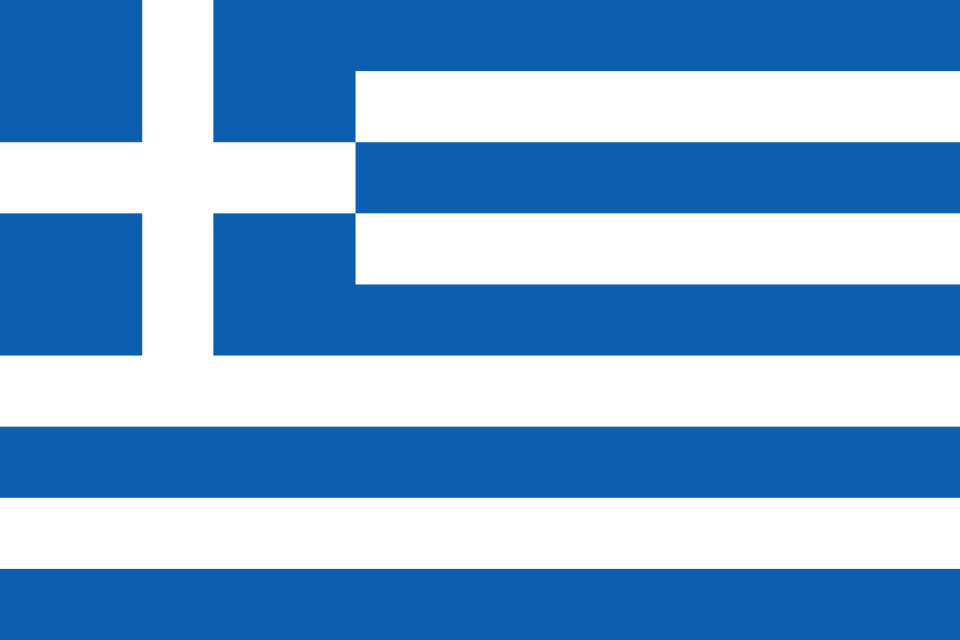
Flag of Greece — Nine equal horizontal stripes alternating azure and argent; on a canton azure, a Greek cross throughout argent. Ratio 2:3. Adopted at Epidaurus, 13 January 1822; unified by Law 851/1978.
During its opening session on 13 January 1822 (Old Style), the First National Assembly of Epidaurus approved a decree defining three emblems for the nascent Greek state: a land flag bearing a plain white cross on a blue field; a naval ensign (the striped, cantoned design familiar today); and a distinct merchant-marine variant. The decision drew on flags already flown by the ships of Spetses, Hydra and Psara during the first years of the uprising.
Between 1822 and 1978, Greece maintained the unusual practice of using two national flags in parallel: the striped cross-in-canton at sea and abroad, the plain cross-on-blue on land. Successive regimes alternated which took precedence:
| Period | Land flag | Sea & state flag |
|---|---|---|
| 1822–1969 | Plain cross on blue | Nine stripes with canton |
| 1970–1975 (junta) | Nine stripes with canton, deepened blue | Same |
| 1975–1978 | Plain cross on blue restored | Nine stripes with canton |
| From 22 December 1978 | Nine stripes with canton — single national flag | |
Law 851/1978, promulgated three years into the Metapolitefsi, dissolves the distinction. The striped design becomes the sole national flag on land, sea, and abroad. The plain cross survives only as the canton itself and as the shield of the coat of arms.
No statute fixes the meaning of the number. Two traditional readings coexist:
Both are 19th-century folk glosses. The Epidaurus decree of 1822 gives no rationale; the choice of nine stripes, five blue and four white, appears to have been drawn from the ensigns already flown by the merchant fleets of the Aegean islands, whose maritime origin explains the striped format itself.
The Greek blue is one of the least fixed tinctures in modern European vexillology. Nineteenth-century flags used a pale sky-blue; state usage darkened progressively after 1863; during the Colonels’ regime (1967–1974) a saturated navy became standard. Presidential Decree 515/1980 issued a general chromatic specification but no single Pantone value, and to this day military, diplomatic and civil usages show visible variation.
Greece belongs to a small European family of flags built around a plain Christian cross on a coloured field. Compared to its cousins, it is the only one to combine the cross with a striped body:
| Flag | Cross type | Position | Field |
|---|---|---|---|
| Greece | Greek cross (equal arms) | Canton, plus 9 stripes | Azure and Argent |
| Denmark (Dannebrog) | Scandinavian cross | Full field, off-centre | Argent on Gules |
| Norway, Sweden, Finland, Iceland | Scandinavian cross | Full field, off-centre | Nordic tinctures |
| Switzerland | Greek cross | Centre, on a square | Argent on Gules |
| Georgia | St George’s cross + four bolnisi crosses | Full field | Gules on Argent |
Greece is the only member of the group to have retained a distinct maritime striped format rooted in a merchant-marine tradition, rather than the medieval Scandinavian or Swiss cross-of-honour patterns.
Under the Kallikratis reform of 2010, Greece is divided into 13 administrative regions (peripheries), together with the Autonomous Monastic State of Mount Athos, whose civil administration is governed by a distinct constitutional regime. Each region carries its own emblem, often layering classical, Byzantine and modern Hellenic elements:
Click on Greece on the interactive map above to browse the emblems of the thirteen regions.
No statute fixes the meaning of the number. Two traditional readings coexist: the nine syllables of the motto Eleftheria i Thanatos (“Freedom or Death”) and the nine letters of Eleutheria (“Freedom”). Both are 19th-century folk glosses; the Epidaurus decree of 1822 gives no rationale, and the striped format itself derives from the ensigns of the Aegean merchant fleets.
It is the Greek Cross — a plain cross with arms of equal length — identifying the state with Eastern Orthodox Christianity, named as the prevailing religion under Article 3 of the Constitution. The same charge appears alone on the coat of arms.
The First National Assembly at Epidaurus fixed both the striped naval ensign and the plain-cross land flag on 13 January 1822. The current unified form — where the striped design is the single national flag on land, sea and abroad — was fixed by Law 851/1978, replacing the parallel land/sea usage that had prevailed for 156 years.
The laurel (daphne) recalls the classical Greek crown of victory awarded at the Pythian Games, and by extension the crown of civic honour. It replaced the royal supporters and crown of the monarchical arms, and was introduced under the Second Hellenic Republic in 1925 before being confirmed after the Metapolitefsi by Law 48/1975.
Presidential Decree 515/1980 gives a general chromatic specification but does not name a single Pantone value. The shade has varied considerably: pale sky-blue in the 19th century, deepened to navy under the Colonels (1967–1974), standardised as a mid-range azure since 1978. Variation is still visible across state, military and civil usages.
Last reviewed by the Emblema Mundi editorial team on 5 July 2026.