Country
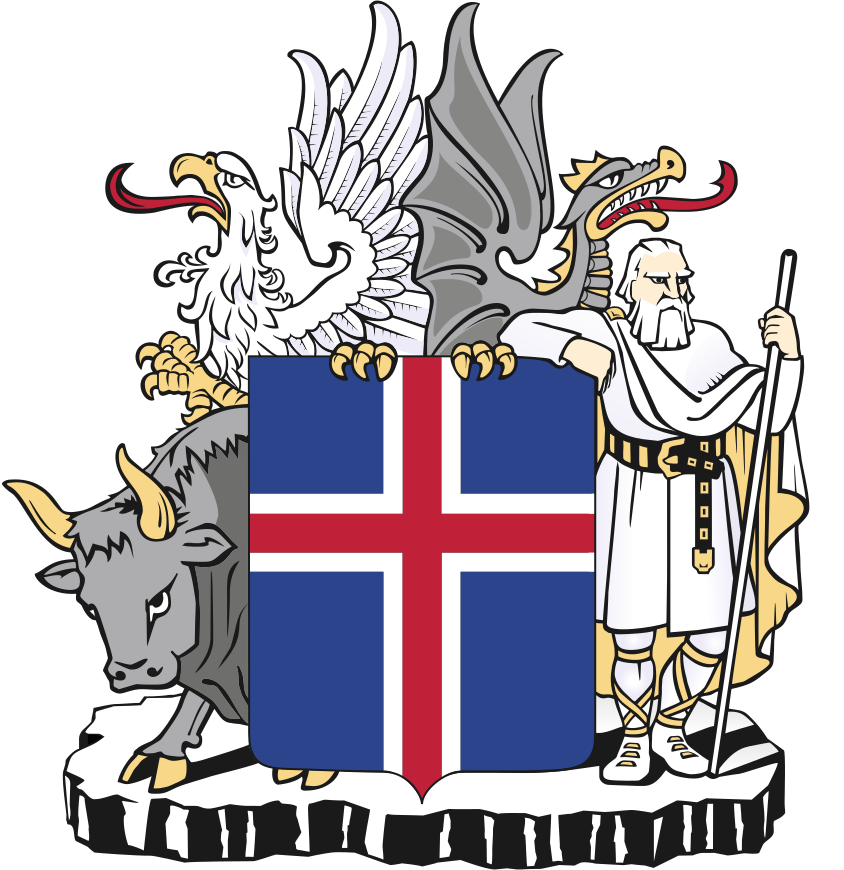
Iceland holds a unique distinction in world heraldry: it is the only nation whose coat of arms has four supporters. The four landvættir — a bull, an eagle, a dragon, and a rock-giant — stand guard over the island’s four quadrants, just as Snorri Sturluson described them in the Heimskringla eight centuries ago. At the centre of the shield, a red cross edged in silver on blue mirrors the national flag, itself a Nordic cross designed by Matthías Þórðarson in 1906 and adopted by royal decree in 1915. Both symbols were enshrined in Law No. 34/1944 on 17 June 1944, the day Iceland declared itself a republic and severed its last constitutional link to Denmark.
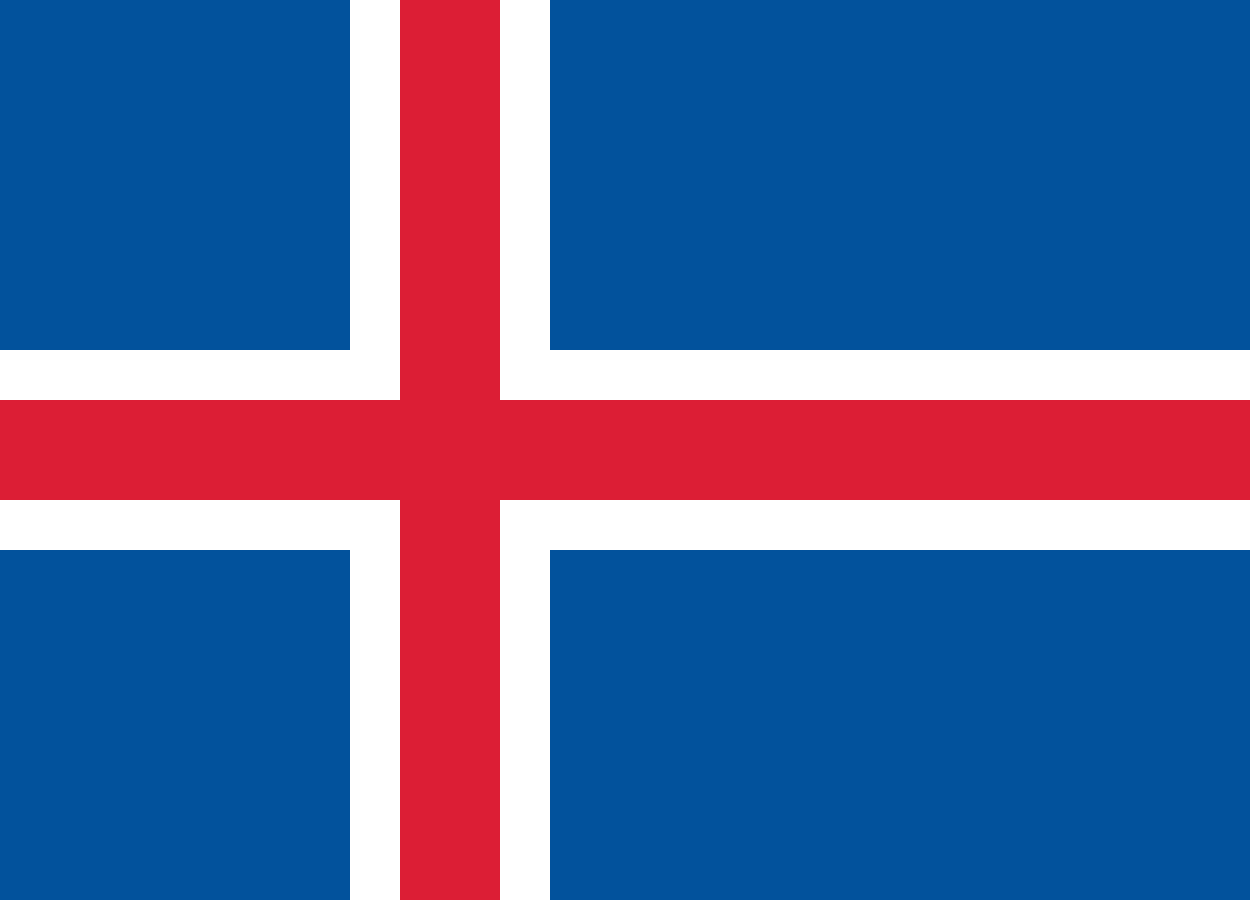
Flag
Not available
Coat of Arms
Not available
| Official name | Ísland (Lýðveldið Ísland) |
|---|---|
| Coat of arms | Blue shield, red cross fimbriated Argent; four landvættir supporters on basalt |
| Blazon | Azure, a cross Gules fimbriated Argent |
| Arms adopted | 12 February 1919 (Kingdom); redesigned 17 June 1944 (Republic) |
| National flag | Sky-blue, snow-white Nordic cross with fiery-red cross inside |
| Flag adopted | 19 June 1915 (royal decree); Law No. 34/1944 |
| Flag designer | Matthías Þórðarson (1906) |
| Capital | Reykjavík |
| Government | Unitary parliamentary republic |
| Head of State | Halla Tómasdóttir (since 2024) |
Coat of Arms of Iceland — Azure, a cross Gules fimbriated Argent; four landvættir
The Icelandic coat of arms is one of the most distinctive in European heraldry, notable both for its elegant shield and its unprecedented four supporters.
The shield bears a direct heraldic rendering of the national flag:
Azure, a cross Gules fimbriated Argent.
A red cross, edged in silver, on a blue field — one of the most harmonious correspondences between flag and arms anywhere in the world.
Iceland is the only nation whose coat of arms features four supporters. They are the landvættir (land spirits), the mythical guardians of Iceland described by Snorri Sturluson in the Heimskringla (c. 1230). Each protects one quadrant of the island:
In Norse tradition, such great respect was given to these creatures that Viking-age law forbade ships from bearing grimacing figureheads when approaching Iceland, lest the landvættir be provoked. The four guardians stand on a slab of columnar basalt, evoking the volcanic geology of the island.
The first official coat of arms featuring the landvættir was adopted on 12 February 1919, when Iceland was a sovereign kingdom in personal union with Denmark. That version bore the Danish royal crown above the shield. When Iceland declared itself a republic on 17 June 1944, the crown was removed and the landvættir were redrawn in their current form. Law No. 34/1944 — The Law of the National Flag of Icelanders and the State Arms — governs both symbols to this day.
Flag of Iceland — Sky-blue, snow-white cross, fiery-red cross inside
The Icelandic flag is a Nordic cross — sky-blue with a snow-white cross bearing a fiery-red cross inside — sharing the cross-shifted-to-the-hoist design with Denmark, Norway, Sweden, and Finland.
In the late 19th century, an unofficial blue-and-white flag (white cross on blue) served as a national symbol, first displayed publicly in 1897. On 27 September 1906, Matthías Þórðarson presented a revised design at a Reykjavík Students’ Association meeting. Drawing on Einar Benediktsson’s colour scheme, he added a red cross inside the white one — evoking Iceland’s volcanic fire and, practically, distinguishing the flag from similar Scandinavian banners.
On 19 June 1915, King Kristján X issued a decree adopting the blue-white-red flag for use in Icelandic territorial waters. It became the sole national flag when Iceland gained sovereignty under the Act of Union with Denmark in 1918.
The colours are traditionally said to represent Iceland’s landscape: blue for the mountains and the Atlantic sky, white for the glaciers and snow, and red for the volcanic fire that shaped — and continues to shape — the island.
On 17 June 1944, the day Iceland became a republic, Law No. 34/1944 enshrined the flag in statute. The law specifies the proportions precisely: the white cross is 2/9 of the flag’s width, the red cross 1/9, and the overall ratio is 18:25.
Iceland’s heraldic tradition is shaped by its unique position: a Norse society that preserved mediaeval literary culture more completely than any other, yet spent centuries under Norwegian and then Danish sovereignty. The stockfish (þurrfiskur) was an early symbol of Iceland in Danish royal heraldry, appearing on coins and seals from the 14th century. The shift to the landvættir in the 20th century represented a conscious return to the island’s own mythological roots.
Municipal heraldry is modest compared to continental Europe, but several Icelandic towns maintain official arms. Reykjavík’s arms feature the Víkingaskip (Viking ship), while Akureyri and other towns bear charges reflecting local geography and economy. The Alþingi (parliament), one of the oldest legislative assemblies in the world (founded 930), does not have a coat of arms in the strict heraldic sense but uses the national emblem in its official identity.
The four landvættir (land spirits) are the mythical guardians of Iceland described in Snorri Sturluson’s Heimskringla: Griðungur (bull) protects the northwest, Gammur (eagle or griffin) the northeast, Dreki (dragon) the southeast, and Bergrisi (rock-giant) the southwest. Iceland is the only nation whose coat of arms features four supporters.
The colours evoke Iceland’s natural landscape: sky-blue for the mountains and the Atlantic sky, snow-white for the glaciers and ice, and fiery-red for the volcanic fire beneath. The flag uses the Nordic cross design shared by Denmark, Norway, Sweden, and Finland.
Matthías Þórðarson unveiled the current design on 27 September 1906 at a Reykjavík Students’ Association meeting. He drew on Einar Benediktsson’s colour scheme, adding the red cross to the earlier blue-and-white proposal. King Kristján X formally adopted the flag by decree on 19 June 1915.
The first version with the four landvættir became official on 12 February 1919, when Iceland was a kingdom under the Danish Crown. When Iceland declared itself a republic on 17 June 1944, the coat of arms was redesigned: the Danish royal crown was removed and the landvættir were redrawn. Law No. 34/1944 governs both the flag and the state arms.
The shield bears a red cross fimbriated (edged) in silver on a blue field — essentially the Icelandic flag rendered as a heraldic blazon: Azure, a cross Gules fimbriated Argent. This direct correspondence between flag and shield is one of the most elegant in European heraldry.
Last reviewed by the Emblema Mundi editorial team on 2026-06-22.