Country
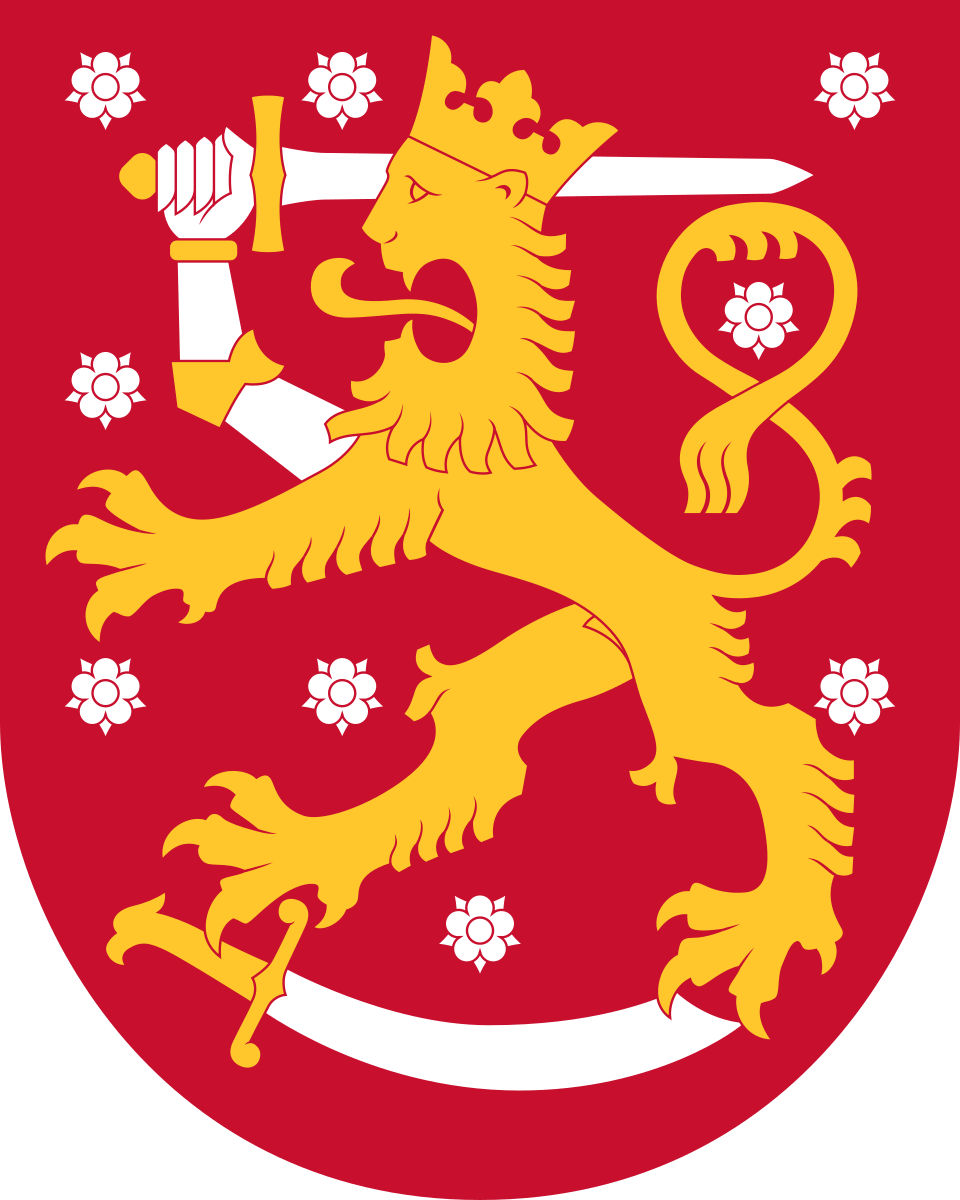
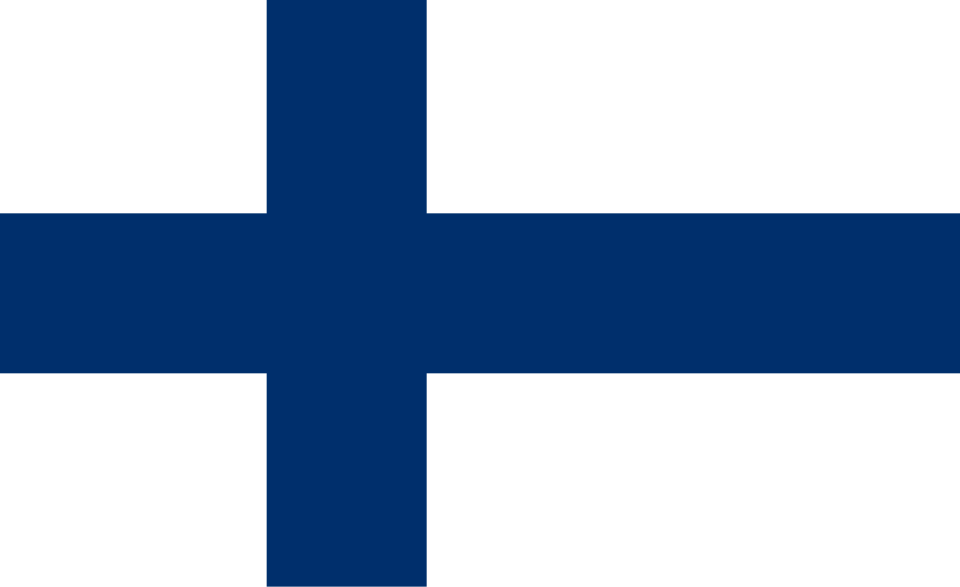
The national emblems of Finland juxtapose two very different heraldic layers. The coat of arms — a crowned golden lion trampling a curved sabre with a straight sword raised in an armoured arm — is a piece of 16th-century Vasa political theatre, sculpted onto the tomb of King Gustav I in Uppsala Cathedral around 1580. The Siniristilippu, the blue Nordic cross on white, is the work of the young Republic: adopted on 29 May 1918, it draws the country into the visual family of Denmark, Norway, Sweden, and Iceland.
Flag
Not available
Coat of Arms
Not available
| Country | Republic of Finland (Suomen tasavalta / Republiken Finland) |
|---|---|
| Coat of arms first documented | c. 1580 — tomb of Gustav I Vasa, Uppsala Cathedral, sculpted by Willem Boy |
| Coat of arms codified | Law 381/1978 of 26 May 1978 (Laki Suomen vaakunasta) |
| Flag adopted | 29 May 1918, Provisional Government (Regulation 449/1918) |
| Flag ratio | 11:18 |
| Tinctures (arms) | Gules, Or, Argent |
| Tinctures (flag) | Azure (Pantone 294 C) and Argent |
| Central charge | Crowned lion Or, sword against sabre, on a semé of nine roses |
| Subdivisions | 19 regions (maakuntia) + Autonomous Region of Åland |
Coat of Arms of Finland — Gules, a crowned lion Or holding an armoured arm with sword Argent, trampling a sabre Argent; nine roses Argent semé. Fixed by Law 381/1978.
Gules, a crowned lion rampant Or, armed and langued Argent, wielding in the dexter forepaw — figured as an armoured human arm gauntleted Argent — a straight sword Argent hilted Or, and trampling under the hindpaws a curved sabre Argent hilted Or; the field semé of nine roses Argent.
The composition is deliberately narrative rather than static. Unlike the sober lions of Norway or Denmark, the Finnish lion tells a story in a single frame: a Christian European sovereign, sword in hand, standing over a defeated eastern adversary.
| Colour | Heraldic name | Element | Traditional symbolism |
|---|---|---|---|
| Red | Gules | Field | Sovereignty, courage; the field of the Vasa dynastic arms |
| Gold | Or | Lion, crown, sword and sabre hilts | Royal dignity; the Swedish Vasa lion |
| Silver | Argent | Armour, sword blade, sabre blade, roses | The steel of the sword, the snow of the field |
The arms are among the earliest in Europe to encode a specific geopolitical claim into a single charge. Three elements matter:
The device migrates from a personal-dynastic assertion into the territorial arms of the Grand Duchy through repeated use on state seals, coinage and church banners.
No 16th-century source explains the roses. The number was not initially fixed at nine — period exemplars show from five to fifteen. Nineteenth- and twentieth-century commentators have proposed a mapping to the historic provinces of Finland (Egentliga Finland, Nyland, Tavastland, Karelia, Savolax, Österbotten and neighbours), but no legal or period text supports this reading. Heraldically, the roses are best treated as a semé — a decorative strewing on the field — whose count stabilised at nine only in modern usage.
c. 1580 — Uppsala. The arms first appear, in effigy, on the tomb of King Gustav I Vasa in Uppsala Cathedral, sculpted by the Netherlandish master Willem Boy and installed by 1591.
1581 — Duke Johan (later Johan III) is styled Grand Duke of Finland; the arms circulate as those of the Grand Duchy within the Swedish crown.
1719 — The Riksarkiv codifies the Finnish arms among the provincial arms of Sweden. The count of roses stabilises around nine.
1809 — Following the Finnish War, Aleksandr I of Russia proclaims the Grand Duchy of Finland as an autonomous polity in personal union with the Empire. The Vasa lion is retained; the Russian imperial crown replaces the earlier open crown.
6 December 1917 — Finland declares independence. The arms continue in use by inertia, without a legal definition.
26 May 1978 — Codification. Law 381/1978 (Laki Suomen vaakunasta) fixes the modern form: crown, lion, sword, sabre, nine roses, tinctures. The 400-year drift in details ends.
Flag of Finland — A Nordic cross Azure on a field Argent, the vertical arm shifted toward the hoist. Ratio 11:18. Adopted 29 May 1918.
The idea of a blue-cross-on-white flag for Finland is first articulated by the writer Zachris Topelius in 1862, in an article for Helsingfors Tidningar. Topelius rejected the red-and-yellow of the Vasa arms as too closely tied to the Swedish monarchy, and argued that the country’s two constant landscape colours — the blue of the lakes and summer sky and the white of winter snow — furnished a natural civic vocabulary.
The proposal circulated through student associations and yacht clubs in the following decades. The Nyländska Jaktklubben (Nyland Yacht Club) adopted a blue-cross flag in 1861, one year before Topelius’s article — the earliest documented Finnish blue-cross ensign.
Six months after independence and at the end of the Civil War, the Provisional Government of the Republic issues Regulation 449/1918 on 29 May 1918 defining the state flag. Two competing designs had been on the table:
The blue-and-white design prevails. The choice explicitly aligns Finland with the wider Nordic flag family — Denmark, Sweden, Norway, Iceland — whose shared cross-off-centre pattern signals a common cultural and political space.
The vertical arm of the cross is offset toward the hoist, producing four rectangular quarters of unequal size — the format shared by every Nordic ensign. The Dannebrog of Denmark, in continuous use since the 13th century, is the archetype. Finland’s 11:18 ratio matches the Swedish 5:8, distinguishing it from the wider Norwegian and Danish rectangles.
Regulation 449/1918 also defines two variants used on state and military occasions:
The Nordic cross is one of the most cohesive heraldic families in Europe. Every ensign shares the same off-centre cross geometry, distinguishing only by tincture:
| Flag | Field | Cross | Adoption |
|---|---|---|---|
| Denmark (Dannebrog) | Gules | Argent | 13th century (traditional) |
| Sweden | Azure | Or | 16th century |
| Norway | Gules | Azure fimbriated Argent | 1821 |
| Iceland | Azure | Gules fimbriated Argent | 1915 |
| Finland | Argent | Azure | 1918 |
Finland is the last of the sovereign Nordic states to adopt the pattern, and inverts the medieval Danish scheme — making its flag the visual complement of the Dannebrog.
Finland is divided into 19 regions (maakuntia), together with the Autonomous Region of Åland, whose self-governance is guaranteed by international treaty since 1921. Each region carries its own arms, most drawing on the medieval provincial heraldry of the Swedish crown:
Click on Finland on the interactive map above to browse the emblems of the twenty regional entities.
The confrontation between the straight European sword — held by an armoured arm — and the curved sabre trampled underfoot is a 16th-century political statement about the eastern frontier of the Swedish crown. The straight sword stands for the Swedish-Lutheran west; the sabre for Muscovy and its Tatar auxiliaries. The composition dates from around 1580, during the Livonian War against Ivan IV.
The earliest documented representation is on the tomb of King Gustav I Vasa in Uppsala Cathedral, sculpted by the Netherlandish master Willem Boy around 1580 and installed by 1591. It circulated as the arms of the Grand Duchy of Finland throughout the Swedish and Russian periods, and was legally fixed as the arms of the Republic by Law 381/1978 on 26 May 1978.
No period source explains them. The count was not fixed at nine before the 20th century — earlier variants show from five to fifteen. A retrospective mapping to the historic Finnish provinces has been proposed but has no legal or period basis. Heraldically the roses are best understood as a semé, a decorative strewing on the field.
The Siniristilippu was adopted by the Provisional Government of the Republic on 29 May 1918, six months after independence and at the end of the Civil War. The blue-cross-on-white design had circulated since the 1860s — first in the yacht-club ensign of the Nyländska Jaktklubben (1861) and then in an 1862 article by Zachris Topelius.
The Nordic cross format signals affiliation with the wider Scandinavian family. The colour choice diverges deliberately: blue for the lakes and summer sky, white for winter snow — the two constants of Topelius’s landscape reading. Red-and-yellow alternatives drawn from the Vasa arms were rejected in 1918 as too dynastic and too closely tied to the Swedish monarchy.
Last reviewed by the Emblema Mundi editorial team on 5 July 2026.