Country
The German coat of arms is one of the oldest national emblems still in use in Europe — a black eagle (Bundesadler) on a golden field, in direct continuity with the eagle of the Holy Roman Empire used from the eleventh century. The black-red-gold flag, adopted by the liberal revolutionaries of 1848, then by the Weimar Republic in 1919 and by the Federal Republic in 1949, marks a sharply different lineage: the colours of the unification movement against the empires and dictatorships of the 19th and 20th centuries.
Flag
Not available
Coat of Arms
Not available
| Country | Federal Republic of Germany (Bundesrepublik Deutschland) |
|---|---|
| Coat of arms adopted | 20 January 1950 by Federal Decree; design by Tobias Schwab, originally 1928 |
| Flag adopted | 23 May 1949, Article 22 of the Basic Law (Grundgesetz) |
| Tinctures (arms) | Or, Sable, Gules |
| Blazon | Or, an eagle displayed Sable, beaked, langued and membered Gules |
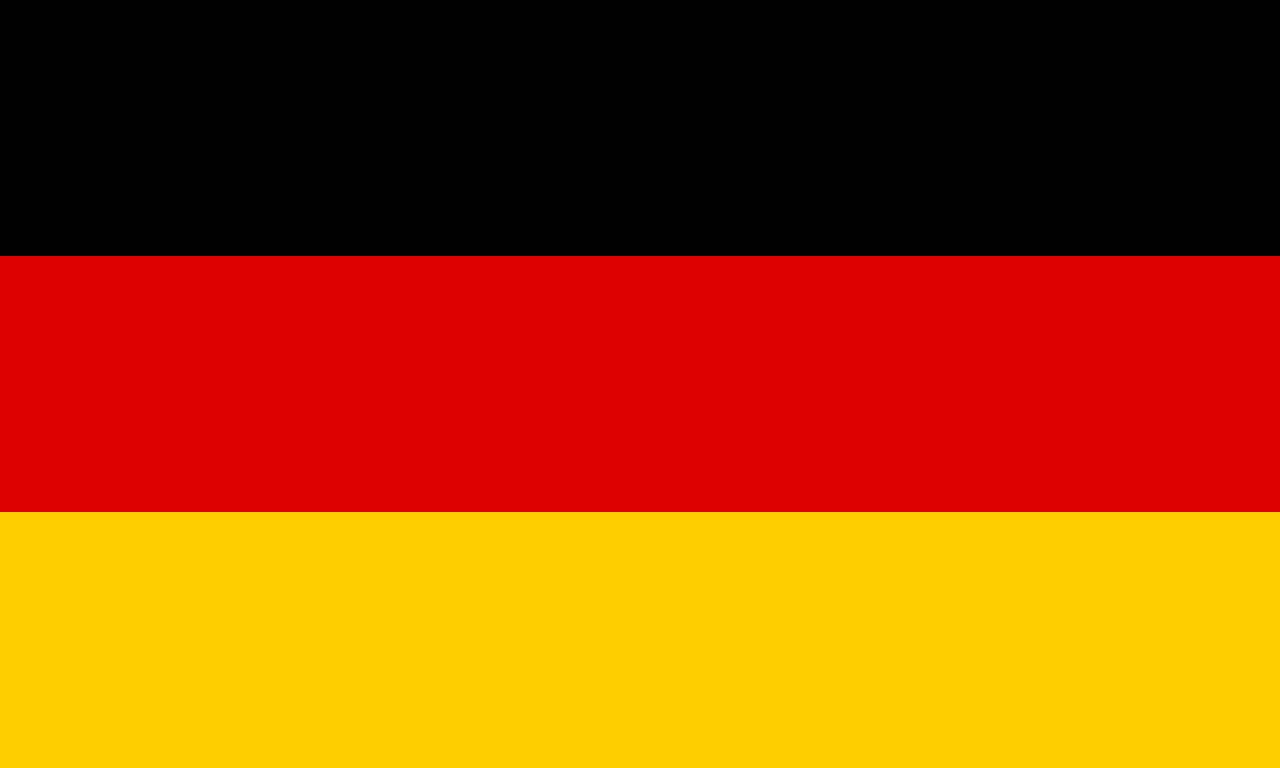
| Flag colours | Black (top), red (middle), gold (bottom), equal horizontal bands, ratio 3:5 |
| Bundesländer | 16 federal states (11 from the Federal Republic + 5 from the GDR after 1990 reunification) |
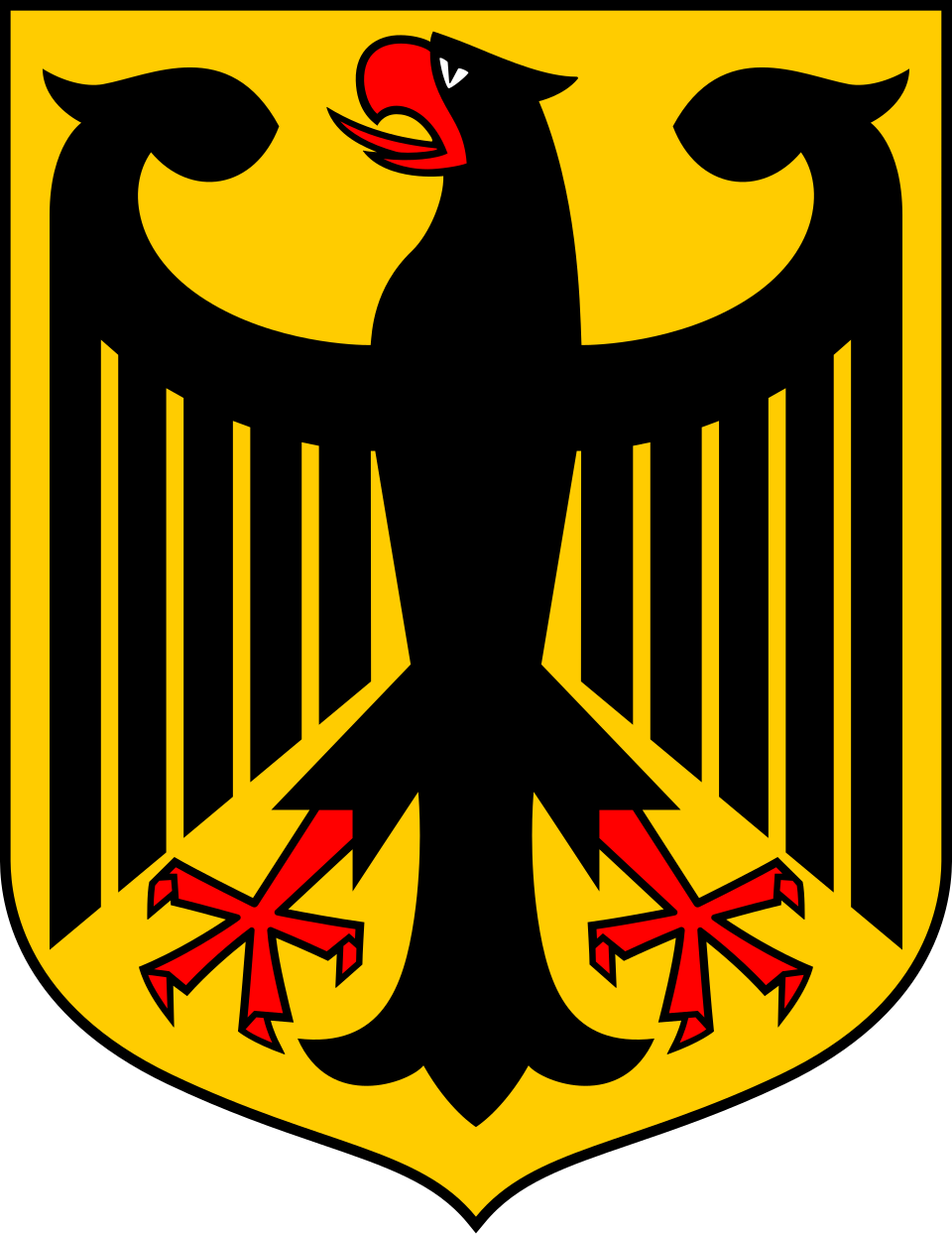
Coat of Arms — Bundesadler — Or, an eagle displayed Sable, beaked, langued and membered Gules.
Or, an eagle displayed Sable, beaked, langued and membered Gules.
The German coat of arms is a single eagle, wings spread (displayed), facing the viewer's left (heraldic dexter). The body, head and feathers are black (Sable) on a yellow-gold field (Or); the beak, tongue and talons are red (Gules). The eagle has no shield around it in the modern federal version — it floats freely as the national emblem.
The bird wears no crown, holds no orb or sceptre, and bears no breast-shield. This deliberate simplicity contrasts with all earlier German eagles, which carried various imperial regalia (crowns, sceptres, swords, shields with the arms of individual territories). The current austerity dates from the Weimar Republic's adoption of Tobias Schwab's 1928 design.
The eagle is the oldest continuously used German national symbol. It traces back to the aquila of the Roman legions, adopted by the Frankish kings, then by Charlemagne (crowned emperor in 800), and finally codified by the Holy Roman Empire:
The Federal Republic uses three official variants:
Flag — Schwarz-Rot-Gold — Three equal horizontal bands: black (top), red (middle), gold (bottom). Ratio 3:5.
The colours Schwarz-Rot-Gold (black-red-gold) are not, despite popular belief, the colours of the Holy Roman Empire. Their origin is romantic and revolutionary, dating from the Napoleonic Wars of liberation (Befreiungskriege) of 1813–1815.
The volunteer corps of Adolf von Lützow — the famous Lützowsches Freikorps, which counted the poet Theodor Körner and the philosopher Friedrich Jahn among its ranks — wore black uniforms (improvised from dyed civilian coats), with red facings on the lapels and gold buttons. After the wars these colours were adopted by the Burschenschaften, the patriotic and liberal student fraternities that demanded German unification and constitutional government.
27 May 1832 — Hambach Festival. Some 30,000 demonstrators climb to Hambach Castle in the Palatinate carrying the black-red-gold tricolour as the flag of a hoped-for united liberal Germany. The Diet of the German Confederation responds by banning the colours.
18 March 1848 — Berlin Revolution. Liberal revolts sweep the German states. King Frederick William IV of Prussia, riding through Berlin under the black-red-gold banner, declares: "Henceforth Prussia merges into Germany."
9 March 1848 — Frankfurt Parliament. The German Confederation formally adopts black-red-gold as the national colours of a future German state. The revolution fails by 1849, but the tricolour remains the rallying symbol of liberal Germany.
1867 — The North German Confederation, dominated by Prussia, adopts a different flag: black-white-red (Schwarz-Weiss-Rot), combining the black-white of Prussia and the red-white of the Hanseatic cities. This becomes the flag of the German Empire of 1871 and remains in use until 1919. Bismarck deliberately chose black-white-red against black-red-gold to mark the rejection of the liberal-democratic tradition of 1848.
From 1933 to 1945, Nazi Germany also used black-white-red (alongside the swastika flag), claiming it as the authentic "national" tricolour. This is one reason modern Germany cannot rehabilitate black-white-red without political controversy.
1919 — Weimar Republic. Article 3 of the Weimar Constitution restores Schwarz-Rot-Gold as the national flag, explicitly choosing the colours of 1848 over those of the Empire.
1933 — Nazi reversal. The black-red-gold flag is replaced by the swastika.
23 May 1949 — Basic Law. Article 22 of the Grundgesetz of the Federal Republic of Germany states simply: "Die Bundesflagge ist schwarz-rot-gold" ("The federal flag is black-red-gold"). The German Democratic Republic adopts the same colours in 1949, adding the hammer-and-compass emblem in 1959. After reunification in 1990, the East German emblem is removed and the flag of the Federal Republic becomes the flag of the whole of Germany.
Germany is a federation of 16 Bundesländer (federal states), each with its own coat of arms, flag, constitution and parliament. The current 16 result from the unification of the eleven Länder of the Federal Republic (1949) and the five Länder reconstituted in the territory of the German Democratic Republic on 3 October 1990.
Three of the sixteen are city-states (Stadtstaaten): Berlin, Hamburg, and Bremen.
Each Land's arms reflect a distinct historical lineage — Imperial duchy, free city, kingdom, or post-1945 administrative creation. A selection:
The eagle (Reichsadler, now Bundesadler) is the direct continuation of the eagle of the Holy Roman Empire, itself adopted from the Roman aquila by the Frankish and Ottonian emperors in the early Middle Ages. It has been associated with German sovereignty for over a thousand years, surviving the Holy Roman Empire (962–1806), the German Confederation, the Empire of 1871, the Weimar Republic, and reappearing in the Federal Republic in 1950.
The colours were popularised by the Lützow Free Corps in the Napoleonic Wars of liberation (1813–1815) — black uniforms with red facings and gold buttons. Adopted by the Burschenschaften student fraternities, raised at the Hambach Festival of 1832, then officially by the Frankfurt Parliament in 1848 as the colours of a united liberal Germany. They were rejected by Bismarck's Empire (which used black-white-red) but restored by the Weimar Republic in 1919 and the Federal Republic in 1949.
They are the same eagle in different political contexts. The Reichsadler ("eagle of the Reich") was used by the Holy Roman Empire, the German Empire (1871–1918), the Weimar Republic, and Nazi Germany. The Bundesadler ("federal eagle") is the post-war designation since 1950, identical in design to the Weimar version of 1928 by Tobias Schwab. The change of name signals the rejection of the militaristic eagle versions of 1933–1945 in favour of the friendlier Weimar form.
Black-white-red (Schwarz-Weiss-Rot) was the flag of Bismarck's German Empire from 1871 to 1918 and of Nazi Germany from 1933 to 1945. The colours combined the black-white of Prussia with the red-white of the Hanseatic cities and the German Confederation. After 1949, the Federal Republic and the German Democratic Republic both rejected it in favour of black-red-gold, the liberal colours of 1848. The flag remains legal in modern Germany but carries strong far-right associations.
Sixteen, since reunification on 3 October 1990. The eleven original Länder of the Federal Republic (West Germany), plus the five Länder reconstituted in the territory of the former German Democratic Republic: Brandenburg, Mecklenburg-Vorpommern, Sachsen, Sachsen-Anhalt and Thüringen. Berlin became the sixteenth as a unified city-state.
The double-headed eagle (Doppeladler) was a Byzantine import, used by the Palaeologos emperors of Constantinople from the 13th century. Sigismund (Holy Roman Emperor 1433–1437) adopted it to distinguish the Emperor's arms from those of the German King (who retained the single-headed eagle), signalling the dual claim to universal — Roman and Christian — sovereignty. After 1806, the double-headed eagle migrated to the new Empire of Austria, while German national heraldry returned to the single-headed form.
Last reviewed by the Emblema Mundi editorial team on 14 June 2026.