Federal State
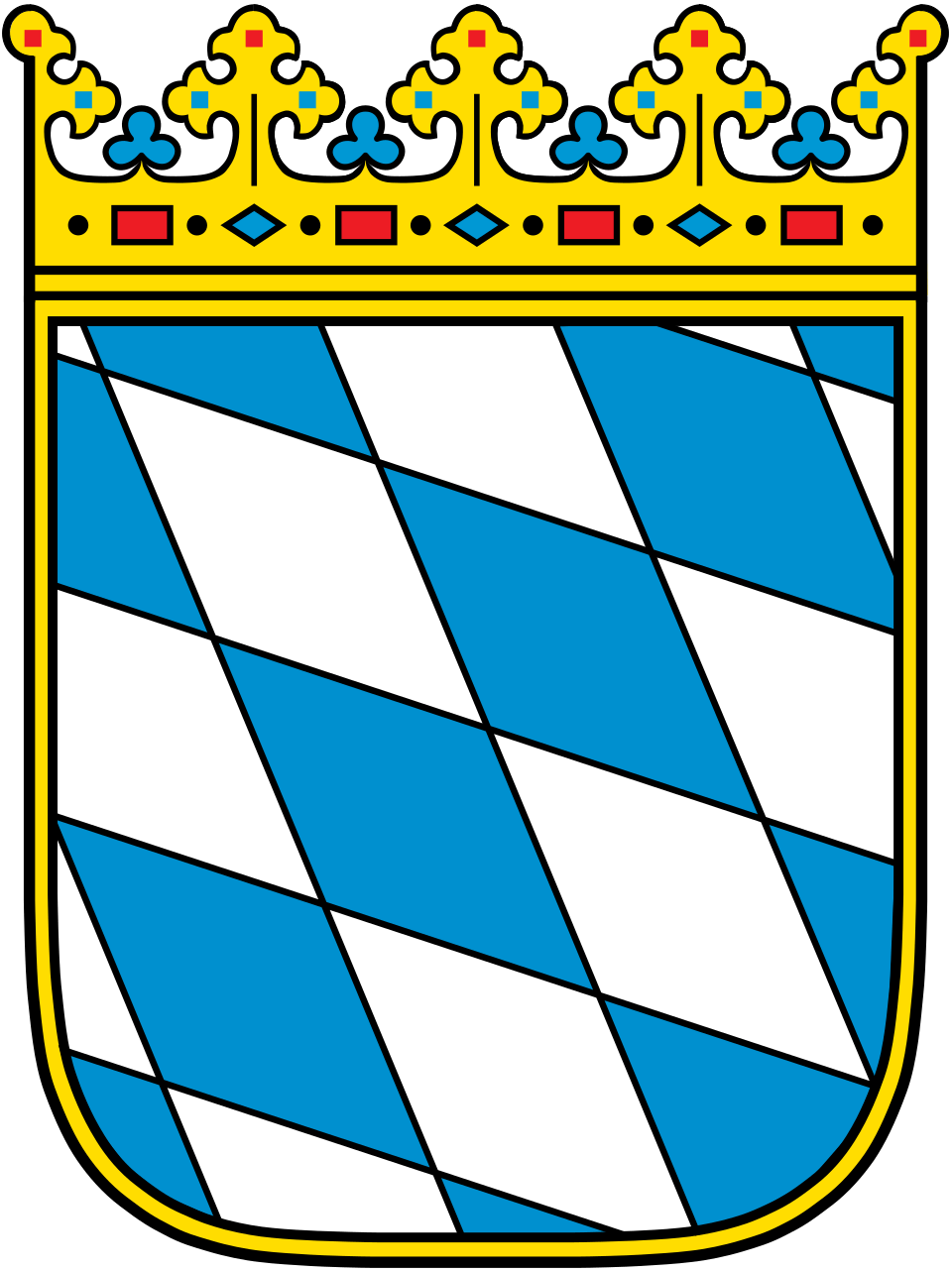
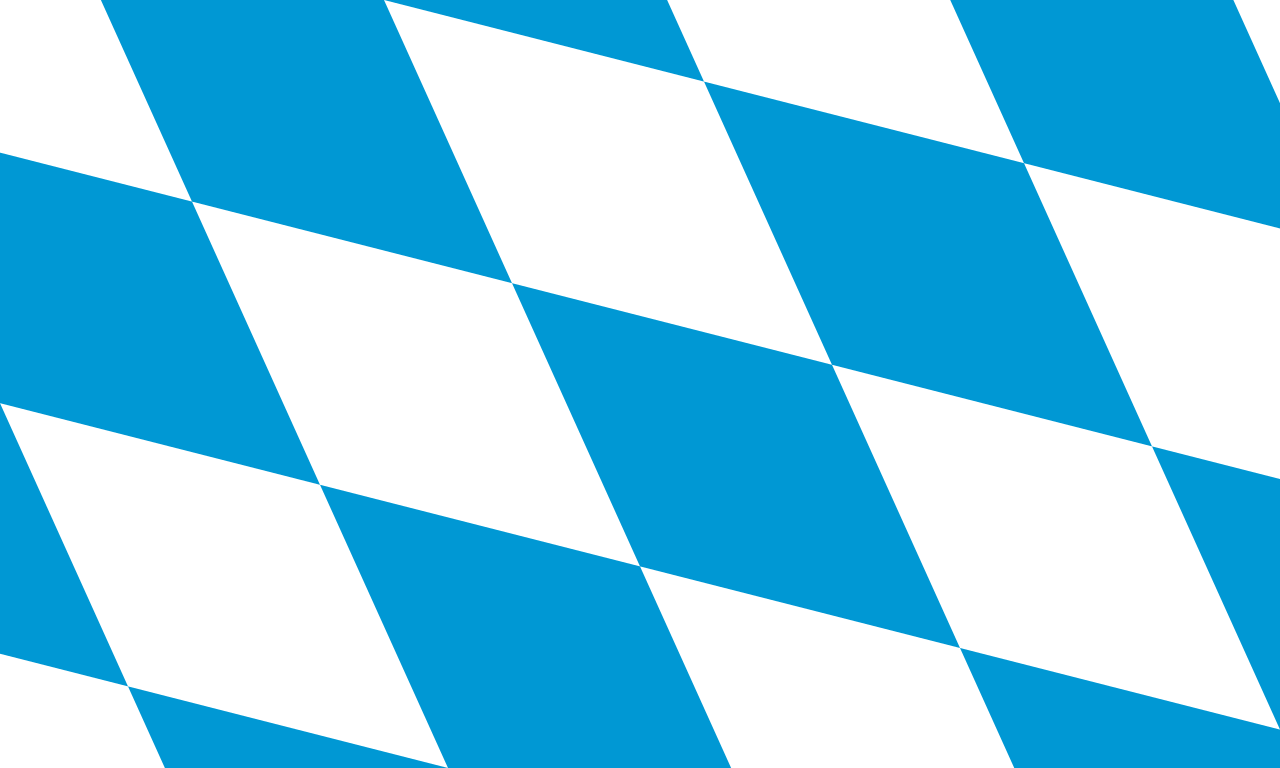
Bayern (Bavaria) is Germany's largest federal state by area and one of the oldest political entities in central Europe. Its coat of arms — a quartered shield bearing the Wittelsbach lozenges, the Frankish rake, the lion of the Upper Palatinate, and the pales of Burgau — encapsulates eight centuries of dynastic history. Its flag, in white and blue, is among the most instantly recognized regional symbols in Germany, existing in two equally official forms: the Streifenflagge (striped) and the Rautenflagge (lozenge).
Flag
Not available
Coat of Arms
Not available
| Federal State | Bayern (Bavaria) |
|---|---|
| Capital | München (Munich) |
| Coat of Arms adopted | 1946 (constitution); confirmed 1953 |
| Flag adopted | 1953 (State Symbols Act) |
| Colors | White (argent) and blue (azure) |
| Region | Southern Germany |
Coat of Arms of Bayern — quartered shield with Wittelsbach inescutcheon
Quarterly: I. Or, a lion rampant crowned Sable (Upper Palatinate); II. Gules, three piles Argent each charged with a lozenge Argent (Franconia / Frankenrechen); III. Azure, three pallets Argent (Margraviate of Burgau); IV. Lozengy Argent and Azure (Palatine Bavaria / Wittelsbach lozenges); over all an inescutcheon Lozengy Argent and Azure (House of Wittelsbach). Ensigned with a mural crown of the people.
The House of Wittelsbach acquired Bavaria in 1180 when Emperor Friedrich I. Barbarossa granted the duchy to Otto I. von Wittelsbach. The white-and-blue lozenge pattern entered Wittelsbach heraldry in 1242 through the inheritance of the County of Bogen, whose Counts had used the Rautenmuster. Over the following centuries, as the Wittelsbachs accumulated the Upper Palatinate, Franconia, and other territories, the arms grew into the quartered design seen today. The current version was codified by the Bavarian Constitution of 1946 and given legal precision by the Bavarian State Symbols Act (Gesetz über das Wappen des Freistaates Bayern) of 1953.
Flag of Bayern — Streifenflagge (striped version): white over blue
The flag of Bayern exists in two equally official versions. The Streifenflagge displays two equal horizontal stripes: white (argent) above blue (azure). The Rautenflagge covers the same field with diagonal white-and-blue lozenges in a pattern of at least 21 lozenges. Both versions are in a 2:3 ratio. State authorities may use either form; the lozenge version is particularly associated with the Free State of Bavaria and appears widely on public buildings and vehicles.
The white-and-blue color pair is inseparable from the House of Wittelsbach. The Rautenmuster lozenge pattern derives from the arms of the Counts of Bogen, inherited by the Wittelsbachs in 1242. By the 19th century white and blue had become the defining colors of the Kingdom of Bavaria under Ludwig I., who promoted them energetically as national symbols. The striped flag was already in informal use by the early 19th century; both forms were given equal official status by the State Symbols Act of 1953.
Bayern's flag is one of the most widely displayed regional flags in Germany and is heavily used in popular culture, sport, and tourism. The Rautenflagge appears on FC Bayern München's branding, on Bavarian beer products, and as a visual shorthand for the state internationally. By law, official state buildings fly the Streifenflagge; the Rautenflagge is reserved for ceremonial and decorative use.
The quartered shield combines the symbols of the main historical territories that make up Bayern: the Upper Palatinate (golden lion on black), Franconia (Frankenrechen), the Margraviate of Burgau (silver pales on blue), and Palatine Bavaria (Wittelsbach lozenges). The central inescutcheon bears the personal arms of the House of Wittelsbach, who ruled Bayern from 1180 to 1918.
Bayern has two equally official flags: the Streifenflagge (two horizontal stripes, white over blue) and the Rautenflagge (a pattern of white and blue diagonal lozenges). Both were confirmed by the Bavarian State Symbols Act of 1953 and derive from the heraldry of the House of Wittelsbach.
The Rautenmuster (lozenge pattern) derives from the arms of the Counts of Bogen, whose lands in Lower Bavaria were inherited by the Wittelsbachs in 1242. The pattern has been the most recognizable symbol of Bavaria ever since and appears on both the flag and the coat of arms.
The current coat of arms was established by the Bavarian Constitution of 1946 and given full legal definition by the Bavarian State Symbols Act of 1953. The quartered design with Wittelsbach inescutcheon had been in continuous use since the early modern period.
The Frankenrechen — three silver points on red, each charged with a silver lozenge — is the ancient heraldic symbol of Franconia, the northern region of modern Bayern. The rake-like design has been used as a Frankish emblem since the medieval period and reflects Bayern's incorporation of the former Frankish territories in the early 19th century.
Last reviewed by the Emblema Mundi editorial team on June 29, 2026.