Federal State
Baden-Württemberg, created on 25 April 1952 by the merger of the former states of Baden, Württemberg-Baden and Württemberg-Hohenzollern, is one of Germany's most populous and economically powerful Bundesländer. Its capital is Stuttgart. The state's heraldry reaches back to the Hohenstaufen (Staufer) dynasty, one of the most powerful medieval ruling houses of the Holy Roman Empire, whose ancestral homeland lay in Swabia. The black lions on gold of the Staufer became the core element of Baden-Württemberg's coat of arms when it was adopted on 3 May 1954, representing the historical continuity between the medieval duchy and the modern federal state.

Flag
Not available
Coat of Arms
Not available
| Federal State | Baden-Württemberg |
|---|---|
| Capital | Stuttgart |
| Coat of Arms adopted | 3 May 1954 |
| Flag adopted | 3 May 1954 |
| Colors | Black and gold |
| Region | Southwest Germany |
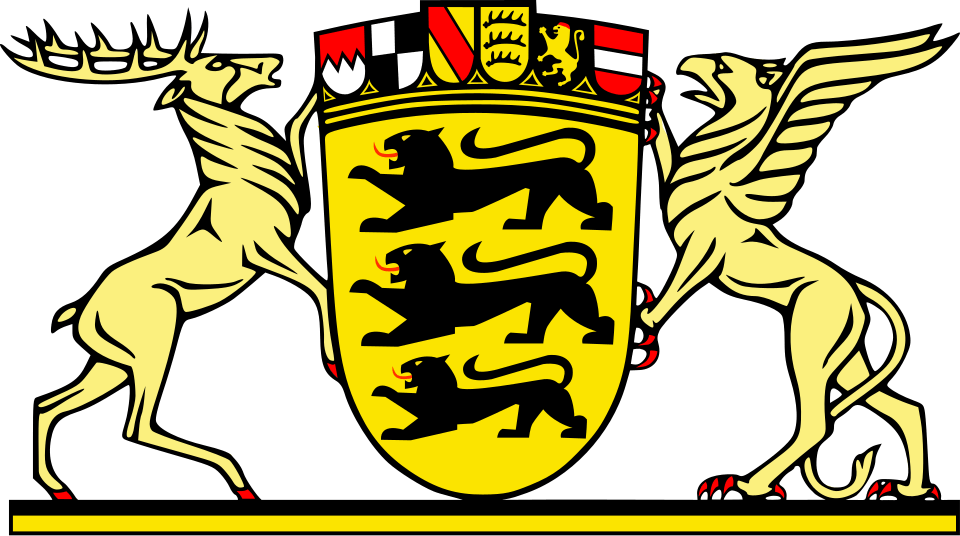
Coat of Arms of Baden-Württemberg — Landeswappen with Hohenstaufen lions
Or, three lions passant guardant in pale Sable (lesser arms). The greater arms add a chief of six shields and two supporters: a stag (Württemberg) dexter and a griffin (Baden) sinister.
The Staufer dynasty rose to prominence in the 11th century from their base in Swabia and produced Holy Roman Emperors including Friedrich I. Barbarossa (reigned 1155–1190) and his grandson Friedrich II. (reigned 1220–1250). Their black lions on gold became the dynastic emblem of Swabia. When Baden-Württemberg was created in 1952 from the three post-war states, heraldic experts selected the Staufer lions as the most representative medieval symbol for the new state. The arms were officially adopted on 3 May 1954 by state law, in both the lesser version (plain lion shield) and the greater version (with six subsidiary shields and supporters).
Flag of Baden-Württemberg — Landesdienstflagge, black over gold
The flag of Baden-Württemberg consists of two equal horizontal stripes: black above gold. The state service flag (Landesdienstflagge) additionally bears the state coat of arms centered on the stripes. These are the only two elements of the design — no additional symbols appear on the civil bicolor.
The black-and-gold colors derive directly from the Hohenstaufen heraldic tradition: black lions on a gold field. The same combination appears in the coats of arms of several former Staufer territories across southern Germany. When the state was created in 1952, black and gold were chosen as the state colors to reflect this shared Swabian heritage, and were formalized alongside the coat of arms on 3 May 1954.
The plain black-gold bicolor is used by private citizens and organizations. State authorities use the Landesdienstflagge bearing the coat of arms. The flag flies on all state government buildings and is displayed at official ceremonies throughout Baden-Württemberg.
The three black lions passant guardant on a gold field are the arms of the Staufer (Hohenstaufen) dynasty, the most powerful ruling family of medieval Swabia and Holy Roman Emperors. They were chosen because the Staufer were the dominant medieval dynasty associated with the region.
The coat of arms was officialized by state law on 3 May 1954, shortly after the state was created by the merger of Baden, Württemberg-Baden and Württemberg-Hohenzollern in 1952.
The flag is black over gold (Schwarz-Gold), taken directly from the Hohenstaufen heraldic tradition of black lions on a gold field.
The Landesdienstflagge is the state service flag — the civil black-gold bicolor with the coat of arms centered on it. It is used by state authorities and on government buildings.
The six subsidiary shields in the greater coat of arms (Großes Landeswappen) represent Franconia, Old Württemberg, Baden, Hohenzollern, Pfalz (Rhenish Palatinate) and Vorderösterreich (Further Austria).
Last reviewed by the Emblema Mundi editorial team on June 29, 2026.