Federal State
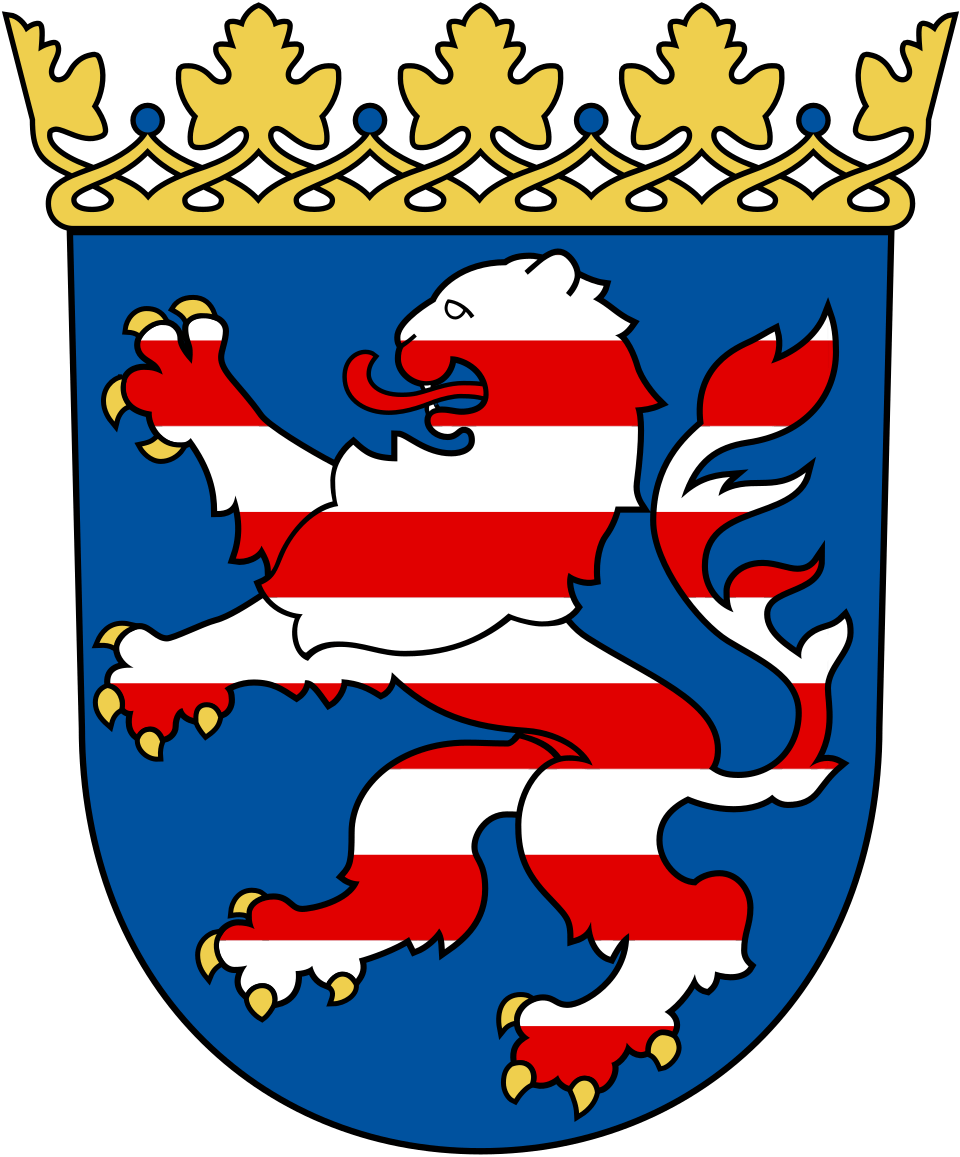
Hessen (Hesse) is a federal state in the heart of Germany, home to the financial capital Frankfurt am Main and the political capital Wiesbaden. Its coat of arms features the celebrated Bunter Löwe — a lion striped in silver and red on blue — a symbol inherited from the medieval Ludovingian Landgraves of Thuringia. Its flag, a simple red-and-white bicolor, equally traces its colors to the same dynastic tradition, making Hessen's heraldry one of the most historically coherent among all German federal states.

Flag
Not available
Coat of Arms
Not available
| Federal State | Hessen (Hesse) |
|---|---|
| Capital | Wiesbaden |
| Coat of Arms adopted | 1946 (Hessian Constitution) |
| Flag adopted | 1 December 1946 |
| Colors | Red (gules) and white (argent); blue (azure) on the arms |
| Region | Central Germany |
Coat of Arms of Hessen — the Bunter Löwe (striped lion) on azure
Azure, a lion rampant barry of ten Argent and Gules, crowned Gules, armed and langued Gules. Ensigned with a mural crown of the people.
The origins of the Hessian lion lie with the Ludovingian dynasty (Ludowinger), who served as Landgraves of Thuringia from 1131. Their heraldic lion, striped in alternating silver and red, passed to the Hessian branch when Landgrave Heinrich I. von Hessen founded the Landgraviate of Hesse as an independent entity after the War of Thuringian Succession (1247–1264). The Hessian line retained the lion unchanged, and it has been carried by every successor state — Landgraviate, Electoral Hesse, Grand Duchy, Free State, and now federal state — without alteration. The current coat of arms was confirmed by the Hessian Constitution of 1946.
Flag of Hessen — red over white bicolor (3:5 ratio)
The flag of Hessen is a horizontal bicolor: red above white, in a 3:5 ratio. The state service flag (Landesdienstflagge), reserved for official government use, additionally centers the state coat of arms — the Bunter Löwe on blue — across the two stripes. The civil flag carries no emblem.
The red and white of Hessen's flag share the same Ludovingian root as the coat of arms. The Landgraves of Thuringia used red and white as their dynastic colors, and these passed to the Landgraves of Hesse. The bicolor flag was formalized by the Hessian Constitution of 1 December 1946, which merged the formerly separate territories of Hesse-Darmstadt, Hesse-Nassau, and parts of the Rhine Province into the new federal state.
The red-and-white flag is flown on public buildings across Hessen and is a recognized symbol of the state in international contexts. The Landesdienstflagge — with the lion arms — is used by state ministries and official delegations. Frankfurt am Main's international profile has made the Hessian flag recognizable well beyond Germany's borders.
The coat of arms of Hessen features the Bunter Löwe — a lion rampant striped barry of ten silver and red on a blue field. It descends from the arms of the Ludovingian dynasty of the Landgraves of Thuringia, from which the Landgraves of Hesse split in the 13th century after the War of Thuringian Succession.
The red and white of the Hessen flag derive from the Ludovingian dynasty, the medieval Landgraves of Thuringia, from whom the Hessian ruling house descended. The bicolor was formalized by the Hessian Constitution of 1 December 1946.
The Bunter Löwe (literally "colorful lion") is the heraldic lion of Hessen. Its body is striped barry of ten, alternating silver and red — an unusual design that makes it instantly recognizable. It has been the emblem of Hesse since the medieval Landgraviate of the 13th century.
The current coat of arms was confirmed by the Hessian Constitution of 1946. The design itself is effectively unchanged from the medieval Landgraviate arms and requires no modernization to reflect the state's identity.
The capital of Hessen is Wiesbaden. The state's largest city is Frankfurt am Main, which is the financial centre of Germany and home to the European Central Bank and the Frankfurt Stock Exchange.
Last reviewed by the Emblema Mundi editorial team on June 29, 2026.