Federal State
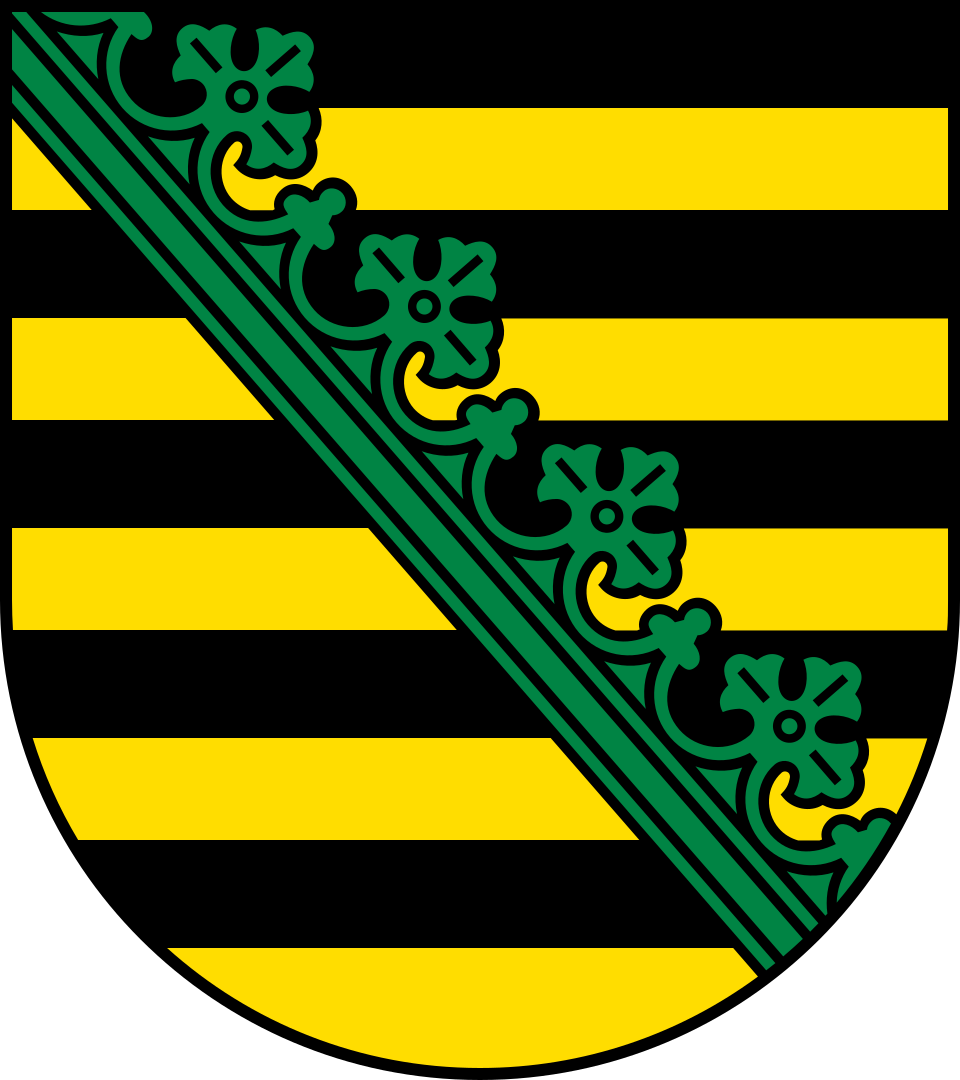
Sachsen (Saxony) is a federal state in eastern Germany, one of the country's most historically significant territories. The Free State of Saxony was reconstituted on 3 October 1990 following German reunification, restoring a polity whose roots reach back to the medieval Ascanian margraves of Meissen and the great Wettin dynasty that ruled from 1423 to 1918. Its coat of arms — the barry of ten sable and or overlaid with the diagonal green Rautenkranz — is among the oldest continuously used territorial arms in German history. The state capital is Dresden.

Flag
Not available
Coat of Arms
Not available
| Federal State | Sachsen (Saxony) |
|---|---|
| Capital | Dresden |
| Coat of Arms adopted | 6 June 1991 (readopted) |
| Flag adopted | 27 May 1992 (constitution) |
| Colors | White and green |
| Region | Eastern Germany |
Coat of Arms of Sachsen — readopted 6 June 1991
Barry of ten sable and or, a bend sinister vert charged with a crown of rue or (Rautenkranz). Ensigned with a people's crown (Volkskrone) of gold.
The barry arms of Saxony first appear in the 12th century on Ascanian seals. When the Wettin margrave Friedrich der Streitbare received the Saxon Electorate from Emperor Sigismund in 1423, the Wettins adopted the barry arms and added the Rautenkranz as their own mark. Through the Albertine and Ernestine branches of the Wettins, the arms spread across central Germany and were borne by successive rulers of the Duchy, Electorate, and Kingdom of Saxony. After the abolition of the monarchy in 1918 the arms were retained by the Free State of Saxony. Suppressed under the GDR, they were formally readopted on 6 June 1991 after reunification.
Flag of Sachsen — white over green bicolor
The flag of Sachsen is a horizontal bicolor of white over green. The state service flag (Dienstflagge) adds the coat of arms centered across both stripes. White and green have been the Wettin dynastic colors since the 15th century, derived from the silver and vert of the Rautenkranz arms, and have been associated with Saxony continuously since the late medieval period.
The white-green bicolor was used by the Kingdom of Saxony and the Weimar-era Free State of Saxony (1918–1933). It was suppressed under National Socialism and the GDR, which imposed its own East German state flag on the region. The bicolor was restored upon the reconstitution of the Free State in 1990 and confirmed by the state constitution of 27 May 1992.
The white-green flag is flown on all Saxon state buildings, the Landtag in Dresden, and Saxon embassies (Landesvertretungen) in Berlin and Brussels. It has become one of the strongest regional identity symbols in eastern Germany, prominently displayed at sporting events and cultural festivals.
The barry of ten sable and or with the diagonal green Rautenkranz represents the historic Duchy and Electorate of Saxony. The barry pattern derives from 12th-century Ascanian heraldry; the Rautenkranz was added by the Wettin dynasty after inheriting the Electorate in 1423.
The Rautenkranz is a diagonal band of green rue leaves crossing the barry field. It has been a distinctive feature of Saxon heraldry since the 15th century and distinguishes the Wettin arms from the older Ascanian barry pattern shared by other territories.
The Free State of Saxony formally readopted its historic coat of arms on 6 June 1991, following German reunification on 3 October 1990, restoring arms suppressed during the East German period.
White (silver) and green are the traditional heraldic colors of the Wettin dynasty, rulers of Saxony from 1423. They derive from the silver and vert of the Rautenkranz arms and have been associated with Saxony continuously since the late medieval period.
Barry of ten sable and or, a bend sinister vert charged with a crown of rue or (Rautenkranz). Ensigned with a people's crown of gold.
Last reviewed by the Emblema Mundi editorial team on June 29, 2026.