Country
The national emblems of Slovakia are unusually old for a state that formalised them so recently. The silver patriarchal cross on a blue three-peaked mount descends from the Byzantine-inflected royal seal of Béla III, king of Hungary around 1190, and served as the arms of Upper Hungary for seven centuries. The white-blue-red tricolour, drawn from the Pan-Slavic vocabulary of the 1848 revolutions, distinguishes itself from its Slavic cousins by carrying the state arms near the hoist. Both were fixed in their present form by the Constitution of the Slovak Republic in 1992.
Flag
Not available
Coat of Arms
Not available
| Country | Slovak Republic (Slovenská republika) |
|---|---|
| Coat of arms adopted | Constitution of the Slovak Republic, 1 September 1992 (Constitutional Law 460/1992); in force from 1 October 1992 |
| Flag adopted | Constitutional Law 220/1990; confirmed by the 1992 Constitution; ratio 2:3 |
| Historical root of arms | Seal of King Béla III of Hungary, c. 1190 |
| Tinctures (arms) | Gules, Azure, Argent |
| Tinctures (flag) | Argent, Azure, Gules (Pan-Slavic sequence) |
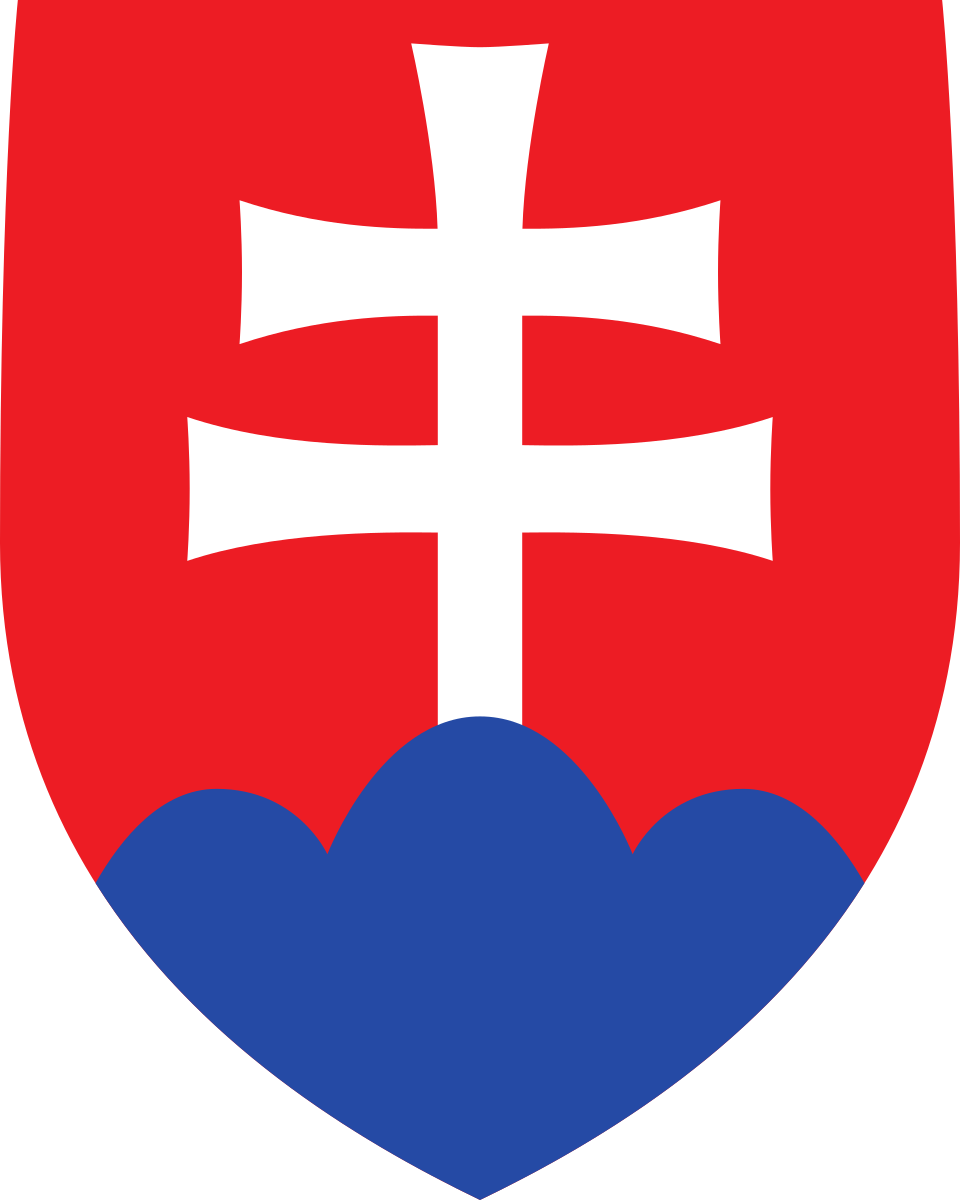
| Central charge | Patriarchal cross Argent on a mount of three peaks Azure |
| Three hills | Traditionally read as Tatra, Fatra and Mátra |
| Subdivisions | 8 self-governing regions (kraje), since 2002 |
Coat of Arms of Slovakia — Gules, on a mount of three peaks Azure, a patriarchal cross Argent. Codified by Constitutional Law 460/1992.
Gules, on a mount of three peaks Azure, a patriarchal cross Argent, the arms of the cross of equal length, the upper arm shorter than the lower, the ends flared and slightly concave.
The composition observes the classic metal-on-colour rule (silver on blue on red) and reproduces, with negligible variation, the shield fixed on the Great Seal of Béla III eight centuries ago. The Slovak arms are among the oldest continuously-used sovereign charges in central Europe.
| Colour | Heraldic name | Element | Traditional symbolism |
|---|---|---|---|
| Red | Gules | Field | Sovereignty; the field of the medieval Hungarian royal arms |
| Blue | Azure | Three-peaked mount | The mountains of the northern march; blue is later than the red field (17th c.) |
| Silver | Argent | Patriarchal cross | Christianity, dignity; the metal of the original 12th-century seal |
The double cross (crux gemina, patriarchal cross) is not native to Latin Europe. It arrives through the Byzantine court, where it served as the standard sign of the Ecumenical Patriarch and, more generally, of ecclesiastical dignity. Its passage into Hungarian royal iconography is documented on the reverse of the great seal of King Béla III (r. 1172–1196), whose formative years were spent at Constantinople as the designated successor of Emperor Manuel I Komnenos. When Béla returned to Hungary in 1172, he brought with him a Byzantine chancery style, including the double cross.
The Golden Bull of Andrew II (1222) and the seals of subsequent Árpád kings show the cross elevated on a mount, sometimes single, from the 13th century on triple — the form that stabilises into the modern Slovak arms.
The three peaks are traditionally identified with the three mountain ranges of the medieval Hungarian northern march: the Tatra (High Tatras), the Fatra (Great and Little Fatra) and the Mátra. Two of the three lie in modern Slovakia; the Mátra lies in present-day Hungary, and its inclusion preserves the pre-1918 geography of Upper Hungary rather than the political map of the Slovak Republic. This survival is deliberate: the modern state took over the arms without editing the mountains to match its post-Trianon borders.
c. 1190 — The Seal of Béla III. The double cross appears on the royal seal, without a mount, on a plain field.
1222 — Golden Bull of Andrew II. The double cross is shown on a single mount — the first ancestor of the three-peaked composition.
Late 13th century — The single mount is subdivided into three peaks; the shape stabilises for the arms of Upper Hungary.
1848 — The Slovak National Council. During the revolutions of 1848, the volunteers under Łudovít Štúr and Josef Miloslav Hurban raise the arms of Upper Hungary as the emblem of an emerging Slovak national identity.
1918–1938 — First Czechoslovakia. The Slovak arms enter the composite arms of the First Czechoslovak Republic (great arms of 1920) as one of the quartered elements.
1939–1945 — First Slovak Republic. The double cross on three hills is used as the state arms, though the regime’s wartime associations complicate the historiography of this episode.
1960–1990 — Communist Federation. The socialist Czechoslovak Republic replaces the arms with a shield derived from Hussite iconography: the Bohemian lion charged with a red star. The Slovak double cross is set aside for three decades.
1990 — Restoration. Constitutional Law 220/1990 reintroduces the historic arms within the still-federal state.
1 September 1992 — Constitutional Anchoring. The Constitution of the Slovak Republic (Constitutional Law 460/1992) fixes the modern form, ahead of the peaceful dissolution of Czechoslovakia on 1 January 1993.
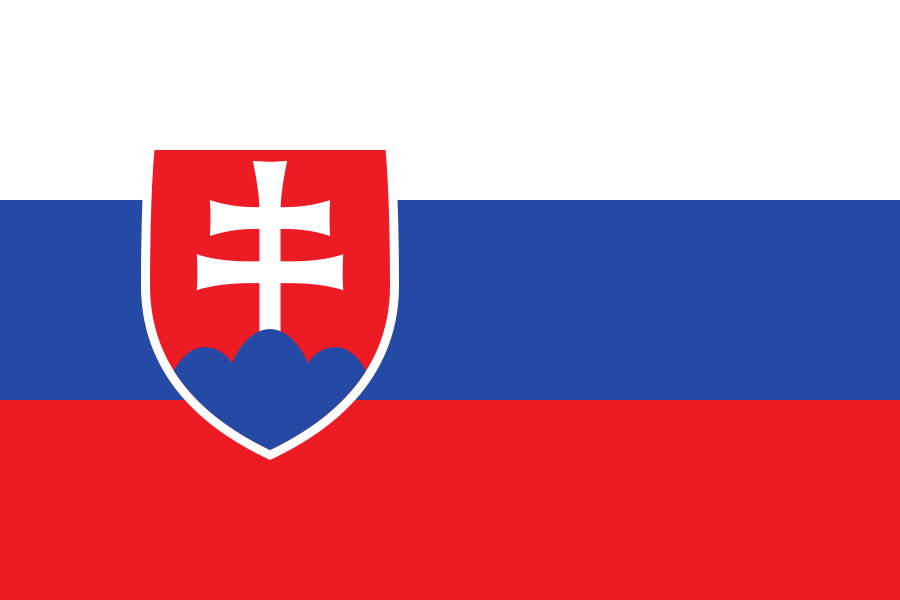
Flag of Slovakia — Three equal horizontal bands: white (top), blue (middle), red (bottom); charged with the national coat of arms near the hoist. Ratio 2:3.
The white-blue-red tricolour is a product of the Prague Slavic Congress of 1848, which crystallised a shared visual vocabulary for the Slavic nationalisms of central and southern Europe. The sequence itself derives from the flag of the Russian Empire, adopted by Aleksandr III in 1883 but already in maritime use since Pyotr Velikiy. Slovak revolutionaries under Łudovít Štúr, Michal Miloslav Hodža and Josef Miloslav Hurban raised a white-blue-red banner during the Slovak Uprising of September 1848.
A plain white-blue-red tricolour would be visually identical to the flag of the modern Russian Federation, and difficult to distinguish at a glance from those of Slovenia, Serbia and Croatia. When the tricolour was reintroduced by Constitutional Law 220/1990 within the still-federal Czechoslovakia, the national coat of arms was placed near the hoist, covering the middle band with an azure shift into the white and red bands.
The 1992 Constitution confirmed the design without modification and defined the precise proportions in an annex: the shield is centred on the vertical axis between the top and bottom edges of the flag, its width equal to half the flag’s hoist.
September 1848 — First raised by the volunteers of the Slovak National Council.
1918–1938 — Within the First Czechoslovak Republic, the tricolour is used regionally; the state flag is the Czechoslovak white-red with blue triangle.
1939–1945 — The First Slovak Republic uses a horizontal white-blue-red, without the coat of arms.
1990 — Constitutional Law 220/1990 restores the tricolour with the coat of arms added.
1992 — Constitutional Law 460/1992 codifies the modern design.
| Polity | Cross type | Field | Distinctive feature |
|---|---|---|---|
| Slovakia | Patriarchal (2 arms) | Gules | Three-peaked mount Azure |
| Hungary | Patriarchal (2 arms) | Gules dexter | Impaled with the Árpád bars |
| France (Lorraine) | Cross of Lorraine | Or | Angevin variant, arms of unequal length |
| Ecumenical Patriarchate of Constantinople | Patriarchal, ecclesiastical | — | The source form (Byzantine) |
| Flag | Order (top to bottom) | Distinguishing device |
|---|---|---|
| Russia | White – Blue – Red | None |
| Slovakia | White – Blue – Red | Coat of arms near hoist |
| Slovenia | White – Blue – Red | Coat of arms at hoist, canton style |
| Serbia | Red – Blue – White | Coat of arms near hoist |
| Croatia | Red – White – Blue | Coat of arms centred |
Since the reform of 2002, Slovakia is divided into eight self-governing regions (samosprávne kraje), each with its own arms confirmed by the Heraldic Commission of the Ministry of Interior:
Click on Slovakia on the interactive map above to browse the emblems of the eight regions.
It is the patriarchal cross (crux gemina) — a cross with two horizontal arms, the upper shorter than the lower. It entered European heraldry from Byzantium through the Hungarian court in the late 12th century and became the emblem of Upper Hungary, the medieval territory that corresponds to modern Slovakia.
By long-standing tradition they stand for Tatra, Fatra and Mátra — the three mountain ranges of the medieval Kingdom of Hungary’s northern march. The Mátra now lies in Hungary; the reading survives as a memory of the pre-1918 geography of Upper Hungary, deliberately preserved by the modern state.
The modern form was codified by the Constitution of the Slovak Republic (Constitutional Law 460/1992), passed on 1 September 1992 and in force from 1 October 1992, three months before the dissolution of Czechoslovakia. It had already been reintroduced within the federation by Law 220/1990.
The plain white-blue-red tricolour would be visually identical to the flag of the modern Russian Federation and hard to distinguish from those of Slovenia, Serbia or Croatia. When the flag was reintroduced by Law 220/1990, the coat of arms was placed near the hoist to differentiate the Slovak ensign within the Pan-Slavic family.
White-blue-red is the Pan-Slavic sequence popularised after the Prague Slavic Congress of 1848, itself derived from the flag of the Russian Empire (Pyotr Velikiy, 1696; Aleksandr III, 1883). It was first raised as a Slovak national flag by the volunteers of the Slovak National Council under Łudovít Štúr in the uprising of September 1848.
Last reviewed by the Emblema Mundi editorial team on 5 July 2026.