Country
The national emblems of Serbia layer eight centuries of Balkan heraldry into a single composition. The silver double-headed eagle is a Byzantine inheritance, transmitted to the Serbian court through the Nemanjić dynasty and its dynastic marriages with the Palaiologan emperors of Constantinople. The cross flanked by four firesteels (ocila) — the “Serbian Cross” — carries a Byzantine imperial motto encoded in stylised Greek letters, absorbed into Serbian usage in the 14th century. The red-blue-white tricolour was fixed by the Sretenje Constitution of 15 February 1835, one of the earliest liberal constitutions in Europe. All three converge in the modern arms and flag codified by the Law of 11 August 2004.
Flag
Not available
Coat of Arms
Not available
| Country | Republic of Serbia (Република Србија / Republika Srbija) |
|---|---|
| Coat of arms adopted | Law on the Coat of Arms, Flag and Anthem of the Republic of Serbia, 11 August 2004 |
| Flag adopted | Sretenje Constitution, 15 February 1835 (OS); current form fixed by the 2004 Law |
| Flag ratio | 2:3 |
| Earliest arms | Seals of Stefan Nemanja and his successors, 12th–14th centuries |
| Tinctures (arms) | Gules, Argent, Or |
| Central charge | Double-headed eagle displayed Argent; inescutcheon Gules with cross Argent between four ocila |
| Motto encoded in cross | Four ocila, from Byzantine Basileus Basileon |
| Subdivisions | 29 districts + Belgrade City; 2 autonomous provinces (Vojvodina; Kosovo and Metohija, of disputed status under international law) |
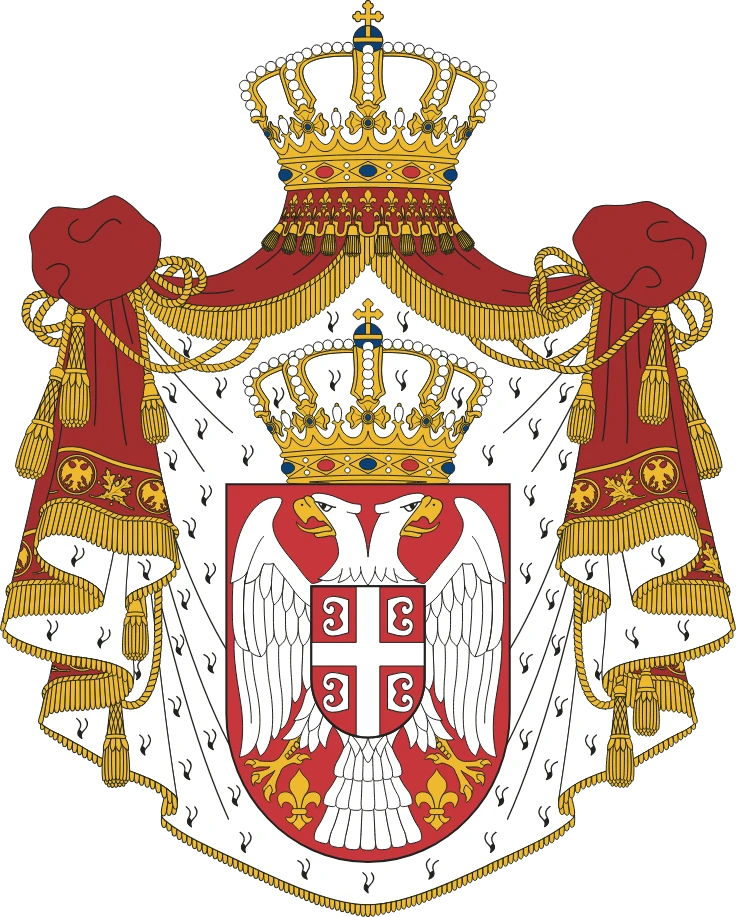
Coat of Arms of Serbia — Gules, a double-headed eagle Argent, inescutcheon with cross and four ocila. Adopted 11 August 2004.
Gules, a double-headed eagle displayed Argent, langued and armed Or, holding in its dexter claw a fleur-de-lys Or and in its sinister a fleur-de-lys of the same; on its breast an inescutcheon Gules, thereon a cross Argent between four firesteels (ocila) Argent addorsed. The shield surmounted by the historical crown of the Kingdom of Serbia; in the Great arms, the whole enclosed in a mantle Gules doubled ermine, ensigned with the crown.
Two forms are officially defined: the Great arms, with mantle and full royal display, used at the highest ceremonial level (Presidency, Constitution); and the Small arms, the shield with crown alone, used on the state flag and by most institutions.
| Colour | Heraldic name | Element | Traditional symbolism |
|---|---|---|---|
| Red | Gules | Field, mantle, inescutcheon | Sovereignty, sacrifice; the field of the medieval Nemanjić arms |
| Silver | Argent | Eagle, cross, firesteels | Purity; the metal of the medieval seals |
| Gold | Or | Crown, claws, fleurs-de-lys | Royal dignity; continuity with the Kingdom of Serbia |
The two-headed eagle enters Serbian heraldry through the same channel that carried it to Muscovy: dynastic union with the Palaiologan house of Constantinople. The critical alliance was the marriage of Simonida Palaiologina, daughter of Emperor Andronikos II Palaiologos, to King Stefan Milutin around 1299. Serbian court iconography absorbed Byzantine imperial vocabulary in the following decades; the double-headed eagle appears on the coinage and seals of Milutin’s successors, most conspicuously on those of Stefan Dušan (r. 1331–1355), who proclaimed himself “Emperor of the Serbs and Greeks” in 1345.
The Serbian eagle differs from its Byzantine model in one telling respect: it is silver on red, not gold on red. The choice inverts the Holy Roman and Russian eagles (gold on red / gold on gules) and matches the Serbian marker of royal-yet-national identity that stabilises in the 19th century.
The inescutcheon — a cross with four flanking devices — is the visual signature of medieval Serbia. The four charges are known as ocila — firesteels — but they too descend from Byzantium. In the imperial arms of the Palaiologan dynasty, four Greek letters B (Beta) flanked the cross of Saint George, abbreviating the imperial motto Basileus Basileon Basileuon Basileuousi — “King of Kings ruling over kings.”
When Serbian heraldry adopted the composition, the letters were stylised into a form that looked more like firesteels than Greek letters. The transformation was gradual; late medieval Serbian exemplars still show clearly Beta-shaped charges, while post-Ottoman exemplars are unambiguously ocila.
A widespread modern reading interprets the four charges as Cyrillic С (S) standing for Samo Sloga Srbina Spašava — “Only Unity Saves the Serbs.” This motto was coined in the 19th century and retrofitted onto the medieval cross; it is a folk etymology, not the historical origin, though it has since become deeply attached to the emblem in popular culture.
12th century — Stefan Nemanja. The founder of the Nemanjić dynasty (r. 1166–1196) uses a shield with variants of the cross-and-charges. Standing eagle motifs, without heads doubled, appear on his silver coinage.
c. 1299 — Milutin–Simonida marriage. The Palaiologan connection introduces the double-headed eagle to the Serbian court.
1345 — Stefan Dušan. Proclaimed Emperor at Skopje; the arms crystallise into their medieval form, with double-headed silver eagle and cross-with-firesteels.
1389 — Battle of Kosovo. The gradual weakening of Nemanjić power; the arms continue in use by regional lords (Lazar Hrebeljanović, the Brankovićs).
1459 — Ottoman Conquest. No sovereign Serbian heraldry for over three centuries; the arms survive in monastic manuscripts, in the arms of the Hungarian Serbian nobility, and in armorials of Central Europe (Ohmučević, Fojnica).
15 February 1835 — The Sretenje Constitution. Prince Miloš Obrenović promulgates one of the earliest liberal constitutions in Europe; the tricolour is fixed.
1882 — The Kingdom of Serbia. Under King Milan I Obrenović, the full royal arms are formalised: the medieval eagle-and-cross composition, historical crown, mantle. This is the direct model for the 2004 restoration.
1918–1945 — Kingdom of Serbs, Croats and Slovenes (1918); Kingdom of Yugoslavia (from 1929). Serbian arms integrated into composite royal Yugoslav arms.
1945–1990 — SFR Yugoslavia. The eagle-and-cross is abolished; SR Serbia bears a socialist emblem — wheat wreath around a landscape with a red star.
1992–2003 — Federal Republic of Yugoslavia; from 2003 State Union of Serbia and Montenegro. Interim arms of variable authority.
11 August 2004 — The Republic of Serbia enacts the Law on State Symbols, restoring the 1882 arms in Great and Small forms. Refined by presidential decree of 11 November 2010.
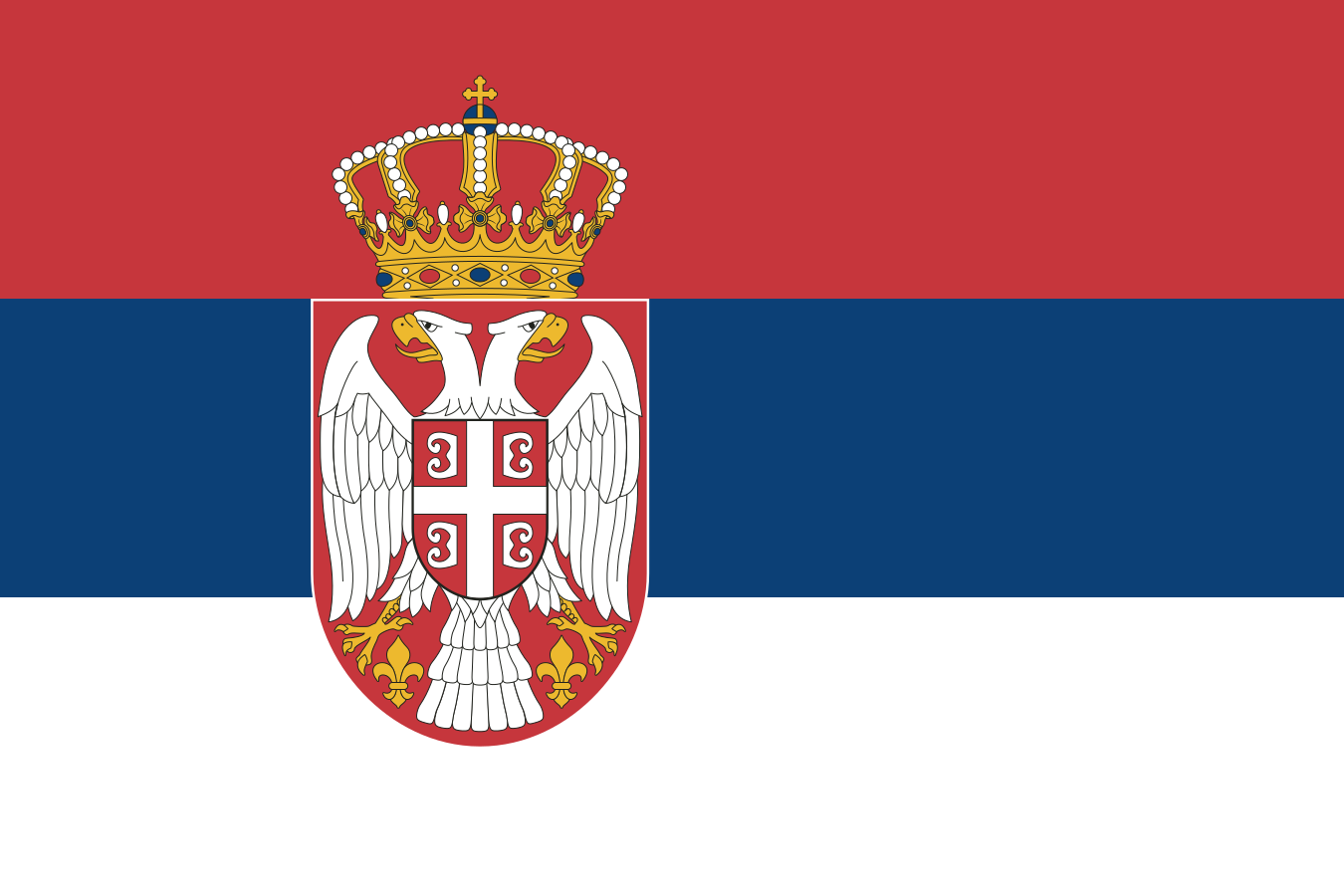
Flag of Serbia — Three equal horizontal bands: red (top), blue (middle), white (bottom); the state variant charged with the Small Coat of Arms near the hoist. Ratio 2:3.
The red-blue-white tricolour is fixed on 15 February 1835 (Old Style) by the Sretenje Constitution, promulgated by Prince Miloš Obrenović at the meeting of the Great National Assembly held on the feast of the Presentation of the Lord (Sretenje) at Kragujevac. It is one of the first liberal constitutions in Europe, drafted with a strong French inspiration by Dimitrije Davidović.
The Sretenje decree does not fix a meaning for the colours; the earliest Serbian tricolours from 1804 already carry the three tinctures in variable order. The sequence red-blue-white stabilises as a marker of Serbian identity by the 1830s and is later reinterpreted through the Pan-Slavic vocabulary that emerges after the Prague Congress of 1848. The three colours reappear, in different orders, on the flags of:
| State | Order (top to bottom) | Distinguishing device |
|---|---|---|
| Serbia | Red – Blue – White | Small Coat of Arms near hoist (state variant) |
| Russia | White – Blue – Red | None (Pyotr Velikiy, 1696) |
| Slovakia | White – Blue – Red | Coat of arms near hoist |
| Slovenia | White – Blue – Red | Coat of arms at hoist |
| Croatia | Red – White – Blue | Coat of arms centred |
The 2004 law defines two forms:
The state variant echoes the Russian Federation practice on some official flags and, structurally, matches the Slovak solution: the arms distinguish the ensign from its Pan-Slavic cousins.
Serbia belongs to a small family of Christian Orthodox states whose modern arms trace back to the Byzantine double-headed eagle. Their divergent choices illuminate what each polity foregrounded:
| State | Eagle tincture | Field | Distinctive feature |
|---|---|---|---|
| Serbia | Argent | Gules | Cross with four ocila on inescutcheon |
| Russia | Or | Gules | Saint George inescutcheon; three crowns |
| Holy Roman Empire | Sable | Or | Halos around each head |
| Albania | Sable | Gules | No charge on breast |
| Montenegro | Or | Gules | Lion on inescutcheon |
The five modern polities all share the Byzantine archetype. Serbia’s silver-on-red inversion, together with the survival of the cross-and-ocila, gives its arms the most direct visual continuity with the medieval Nemanjić original.
Serbia is divided administratively into 29 districts (okruzi) plus the City of Belgrade, and two autonomous provinces: Vojvodina (northern; largely former Habsburg territory) and, in Serbia’s constitutional view, Kosovo and Metohija. The status of Kosovo is contested under international law — recognised as an independent republic by a majority of UN member states, contested by Serbia and by several others; a full heraldic account of the territory appears on its own page.
Notable regional emblems:
Click on Serbia on the interactive map above to browse the emblems of the districts and provinces.
The double-headed eagle entered Serbian heraldry from Byzantium in the 12th century through the Nemanjić dynasty. It is documented on the seals of Stefan Nemanja and his successors, following the marriage of Simonida Palaiologina, daughter of Emperor Andronikos II Palaiologos, to Stefan Milutin around 1299. The two heads signify the dual gaze of empire — east and west, spiritual and temporal — the same imperial vocabulary later borrowed by Muscovy and by the Holy Roman Empire.
The four ocila flanking the cross derive from Byzantine Palaiologan heraldry, where they appeared as four Greek letters Beta (B) said to abbreviate Basileus Basileon Basileuon Basileuousi — “King of Kings ruling over Kings.” Serbian tradition transformed the Bs into stylised firesteels. A modern popular reading interprets the four shapes as Cyrillic С standing for Samo Sloga Srbina Spašava (“Only Unity Saves the Serbs”), a 19th-century motto retrofitted onto the medieval cross — folk etymology rather than historical origin.
The 2004 law names the crown as the historical crown of the Kingdom of Serbia, not the dynastic crown of the Karađorđević family. It is retained as a symbol of continuity with the medieval Serbian state under the Nemanjić dynasty — the same reasoning applied by Bulgaria in 1997.
The Great and Small Coats of Arms were fixed by the Law on the Coat of Arms, Flag and Anthem of the Republic of Serbia on 11 August 2004, following the disintegration of the State Union of Serbia and Montenegro. The composition draws directly on the arms of the Kingdom of Serbia of 1882 as codified under Milan I Obrenović.
The tricolour was first adopted under the Sretenje Constitution of 15 February 1835. The sequence is a variant of the Pan-Slavic vocabulary popularised after 1848, itself derived from the Russian tricolour. Serbia and Croatia invert the Russian order (Russia has white-blue-red).
Last reviewed by the Emblema Mundi editorial team on 5 July 2026.