Country
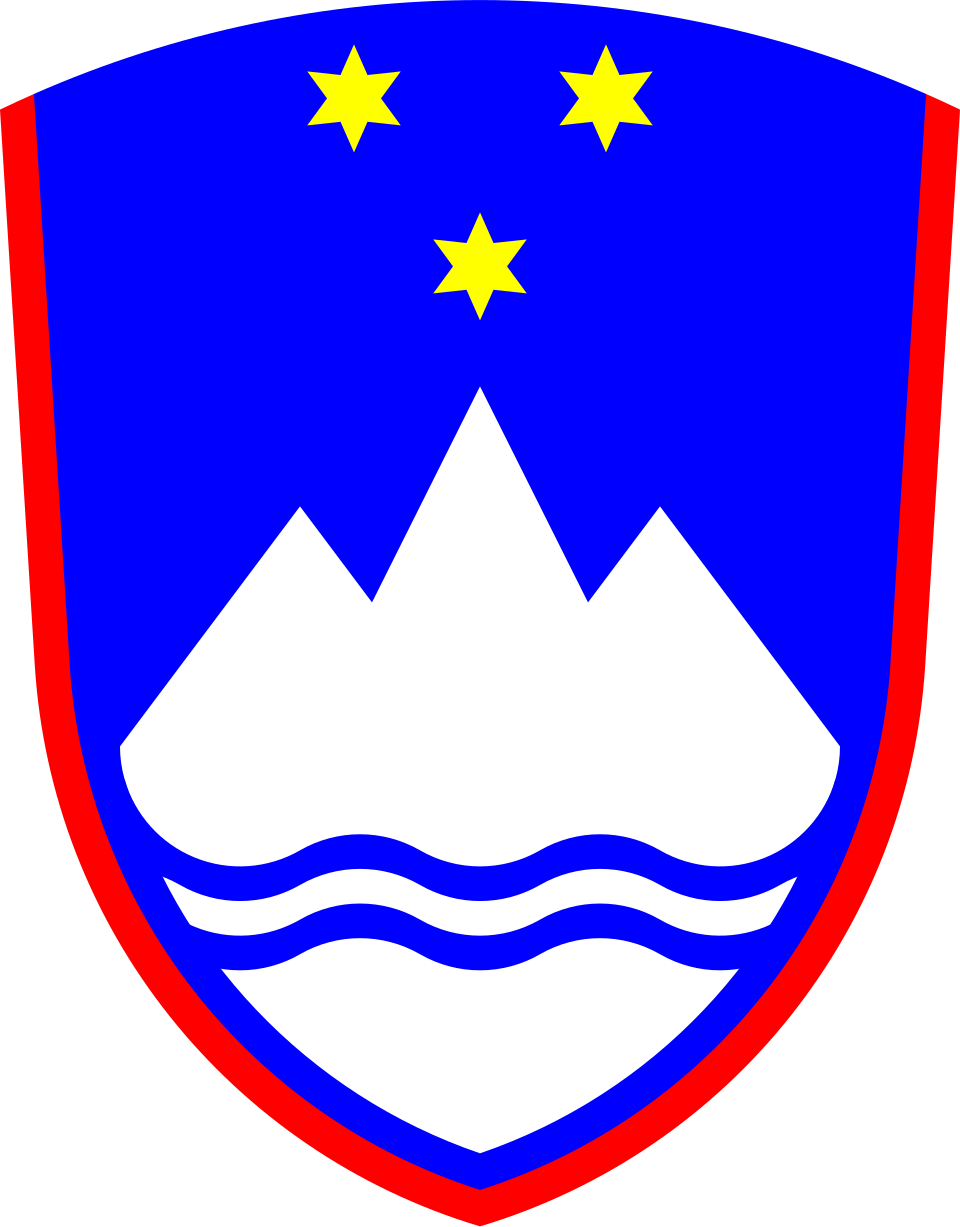
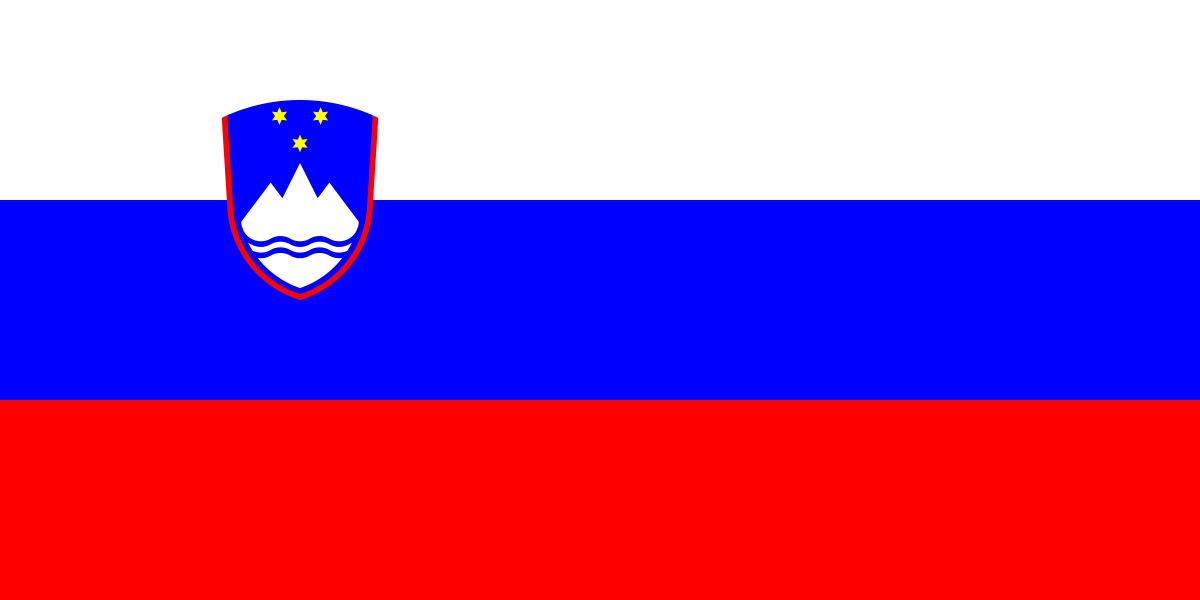
The national emblems of Slovenia fold the country’s landscape and its medieval past into one modern composition. The coat of arms shows Mount Triglav — the three-headed peak that is Slovenia’s foremost national symbol — above two wavy lines for the sea and the rivers, crowned by three golden stars borrowed from the arms of the Counts of Celje (Celjski grofje), the greatest noble house ever to rule on Slovene soil. The white-blue-red tricolour, first raised in Ljubljana in 1848, carries the same Pan-Slavic colours as its Slovak and Russian cousins. Both were remade in 1991, when the artist Marko Pogačnik designed the new arms and the socialist red star was struck from the flag.
Flag
Not available
Coat of Arms
Not available
| Country | Republic of Slovenia (Republika Slovenija) |
|---|---|
| Coat of arms adopted | Constitutional amendment, 24 June 1991; codified by the Act on the Coat of Arms, Flag and Anthem (Uradni list RS 67/1994) |
| Designer of arms | Marko Pogačnik, 1991 |
| Flag adopted | Slovene tricolour first raised 7 April 1848; current national flag 27 June 1991 |
| Flag ratio | 1:2 |
| Tinctures (arms) | Azure, Argent, Or, Gules |
| Central charge | Mount Triglav Argent on a base barry wavy; three mullets Or in chief |
| Source of the stars | Arms of the Counts of Celje (Celjski grofje), inherited from the Counts of Heunburg, 1322 |
| Anthem | Zdravljica (7th stanza), words by France Prešeren, music by Stanko Premrl |
| Subdivisions | 212 municipalities (občine); 12 statistical regions; historic lands of Carniola, Styria, Carinthia, Gorizia and Prekmurje |
Coat of Arms of Slovenia — Azure, Mount Triglav Argent over a base barry wavy, three mullets Or in chief, within a bordure Gules. Adopted 24 June 1991.
Azure, on a base barry wavy Argent and Azure a mountain of three peaks Argent (Mount Triglav); in chief three mullets of six points Or arranged in an inverted triangle (two and one); all within a bordure Gules.
The arms are unusual among European national emblems in owing almost nothing to classical chivalric heraldry: they were composed from scratch in 1991 as a deliberate landscape emblem. Only the three stars are a genuine heraldic quotation — the rest is a stylised portrait of the country itself.
| Colour | Heraldic name | Element | Traditional symbolism |
|---|---|---|---|
| Blue | Azure | Field of the shield | The sky over the Alps; sovereignty and the heavens |
| White / silver | Argent | Mount Triglav; the wavy lines | The snow of the peak; purity; the waters of sea and rivers |
| Gold | Or | The three stars | The Counts of Celje; per Pogačnik, democracy |
| Red | Gules | The bordure | Frames the shield; the third national colour |
Triglav (2,864 m) is the highest peak of the Julian Alps and of Slovenia, and the single most potent symbol of Slovene identity — so much so that its silhouette also appears on the pre-euro tolar coins and on countless institutional badges. Its name means “three heads” (tri glave), which the arms render literally as a three-peaked white mountain. A folk tradition holds that every Slovene should climb Triglav at least once in their life.
Beneath the mountain, the two wavy lines stand for the Adriatic sea along Slovenia’s short coast and for the country’s rivers. The designer, Marko Pogačnik, described the pairing in his own symbolic language: the mountain as a “male” principle rising, the water as a “female” principle below, the whole shield conceived as what he called a cosmogram — an energetic figure meant to protect and quicken the young state. This mystical reading is the designer’s own; the state law fixes only the visual form, not its meaning.
The only element carried over from historical heraldry is the trio of three golden six-pointed stars, set in an inverted triangle above the peak. They are the arms of the Counts of Celje (Celjski grofje; German Grafen von Cilli), the most powerful dynasty ever to rise on Slovene territory. From their seat at Celje they climbed, in barely a century, from provincial lords to princes of the Empire and kingmakers of Central Europe.
The stars themselves are older than the Celje family. As the Lords of Žovnek (Sanneck), they inherited the three golden stars on a blue field from the Carinthian Counts of Heunburg in 1322. Under Count Herman II (c. 1365–1435) the house reached the summit of European politics: his daughter Barbara of Celje married Sigismund of Luxembourg, King of Hungary and Holy Roman Emperor, making her Empress. The last of the line, Ulrik II (1406–1456), was for a time regent of Hungary before he was assassinated in Belgrade in 1456, extinguishing the dynasty. The same three stars had already been absorbed into the emblem of the Kingdom of Yugoslavia between the World Wars, and in 1991 they passed into the arms of independent Slovenia — a rare thread of continuity linking the medieval and modern Slovene states.
As Slovenia moved toward independence in early 1991, a public competition was opened for a new coat of arms; it drew 87 proposals, from which four finalists were chosen. The winning design by Marko Pogačnik — sculptor, land artist and cofounder of the 1960s avant-garde group OHO — was proclaimed by constitutional amendment on 24 June 1991, the day before Slovenia declared its independence. Pogačnik cited the poet France Prešeren’s epic Krst pri Savici (“The Baptism on the Savica”) and an unrealised 1934 proposal by the architect Jože Plečnik among his inspirations.
1322 — The stars enter the family. The Lords of Žovnek inherit the three golden stars on blue from the Counts of Heunburg.
1341–1456 — The Counts of Celje. Raised to comital and then princely rank; Barbara of Celje becomes Empress; the line ends with the murder of Ulrik II in 1456.
1918–1941 — Kingdom of Yugoslavia. The three Celje stars are incorporated into the composite Yugoslav royal emblem.
1945–1991 — Socialist Republic of Slovenia. A socialist emblem (Triglav, sea, wheat and a red star within a wreath) serves as the republican arms inside federal Yugoslavia.
24 June 1991 — Independence arms. Marko Pogačnik’s Triglav-and-stars design is adopted by constitutional amendment on the eve of independence.
1994 — Codification. The Act on the Coat of Arms, Flag and Anthem of the Republic of Slovenia and on the Slovene National Flag (Uradni list RS 67/1994) fixes the exact geometry and use of all state symbols.
Flag of Slovenia — Three equal horizontal bands, white over blue over red, charged near the upper hoist with the coat of arms straddling the white and blue bands. Ratio 1:2.
The Slovene white-blue-red tricolour was first raised in Ljubljana on 7 April 1848, during the Spring of Nations, by students led by Lovro Toman — reportedly hoisted at Ljubljana Castle in answer to a German black-red-gold flag flown there. The gesture turned a set of provincial colours into a national banner almost overnight, and the sequence has represented the Slovene nation ever since.
The three colours are usually read as Pan-Slavic, part of the shared vocabulary that spread after the Prague Slavic Congress of 1848 and that ultimately echoes the flag of Russia. They also have a local root: the historic arms of the Duchy of Carniola (Kranjska) — a blue eagle on a silver field with a red-and-gold crescent — supplied white, blue and red long before Pan-Slavism gave them a wider meaning. The same three tinctures, in different orders, mark a whole family of Slavic flags:
| State | Order (top to bottom) | Distinguishing device |
|---|---|---|
| Slovenia | White – Blue – Red | Coat of arms at the upper hoist |
| Slovakia | White – Blue – Red | Coat of arms centred toward the hoist |
| Russia | White – Blue – Red | None |
| Serbia | Red – Blue – White | Coat of arms near the hoist (state flag) |
| Croatia | Red – White – Blue | Coat of arms centred |
Through the Yugoslav decades the tricolour carried a red five-pointed star edged in gold at its centre. When Slovenia became independent, the star was removed and the new coat of arms put in its place, set near the upper hoist so that the shield straddles the white and blue bands. The current national flag was adopted on 27 June 1991, two days after the declaration of independence, and its exact proportions and construction were later fixed by the 1994 Act.
The 1994 law sets the national flag at a ratio of 1:2, each of the three bands one-third of the width, with the arms placed at the hoist. Alongside it the law also recognises the plain Slovene national flag (slovenska narodna zastava), the bare tricolour without arms, used as an ethnic and cultural banner.
Slovenia is divided into 212 municipalities (občine) and, for statistical purposes, 12 regions; beneath these lie the older historic lands whose arms still shape local identity:
Click on Slovenia on the interactive map above to explore the emblems of its regions and municipalities.
The three golden six-pointed stars, set in an inverted triangle above Mount Triglav, are taken from the arms of the Counts of Celje (Celjski grofje), the most powerful late-medieval dynasty on Slovene soil. The Counts had inherited the stars on a blue field from the Carinthian Counts of Heunburg in 1322. Designer Marko Pogačnik said that in the modern arms the stars symbolise democracy.
It is Mount Triglav (2,864 m), Slovenia’s highest peak and its foremost national symbol. Its name means “three heads” (tri glave), which the arms show as a stylised white three-peaked mountain. The two wavy lines beneath it represent the Adriatic sea and the country’s rivers.
The artist Marko Pogačnik designed it in 1991, after a public competition that drew 87 proposals. His design was adopted by constitutional amendment on 24 June 1991, on the eve of independence, and later codified by the Act on the Coat of Arms, Flag and Anthem (Uradni list RS 67/1994).
The white-blue-red Slovene tricolour was first raised in Ljubljana on 7 April 1848, by students led by Lovro Toman. The current national flag — tricolour with the new arms and no star — was adopted on 27 June 1991, two days after independence.
Both are white-blue-red horizontal tricolours in the Pan-Slavic colour scheme and share the same band order as Russia’s flag. Each is told apart by its own coat of arms: Slovenia’s Triglav-and-stars shield sits at the upper hoist, while Slovakia’s double-cross shield is set toward the centre.
During the Socialist Republic of Slovenia the tricolour carried a red five-pointed star edged in gold at its centre. On independence in 1991 the star was removed and replaced by the new coat of arms.
Last reviewed by the Emblema Mundi editorial team on 12 July 2026.