US City
Tulsa has the best-rated new city flag in the United States, and it earned that by doing something no other emblem in this atlas does. The city’s seal, adopted in 1967, records oil, rivers, an arrowhead and forty-six stars — a tidy inventory of assets. The flag Tulsans voted for in 2018 keeps every one of those things and adds the one the seal leaves out: a red circle for the massacre of 1921.

Click on a country to learn more
| City | Tulsa, Oklahoma |
|---|---|
| Founded | 1879 |
| Incorporated | 1898 — the date on the seal |
| Seal adopted | 1967 |
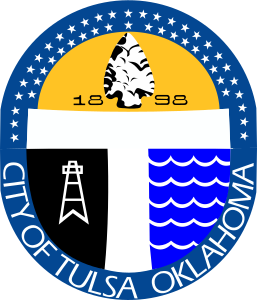
| Seal | An ellipse divided by white into a letter T: an arrowhead and 46 stars on gold above, an oil derrick on black and waves on blue below |
| Current flag adopted | 3 October 2018, unanimously |
| Designers | Jordan Michael Winn, from a concept sketch by Dakota Lee Bryant |
| Rights | Released under a CC0 licence |
| Proportions | 2:3 |
| NAVA 2022 survey | 1st of 312, scoring 8.17 |
Flag of Tulsa — a navy upper half and a beige lower half divided by a gold line, with a gold Native American shield towards the hoist holding a red circle and a beige star. Navy for the Arkansas River, gold for the discovery of oil in 1901, the red circle for the lives lost in the 1921 massacre. Adopted 3 October 2018.
A navy upper half, a beige lower half, a gold line between them, and towards the hoist a gold Native American shield holding a red circle with a beige star. Proportions 2:3. No lettering anywhere.
It was designed by Jordan Michael Winn, from a concept sketch by Dakota Lee Bryant, chosen by public vote through the Tulsa Flag Project, and adopted unanimously by the city council on 3 October 2018. The design was released under a CC0 licence, in the public domain.
| Navy field | The Arkansas River, and the resources it has provided throughout the city’s history |
|---|---|
| Gold line | The discovery of oil in 1901 — the “black gold” that brought growth and commerce |
| Gold shield | The settlement of the area by Native American tribes; a simplified form of the shield on the Oklahoma state flag |
| Red circle | The blood shed and lives lost in the 1921 Tulsa Race Massacre, which destroyed Black Wall Street |
| Beige star | Tulsa’s future, and a reference to the city’s Art Deco architecture; healing |
| Beige field | The warmth and community found in Tulsa |
Look back at the 1967 seal and you will find the flag has kept its whole vocabulary, abstracted:
That is the discipline that wins these surveys. The designers did not invent a new set of meanings; they took the ones the city already had and found the simplest possible shape for each. It is the same move Phoenix made in 1987 when it lifted the bird out of its 1881 seal and dropped the ring of lettering.
And then they added one thing that was not in the seal.
On 31 May and 1 June 1921, mobs of white residents — some of them armed and deputised by city officials — attacked the Greenwood District of Tulsa, the Black neighbourhood known as Black Wall Street.
They burned more than 35 square blocks. The Red Cross recorded 1,256 houses burned and another 215 looted, along with 191 businesses, a junior high school and several churches. About 10,000 Black residents were left homeless. Official state records listed 36 dead; the later state commission gave estimates ranging from 39 to around 300.
The published symbolism of the flag gives the red circle as the blood shed and the lives lost.
The massacre was largely omitted from local, state and national histories for years. It was not until 1997 that the state legislature authorised a commission to study it, and the findings were published in 2001.
Set the two dates side by side and the emblems explain themselves:
This is worth stating carefully, because it is a genuinely unusual thing for a civic emblem to do. Coats of arms and civic seals are almost always claims: what a place has, makes, ships, or descends from. They commemorate disasters only when the city was the victim — Atlanta’s phoenix rises from a fire set by armies, San Francisco’s from the fires of the gold rush.
Tulsa’s red circle is not that. It marks something the city’s own population did to another part of itself, and it was put there by a public vote. Whatever one concludes about the design, that is not a common thing to find on a flag.
Compare the one other live case in this atlas. In Seattle a tribe asked the city in 2021 either to live up to the values of the man on its seal or to stop using his face, and reported no reply. Both cities are working out what an emblem owes to the people it depicts. Tulsa answered the question on the flag itself.
Seal of Tulsa — a vertical ellipse divided by white into the letter T: on gold above, an arrowhead bearing the numerals 1, 8, 9 and 8 for 1898, surrounded by two rows of blue stars, forty-six in number; below, a white oil derrick on black and white arcs on blue. The rim reads City of Tulsa Oklahoma.
The corporate seal was adopted in 1967, and for a civic seal it is unusually graphic — less an engraved scene than a piece of mid-century design.
It is a modified vertical ellipse, divided by bands of white into three fields that together form the letter T, the initial of the city.
The whole is circumscribed “City of Tulsa Oklahoma” in gold letters.
| The T | The initial of the city’s name |
|---|---|
| The arrowhead | The importance of the early Native Americans in the region, and their continuing influence |
| The 46 stars | Oklahoma as the forty-sixth state admitted to the Union, on 16 November 1907 |
| The derrick | The petroleum industry, and the speed at which it built the city |
| The waves | The Arkansas and Caney Rivers, and Keystone Lake |
Note the count: forty-six stars for the forty-sixth state. It is a habit of American civic design — when in doubt, count something.
The navy field stands for the Arkansas River, the gold line for the discovery of oil in 1901, and the beige lower field for the warmth and community of the city. Towards the hoist is a gold Native American shield, drawn from the Oklahoma state flag; the red circle within it stands for the blood shed and lives lost in the 1921 Tulsa Race Massacre, and the beige star for the city’s future and its Art Deco architecture.
It commemorates the Tulsa Race Massacre of 31 May and 1 June 1921, when white mobs attacked and destroyed the Greenwood District, known as Black Wall Street. The city’s published symbolism gives it as the blood shed and the lives lost. The older city seal makes no reference to the massacre at all.
Jordan Michael Winn was the primary designer, working from an initial concept sketch by Dakota Lee Bryant. Their design was chosen by public vote through the Tulsa Flag Project.
On 3 October 2018, by a unanimous vote of the city council. The design was released under a CC0 licence, placing it in the public domain for anyone to use or reinterpret.
A vertical ellipse divided by white into the letter T. The upper gold field carries an arrowhead with the numerals 1, 8, 9 and 8 for 1898, surrounded by two rows of blue stars, forty-six in number. The lower left quadrant is black with a white oil derrick; the lower right is blue with white arcs suggesting waves. The rim reads “City of Tulsa Oklahoma”.
Because Oklahoma was the forty-sixth state admitted to the Union, on 16 November 1907. The numerals inside the arrowhead give 1898, the year Tulsa was incorporated; the city itself dates from 1879.
A note on method. Both emblems are described here from the published descriptions and the city’s own stated symbolism, not from the drawing. The figures for the 1921 massacre are reported with the ranges the sources give, including the difference between the official record of 36 dead and the later commission’s estimates of 39 to around 300.
Last reviewed by the Emblema Mundi editorial team on 29 September 2026.