US City
San Francisco has something almost no American city has: a complete achievement of arms — shield, crest, supporters and motto. It also lacks the one thing no European coat may lack: its official description names no colours at all. And the phoenix on its flag and seal has nothing to do with 1906: it was already there in 1852.
Click on a country to learn more
| City | San Francisco, California |
|---|---|
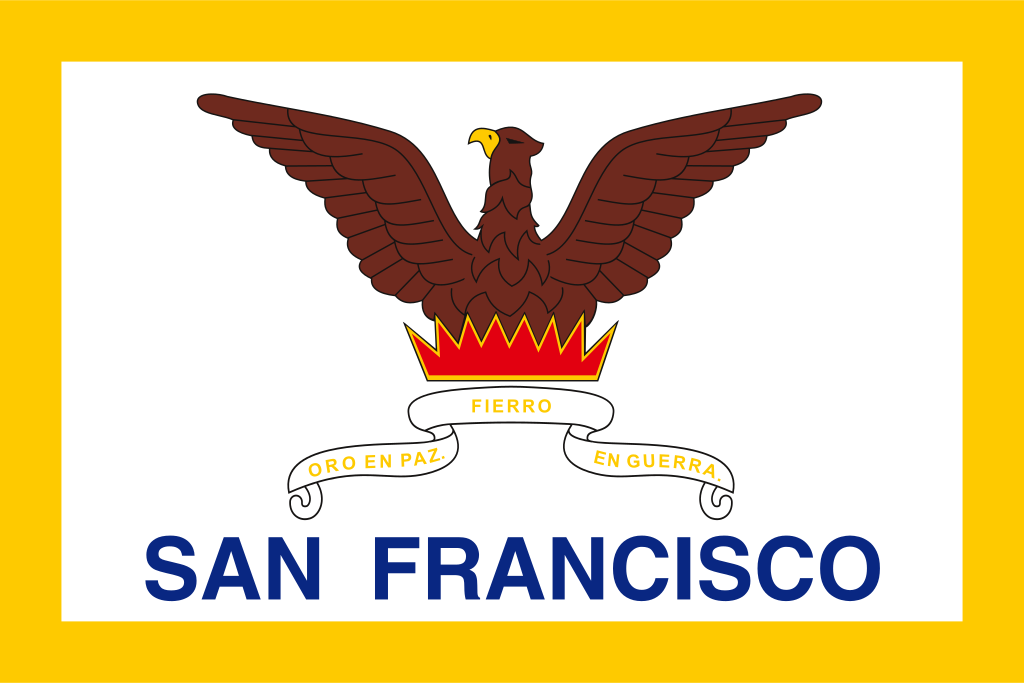
| Flag | A black phoenix rising from gold flames on white, above the motto, within a yellow border |
| Flag design | John M. Gamble, 1900; executed by Robert Ingersoll Aitken; codified 16 December 1940 |
| Seal | 1859 — a shield, a phoenix crest, a miner and a sailor as supporters, and a motto |
| Motto | Oro en paz, fierro en guerra — “Gold in peace, iron in war” |
| Colours | None in the official description; the city colours, gold and black, come from the motto |
Flag of San Francisco — a phoenix rising from flames on a white field, above the city’s name and motto, within a yellow border. From a concept by the artist John M. Gamble, executed by Robert Ingersoll Aitken.
A black phoenix rising from gold flames on a white field, with the motto on a scroll and the name SAN FRANCISCO in blue letters below, all within a yellow border.
The concept is by the artist John M. Gamble, chosen in 1900 after Mayor James Duval Phelan called for a city flag. It was executed by Robert Ingersoll Aitken, who later sculpted the figures above Equal Justice Under Law at the United States Supreme Court. The Board of Supervisors added the city’s name and made the design official on 16 December 1940.
By the usual account, the yellow border was never meant to be printed: it was intended as a gold fringe, the cloth trim sewn round a flag, and ended up in the design by mistake. So when the flag is flown indoors, a real fringe is added round the printed one, and the flag wears its trim twice. It is a good story; the source that carries it marks it as unsupported, and it is passed on here as an account rather than a fact.
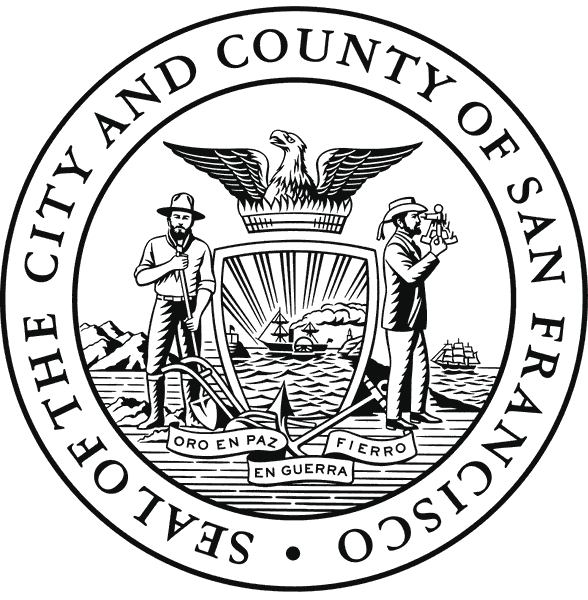
Seal of San Francisco — a shield showing the Golden Gate and its hills as they looked in 1859, with a paddlewheel steamship entering the bay, crested by a phoenix issuing from flames, supported by a miner with a shovel and a sailor with a sextant, a plough and an anchor at their feet. Motto: Oro en paz, fierro en guerra. The official description assigns no colours.
The city describes its seal in these words:
A shield supported by a miner on the left and a sailor on the right, with a device of a steamship passing the Golden Gate. At the foot of the supporters emblems of commerce, navigation, and mining. Crest, Phoenix issuing from flames. Motto, “oro en Paz, Fierro en Guerra” (Gold in Peace, Iron in War). Around the margins the words, “Seal of the City and County of San Francisco.”
Ordinance no. 39, Board of Supervisors, 26 March 1900.
That paragraph names, in order, the four parts of a European achievement of arms: the shield, the crest above it, the supporters that hold it, and the motto on its scroll. Most American city seals are pictures on a disc; very few carry the whole heraldic apparatus. San Francisco adopted it in 1859, ten years after the gold rush reached the city.
European charges are abstract: a lion is not a particular lion. This shield carries a view — the Golden Gate and its hills as they looked in 1859, with a paddlewheel steamship entering the bay. The supporters are dated too: a miner with a shovel and a sailor with a sextant, in 1850s clothing, a plough and an anchor at their feet. Gold and the sea, the two things that made the city, on either side of the gate they both came through. Only the crest is timeless, and the crest is a bird that does not exist.
The official description assigns no colours — not to the shield, the phoenix, the flames or the supporters. In European heraldry the tinctures are part of the arms, and a blazon without them is only a sketch. Here, anyone reproducing the seal has to choose the colours, and different renderings legitimately differ: the flag has a black phoenix on gold flames, the fire department has used a brown one on red and orange.
The motto, Oro en paz, fierro en guerra, is in Spanish — unusual on an American seal, where Latin is the convention. It reads naturally off the shield: the gold the miner digs in peace, the iron the same hands take up in war, and it is usually linked to the troops who sailed from San Francisco for the Philippines in 1898. It also did something few mottoes do: it gave the city its official colours, gold and black, which decorate the dome of City Hall. The arms had no colours, so the city took them from the words.
The phoenix is usually taken to commemorate the city’s recovery from the earthquake and fires of 1906. The dates do not allow it. It was a civic symbol of San Francisco by 1852, on the city’s first official seal; it was on the seal of 1859; and it was on the flag chosen in 1900. All three come before the earthquake.
What it refers to is the great fires of the 1850s, which burned through the gold-rush city again and again in its first years. The symbol was simply already in place when the city burned again, on a far greater scale, half a century later — which is why the mistaken reading lasts: it is more satisfying than the truth, and the picture supports it.
No. The phoenix was already on the city’s first seal by 1852 and on the seal of 1859, half a century before the earthquake. It refers to the great fires that repeatedly burned the gold-rush city in the 1850s.
A shield showing the Golden Gate as it looked in 1859, with a paddlewheel steamship entering the bay; a crest of a phoenix issuing from flames; a miner with a shovel and a sailor with a sextant as supporters; and the motto Oro en paz, fierro en guerra.
“Gold in peace, iron in war”, in Spanish. The city’s official colours, gold and black, are taken from it.
The official description does not say: it assigns no colours to any part of the seal, so renderings differ.
By the usual account, it was meant to be a gold fringe and was printed into the design by mistake. The story is widely repeated but not well sourced.
A note on method. The seal is described from the 1900 ordinance and the city’s own description, not from the drawing; where those texts are silent — as they are on every colour — this page says so. The account of the yellow border is reported as an account, since its source marks it as unsupported.
Last reviewed by the Emblema Mundi editorial team on 30 September 2026.