US City
One word, one bird, two dates. Atlanta’s seal is among the shortest statements in this atlas: a phoenix rising from fire, the motto Resurgens, and the years 1847 and 1865. One of those dates is well documented. The other is never explained. And the flag that carries the whole thing has no known adoption date and no known designer.
Click on a country to learn more
| City | Atlanta, Georgia — state capital since 1868 |
|---|---|
| Earlier names | Terminus (1837), Marthasville (1843) |
| Incorporated as Atlanta | 29 December 1847 |
| Seal device | A phoenix rising from a fire |
| Seal colours | Blue and gold only |
| Seal inscriptions | RESURGENS · ATLANTA GA · 1847 · 1865 |
| Motto | Resurgens — Latin for “rising again” |
| Flag | Solid blue with the seal in the centre |
| Flag proportions | 2:3 |
| Flag adopted | Unknown |
| Flag designer | Unknown |
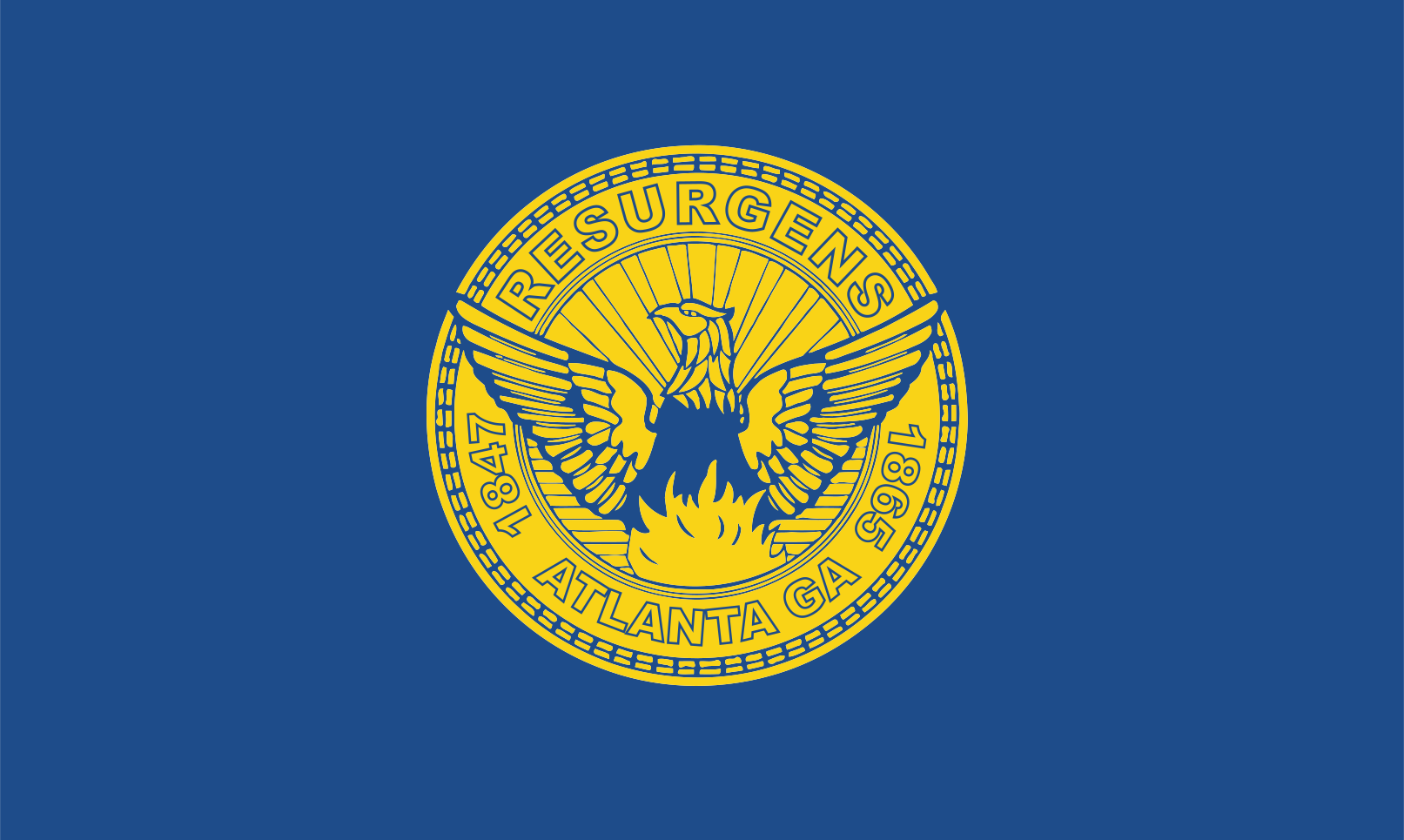
Flag of Atlanta — the city seal on a blue field. Neither the date of its adoption nor the identity of its designer is recorded.
The flag of Atlanta is solid blue with the city seal in the centre, in proportions 2:3. The seal being itself only blue and gold, the whole flag runs on two colours.
And then there is the part that is genuinely strange for a city of this size:
The date the flag was adopted is unknown, as well as the creator of the flag.
Not disputed. Not contested between two claimants. Unknown. A major American city flies a flag whose origin nobody has established.
Placing a municipal seal on a plain field is the single most criticised habit in American city vexillology. The objection is practical rather than aesthetic: a seal is designed to be read at the size of a document, with fine lettering and small detail, and a flag is seen at distance, in motion, from both sides. Lettering reverses; detail disappears; two flags of this kind are told apart only by words nobody can read.
Atlanta’s flag has four separate inscriptions on it.
The contrast sits a few hundred miles away in this same atlas: Chicago deliberately kept its seal off its flag, used two bars and four stars instead, and ended up with a design its citizens tattoo on themselves. Same country, same century, opposite choices — and the city that chose the phoenix put it inside a ring of small print.
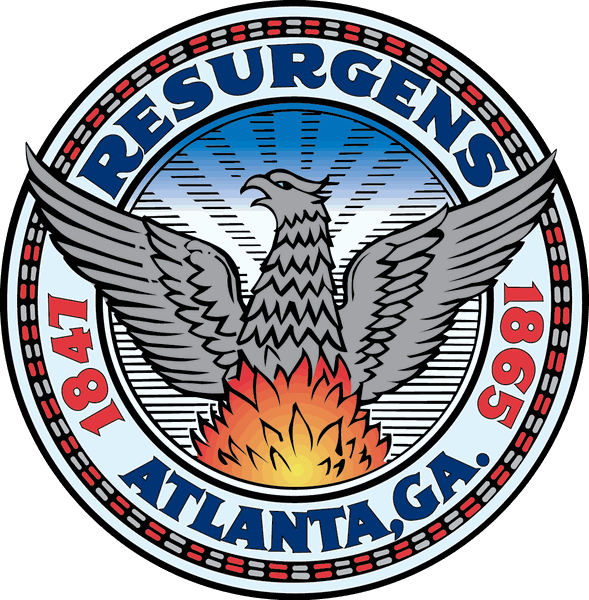
Seal of Atlanta — a phoenix rising from a fire, in blue and gold only, ringed by four inscriptions in capitals: RESURGENS, ATLANTA GA, 1847 and 1865.
There is very little on this seal, and that is the point of it.
A phoenix rising from a fire, drawn in blue and gold and nothing else, ringed by four inscriptions in capitals:
No shield, no supporters, no crest, no landscape. Compared with the full achievement of arms at San Francisco or the Dutch trading post on the seal of New York, this is almost nothing: one creature, one word, two numbers.
The phoenix is a standard charge in European heraldry, and it is always drawn the same way — a bird rising from flames, usually shown only to the waist, because the lower half is understood to be still in the fire. It is a demi-eagle issuing from flames in most blazons.
What makes it unusual as a civic device is what it commits the city to saying. A lion claims strength; a tower claims defence; a ship claims trade. A phoenix claims that something terrible happened. Very few places choose an emblem whose whole meaning depends on a catastrophe.
Atlanta chose one. So did San Francisco. In both cases the catastrophe was fire.
The popular version is four words long: Sherman burned Atlanta. The record is more divided than that, and since the seal is built on the fire, the fire is worth getting right.
The sequence, as the sources give it:
Note the word remaining in the last line. It is there because the first destruction order came ten weeks earlier and from the other side: the retreating Confederate commander, denying the city’s stores to the enemy.
The fire that the phoenix rises from was therefore lit twice, by both armies, for opposite reasons. The seal does not adjudicate between them — it does not name a war, an enemy or a cause. It shows a bird coming out of flames and gives a date.
For a Southern city adopting an emblem in the aftermath of that war, the omission is not an oversight. It is the whole design.
Two numbers, and they are not of equal standing in the record.
Atlanta was incorporated as a city on 29 December 1847. That was already its third identity:
So the date on the seal marks neither a founding nor a settlement but the year the city took the name it still has. A city named after a railway company, put on its seal as a birth.
Here this page has to be honest about a gap. The sources that describe the seal list 1865 among its inscriptions and say nothing about what it marks.
The ordinary reading is the obvious one: 1865 is the year the Civil War ended and the rebuilding of Atlanta began, during Reconstruction. That is what the histories record about the year; it is not what any source says about the seal.
Read that way the two dates are a pair — the year of the name and the year of the second start — and the phoenix stands between them, which is exactly where a bird rising from fire belongs. But this atlas marks the difference: one date is sourced, the other is inferred.
Resurgens.
One word. Latin for “rising again”.
Look at the grammar, because it is doing more than it appears to. Resurgens is a present participle. It is not resurrexit, “it has risen”, and not resurget, “it will rise”. It is the thing happening now, unfinished.
Set it against the ones nearby and the difference is sharp:
A motto in a participle cannot expire and cannot be fulfilled. Whenever it is read, it is true in the present tense. For a city that adopted it while still clearing rubble, that grammar was probably the most useful thing about it.
A phoenix rising from a fire, in blue and gold only, ringed by four inscriptions in capitals: RESURGENS, ATLANTA GA, 1847 and 1865. The seal appears in the centre of the city flag.
It is Latin for “rising again”, and it is the motto of the city of Atlanta. Grammatically it is a present participle rather than a statement: not a claim about what the city is or will do, but a description of something in progress.
1847 is documented: the city was incorporated as the City of Atlanta on 29 December 1847, after earlier lives as Terminus from 1837 and Marthasville from 1843. For 1865 the sources describing the seal give no explanation; it is the year the Civil War ended and the rebuilding of the city began, and that is the ordinary reading.
Not alone, and not first. On 1 September 1864 the Confederate general John Bell Hood, retreating, ordered the destruction of all public buildings and assets that might be of use to the Union Army. The city surrendered the next day. On 11 November 1864, preparing for the March to the Sea, Sherman ordered the destruction of Atlanta’s remaining military assets. The fire the phoenix rises from had two authors.
Nobody knows. The reference works state plainly that both the date the flag was adopted and the identity of its creator are unknown — an unusual gap for a city of this size.
Both cities burned and rebuilt, but for different reasons and at different times. San Francisco’s phoenix dates from 1852 and refers to the great fires of the gold-rush decade. Atlanta’s refers to the destruction of 1864 and the rebuilding that followed the end of the Civil War in 1865.
A note on method. The seal and flag are described from the published descriptions, not from the drawing. The meaning of 1847 is documented and given as such; the meaning of 1865 is not stated by any source consulted for the seal, and the usual reading — the end of the war and the beginning of the rebuilding — is marked here as a reading rather than a fact about the emblem. The account of the burning of Atlanta follows the record of the orders given on 1 September and 11 November 1864, which divides responsibility differently from the popular version. The Wikipedia article on the flag is a stub; the claims taken from it are limited to those it attributes to Purcell.
Last reviewed by the Emblema Mundi editorial team on 29 September 2026.