US City
This is canting arms in their purest form: a city called Phoenix, bearing a phoenix. The seal said so in 1881, in eleven words and one date, and the city has never needed anything else — the flag adopted in 1990 is simply that same bird, lifted out of its ring and set on a maroon field. And the pun is doubled, in a way that is easy to miss: the field is maroon because phoinix is Greek for purple.

Click on a country to learn more
| City | Phoenix, Arizona — state capital |
|---|---|
| Seal | 9 May 1881, by the city’s first ordinance — a bird rising, ringed by “Phoenix, Arizona — Incorporated February 25, 1881” |
| Logo | 1987 — the seal’s bird without its ring |
| Flag | 14 February 1990 — a white phoenix on maroon (PMS 228), 5:9 |
| Flag designer | Smit Ghormley Sanft |
| NAVA 2004 survey | 4th of 150 United States city flags |
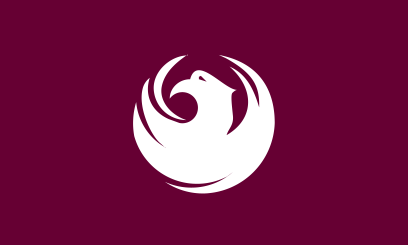
Flag of Phoenix — a maroon field, officially PMS 228, with a white phoenix in the centre, its wings curving upward to nearly complete a circle one third of the flag’s length in diameter. Proportions 5:9; adopted 14 February 1990.
A maroon field, officially PMS 228, with a white phoenix in the centre, its wings curving upward to nearly close a circle one third of the flag’s length across. Proportions 5:9.
In Greek, phoinix means purple, and the colour of the flag was chosen to reflect it. The flag is a pun twice over: the bird on the city’s name in English, the field on the same word in Greek.
The design was not drawn as a flag. It is the city logo, created by the graphic design firm Smit Ghormley Sanft and chosen in 1987; on 14 February 1990 the council set it on a maroon field and adopted it as the city flag.
Three American cities in this atlas bear a phoenix, and no two of them mean the same thing by it.
| San Francisco | On the seal by 1852. Refers to the great fires of the gold-rush decade — and, contrary to the usual belief, not to the earthquake of 1906, which it predates by half a century. |
|---|---|
| Atlanta | Refers to the destruction of 1864 and the rebuilding that followed. The fire had two authors, a retreating Confederate general and a departing Union one, and the seal names neither. |
| Phoenix | Refers to no fire at all. The ruins this city rose from were the abandoned canals of the Hohokam, left centuries earlier. The bird is here because of a name, not an event. |
Two of the three commemorate a catastrophe the city survived. The third commemorates somebody else’s ending — a civilization that did not rise again, whose works a later town built on and took a name from.
Read together, they show what a single charge can be made to carry. The same bird stands for a decade of fires, for a war, and for an inheritance from a vanished people, and in each case it is drawn the same way: rising, wings up, out of what is left.
City logo of Phoenix — the central figure of the seal of 1881, the bird rising, taken out of its ring of lettering and adopted as the city logo in 1987. The seal itself was enacted by the city’s first ordinance on 9 May 1881: in the centre a bird rising, and surrounding this the inscription Phoenix, Arizona — Incorporated February 25, 1881.
Phoenix passed its first ordinance on 9 May 1881, at the first regular meeting of the new City Council, and that ordinance was about the seal. Its description, in full: in the centre a bird rising, and surrounding this the inscription “Phoenix, Arizona — Incorporated February 25, 1881”.
The bird needs no explanation, because it is the name. Darrell Duppa suggested “Phoenix” in 1868 for a town that would spring from the ruins of a former civilization — the abandoned Hohokam canals it was built on — and the seal simply draws the word. Heraldry calls this canting arms.
The ordinance names no colours, carries no motto and shows nothing else.
In 1987 the City Council adopted the central figure of that seal — the bird rising, without its ring of lettering — as the official city logo. It is the image shown above.
A bird rising, surrounded by the inscription “Phoenix, Arizona — Incorporated February 25, 1881”. That is the whole of the description in the city’s first ordinance, adopted on 9 May 1881: no motto and no colours.
A white phoenix in the centre of a maroon field, officially PMS 228 — the bird from the city seal, taken out of its ring. It was adopted on 14 February 1990.
Because phoinix means purple in Greek. The bird puns on the city’s name in English, and the field on the same word in Greek.
The graphic design firm Smit Ghormley Sanft, as the city logo chosen in 1987. The council adopted it as the city flag in 1990.
A note on method. Both emblems are described from the ordinance and the published descriptions, not from the drawing. The image shown beside the seal section is the city logo adopted in 1987, the central figure of the 1881 seal without its ring of lettering; it is not a reproduction of the seal itself.
Last reviewed by the Emblema Mundi editorial team on 29 September 2026.