Historic county of England
Norfolk carries one of the deepest heraldic memories in England. The county was the tribal seat of the Iceni under Boudica in the first century, the heartland of the Anglo-Saxon Kingdom of the East Angles in the seventh, the storm-front of the Danish invasions that killed King Edmund the Martyr in 869, and the base of one of the greatest medieval families of the realm — the ducal Howards, who have held the office of Earl Marshal of England continuously since 1672. The modern civic heraldry — the arms granted to Norfolk County Council in 1904 and the county flag registered with the Flag Institute in 2014 — sits on top of all of it.
Click on a country to learn more
| Territory | Norfolk — historic and ceremonial county of England, part of East Anglia |
|---|---|
| Council arms granted | College of Arms, 20 January 1904 |
| County Flag registered | Flag Institute UK Flag Registry, 2014 |
| County town | Norwich (episcopal see since 1094) |
| Historic sub-region | East Anglia (with Suffolk and Cambridgeshire) |
| Central charges (Council arms) | Prince of Wales feathers, English lion passant guardant, half-lion half-herring supporter |
| Ducal title | Duke of Norfolk — premier duke of the Peerage of England (Howard family since 1483) |
| Earl Marshal of England | Held by the Duke of Norfolk since 1672 |
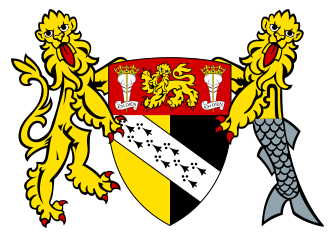
Coat of Arms of Norfolk County Council — Granted by the College of Arms on 20 January 1904.
Per pale Or and Sable a Bend Ermine on a Chief Gules a Lion passant guardant of the first between two Ostrich Plumes Argent quilled and each ensigned with a Prince’s Coronet thereon the motto Ich Dien as borne on the Banner of King Edward III. Supporters: on either side a Lion guardant Or, that on the sinister dimidiating a Herring erect Argent.
The arms were granted by the College of Arms to Norfolk County Council on 20 January 1904, sixteen years after the establishment of the Council under the Local Government Act 1888. They are the arms of the modern civic authority, not of the historic Earldom or Dukedom of Norfolk — a distinction that matters, because the aristocratic heraldry of the county runs on a separate track.
| Colour | Heraldic name | Element | Traditional symbolism |
|---|---|---|---|
| Gold | Or | Dexter half of shield; lion; coronets and quills of the feathers | Royal dignity, precious metal; the tincture of the English royal lion |
| Black | Sable | Sinister half of shield | Antiquity, constancy; used to balance the composition |
| Ermine | Ermine (fur) | Bend | Royal and princely status — the fur reserved to sovereigns and high dignitaries |
| Red | Gules | Chief | Royal chief of augmentation; the field on which the sovereign’s lion is borne |
| Silver | Argent | Two ostrich plumes; the herring in the sinister supporter | Purity; also the metal of the silver herring — the North Sea catch of Great Yarmouth |
Heraldic note — the composition observes the classic metal-on-colour rule (Or lion on Gules chief, Argent plumes on Gules chief), and treats ermine as a neutral fur that may be laid over either metal or colour.
The ostrich plumes with the coronet and motto Ich Dien (“I serve”) are the badge of the Prince of Wales, traditionally associated with Edward the Black Prince and formally derived from a badge borne on the banner of his father King Edward III. Their placement on the Norfolk arms was neither decorative nor accidental. It reflects the deep royal presence in the county — above all the Sandringham estate, purchased by Queen Victoria for the future Edward VII in 1862 and used as a private country residence of the reigning monarch ever since. In 1904, when the arms were granted, the future George V was Prince of Wales and a resident at Sandringham; the feathers were entirely appropriate to a Norfolk civic identity.
The two lion supporters are the most inventive element of the composition. On the dexter (viewer’s left), an ordinary lion guardant Or — a routine choice. On the sinister (viewer’s right), the lion is dimidiated with a silver herring standing upright: half-lion, half-fish, the two conjoined at the vertical centre line.
This half-lion half-herring is a direct heraldic borrowing from the medieval arms of Great Yarmouth. Yarmouth’s corporation arms famously combine the three lions of England dimidiated with three ship-sterns or three herrings — a rare surviving example of true medieval dimidiation, used by no other English town in the same visible way. The dimidiation memorialises Yarmouth’s role as one of the great herring ports of the North Sea and its historic membership of the medieval English fishing fleet. The 1904 arms bring the Yarmouth device into the Council arms of the wider county, welding the fishing coast to the agricultural interior in a single heraldic image.
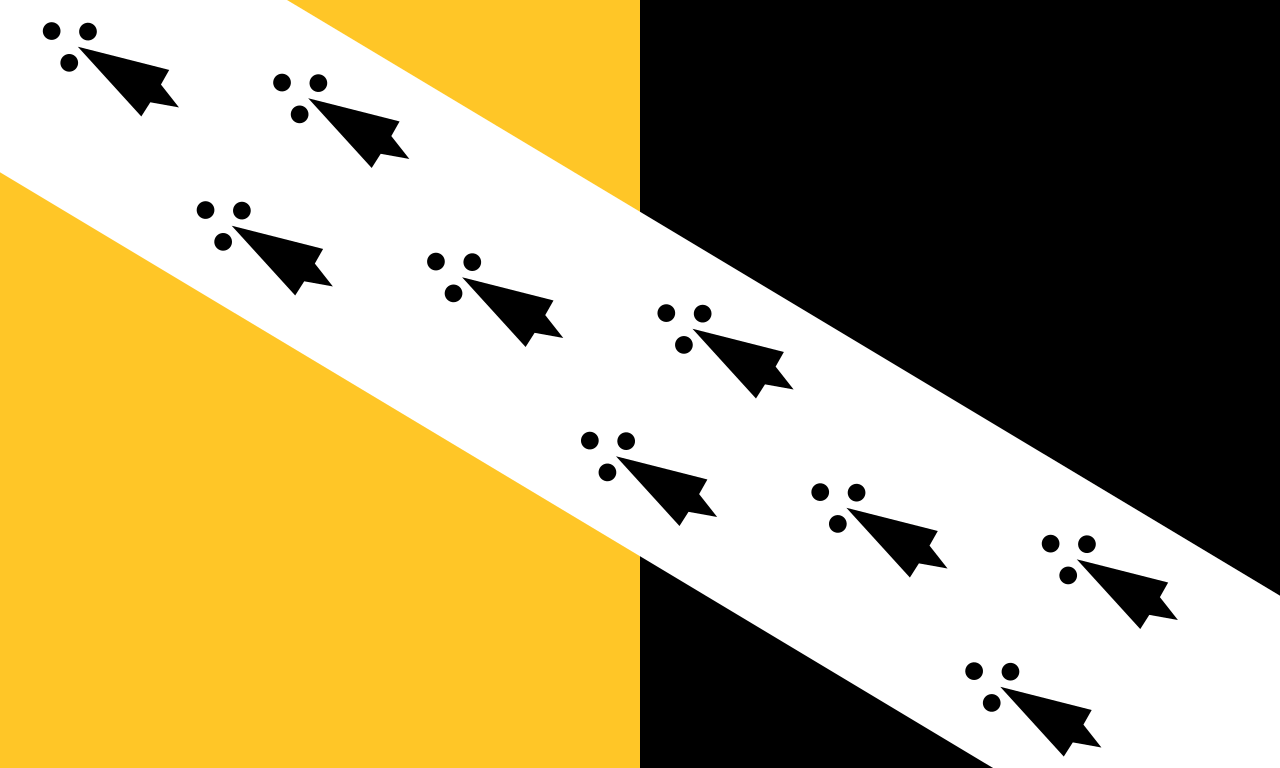
County Flag of Norfolk — Registered with the Flag Institute UK Flag Registry in 2014, following a public design initiative.
The Norfolk County Flag is a distinct emblem from the arms of Norfolk County Council. It was registered with the Flag Institute UK Flag Registry in 2014, following a public design initiative to give the historic county a civic banner outside the institutional heraldry of the Council.
The Flag Institute’s UK Flag Registry has, since its establishment in 2008, catalogued more than 50 English county flags. Most were adopted through public processes rather than by grant — a democratic route to identity that runs in parallel with, but independent of, the aristocratic and civic grants of the College of Arms. Norfolk’s flag joined the register in 2014 and now flies at civic occasions, sporting events and Historic County Flags Day on 23 July each year.
Beneath the civic heraldry runs a much older story. Norfolk was the tribal seat of the Iceni, the British confederation whose queen Boudica led the great revolt against Rome in AD 60–61 — sacking Camulodunum (Colchester), Londinium (London) and Verulamium (St Albans) before defeat at the Battle of Watling Street. The name Iceni still traces on the archaeological map of the county in the coin hoards of Snettisham and the great gold torcs of West Norfolk.
From the late fifth century Norfolk formed the North Folk (Norþfolc) of the Kingdom of the East Angles, an early Anglo-Saxon polity whose greatest monarch, Rædwald of the Wuffingas (r. c. 599–624), was almost certainly the ship-burial king of Sutton Hoo. The kingdom’s religious centre lay first at North Elmham (whose bishopric was moved to Norwich in 1094) and its wealth is still measurable in the fabric of Norfolk’s more than 650 medieval parish churches — the highest concentration in the country.
On 20 November 869, the Danish Great Heathen Army under Ivar the Boneless killed King Edmund the Martyr, the last king of the East Angles. Edmund was canonised within a generation; his shrine at Bury St Edmunds (in modern Suffolk) became one of the great medieval pilgrimage sites of England, and his cult supplied East Anglia — and much of England — with a national saint before the Plantagenet promotion of Saint George in the 14th century. Traces of Danelaw settlement remain in the Norfolk place-name landscape (-by, -thorpe) more densely than almost anywhere else in England south of the Humber.
The Earldom of Norfolk is one of the oldest in England, held by the Bigod family from the reign of Henry I until the death of Roger Bigod, 5th Earl, in 1306. It passed briefly to the Mowbray family, and was raised to a Dukedom in 1483 by Richard III for John Howard.
Since then the title has been held, with interregnums during the 16th and 17th centuries, by the Howard family. The Duke of Norfolk is the premier duke of the Peerage of England — the highest rank outside the royal family — and since 1672 has held the hereditary office of Earl Marshal of England. In that capacity the Duke organises coronations (Elizabeth II 1953, Charles III 2023), royal weddings and state funerals; presides over the Royal Household in the ceremonies of chivalry; and holds a residual authority over the College of Arms itself. It is one of the last hereditary offices of state in Britain.
Two heraldic points are worth stressing:
Norfolk offers a compact case study in the layering of English heraldic identity. Three distinct emblems, each with its own institutional logic, coexist and refer to different sovereignties:
| Emblem | Authority | Date | What it identifies |
|---|---|---|---|
| Arms of the Duke of Norfolk (Howard) | College of Arms (aristocratic grant) | 1483 (Dukedom); Howard tenure since | The premier ducal family; the Earl Marshal of England |
| Arms of Norfolk County Council | College of Arms (civic grant) | 20 January 1904 | The elected local government of the county |
| Norfolk County Flag | Flag Institute UK Flag Registry | 2014 | The historic county as a civic identity |
All three are “Norfolk,” none is the other, and none supersedes any. The civic flag of 2014 does not replace the Council arms of 1904; the Council arms do not compete with the ducal arms of the Howards. Each identifies a different Norfolk.
By royal warrant of the College of Arms on 20 January 1904, sixteen years after the Council was established under the Local Government Act 1888. The arms are held by the Council as an institution and are distinct from the arms of the Bigod, Mowbray and Howard families who held the Earldom and Dukedom of Norfolk, and from the county flag registered in 2014.
The two ostrich plumes with the Prince’s Coronet and the motto Ich Dien (“I serve”) are the badge of the Prince of Wales, traditionally associated with Edward the Black Prince and derived from a badge borne on the banner of King Edward III. Their inclusion reflects the deep royal connection of the county — above all the Sandringham estate, held by the reigning monarch since Queen Victoria’s purchase for the Prince of Wales in 1862.
The sinister supporter is a dimidiated composition — a lion guardant Or fused vertically with a herring erect Argent. The herring is a direct reference to Great Yarmouth, whose medieval corporation arms famously combine the three lions of England dimidiated with three ship-sterns or three herrings. Yarmouth was one of the great herring ports of the North Sea.
The Duke of Norfolk is the premier duke of the Peerage of England, a title held since 1483 by the Howard family. Since 1672 the Duke has been the hereditary Earl Marshal of England — organiser of coronations, state funerals and the ceremonies of chivalry. The Howard family arms are entirely distinct from those of Norfolk County Council; the ducal seat is at Arundel Castle in Sussex, not in Norfolk itself.
The Norfolk County Flag was registered with the Flag Institute UK Flag Registry in 2014, following a public design initiative to give the historic county a distinct civic banner outside the institutional heraldry of the Council. It is a community flag rather than an official grant of arms.
Last reviewed by the Emblema Mundi editorial team on 5 July 2026.