US City
Chicago has one of the most admired flags in the United States and one of its least-seen seals. The flag — two sky-blue bars and four red six-pointed stars on white, designed by the poet and lecturer Wallace Rice and adopted on 28 March 1917 — ranked second among 150 American city flags in a national survey of 2004, and Chicagoans fly it, wear it and tattoo it as few other cities do their own. The seal is the older emblem: struck when the city was incorporated on 4 March 1837 and redrawn in 1905, it carries the Latin motto Urbs in Horto, “City in a Garden.” Here is what each of them means, star by star.
Click on a country to learn more
| City | Chicago, Cook County, Illinois (the state capital is Springfield, not Chicago) |
|---|---|
| Incorporated as a city | 4 March 1837 |
| Seal | Adopted 1837; current design 1905, by Bernard J. Cigrand |
| Seal motto | Urbs in Horto — “City in a Garden” |
| Flag designer | Wallace Rice (1859–1939), poet and lecturer |
| Flag competition | Municipal flag commission appointed 1915; over a thousand entries |
| Flag adopted | 28 March 1917, by city ordinance |
| Stars | Two (1917) → three (1933) → four (since 21 December 1939) |
| Proportions | 2:3 |
| Blazon | Argent, four mullets of six points gules in fess between two bars bleu de ciel |
| NAVA 2004 survey | 2nd of 150 United States city flags (9.03 / 10) |
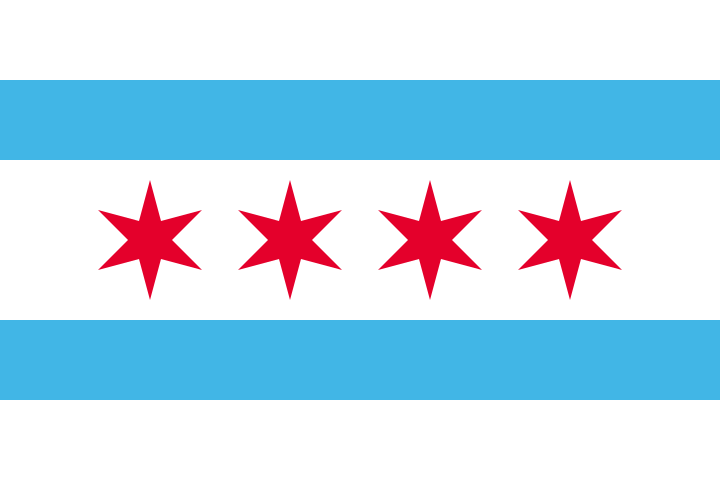
Flag of Chicago — two bars of sky blue and four six-pointed red stars on a white field. Blazon: Argent, four mullets of six points gules in fess between two bars bleu de ciel.
Chicago went without an official flag until the First World War. In 1915 Mayor William Hale Thompson appointed a municipal flag commission, chaired by Alderman James A. Kearns and including the industrialist Charles Deering and the painter Lawton S. Parker. Parker brought in the poet and lecturer Wallace Rice to write the rules of a public competition, which drew more than a thousand entries. The design that won was Rice’s own, and the City Council adopted it by ordinance on 28 March 1917.
The flag is white, crossed by two horizontal bars of light blue, each one-sixth of the height and set a little less than one-sixth from the top and bottom edges. The bars are the city’s water. The upper stands for Lake Michigan and the North Branch of the Chicago River; the lower for the South Branch and the Great Canal, the Sanitary and Ship Canal that reversed the river’s flow. The three white fields the bars divide are read as the three great divisions of the city — the North, West and South Sides. Rice, asked about the blue, called it simply “the color of water.”
Where most American cities put a seal on a coloured sheet, Chicago got a true flag — a few bold shapes, readable at a distance and easy to draw from memory. In the North American Vexillological Association’s 2004 survey of 150 United States city flags it placed second, at 9.03 out of 10, behind only Washington, D.C. It has become part of the city’s visual language, flown from porches and painted on storefronts, worn on caps and jackets and skin — a rare case of a municipal flag that citizens have taken entirely as their own.
The row of red stars is the part everyone learns to read. The flag began with two, gained a third in 1933 and a fourth in 1939, and each marks a moment in the city’s history. Every star has six points, and Rice assigned a separate meaning to each point — so the four stars carry twenty-four ideas in all.
The first star commemorates the Great Chicago Fire of 1871, its six points standing for transportation, labour, commerce, finance, populousness and salubrity (public health). The second marks the World’s Columbian Exposition of 1893, the world’s fair that announced the rebuilt city, its points standing for religion, education, aesthetics, justice, beneficence and civic pride.
Added during the Century of Progress exposition of 1933–34, the third star’s six points gather the city’s own claims about itself: that it was then the second-largest city in the United States, the motto Urbs in Horto, the “I Will” motto, the Great Central Marketplace, the “Wonder City” and the “Convention City.”
The fourth star was added on 21 December 1939 for Fort Dearborn, the frontier post from which Chicago grew — so the star added last commemorates the earliest history of all. Its six points stand for the six governments the area has belonged to: France (from 1693), Great Britain (1763), Virginia (1778), the Northwest Territory (1789), Indiana Territory (1802) and the Illinois Territory (1809) and State (from 1818).
The stars are six-pointed by design. The rule Rice worked to held that a five-pointed star stood for a sovereign state, and that a six-pointed star of this exact form appeared on no other flag known in 1917 — leaving the shape free for the city to claim. The point was tested in 1928, when Mayor Thompson proposed changing the stars to five points he thought more American; when the third star was added in 1933 the City Council kept all of them at six.
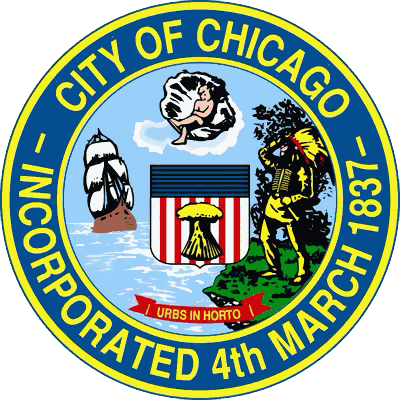
Seal of Chicago — an American shield, a sheaf of wheat, a ship in full sail, a Native American figure and an infant in a shell, with the motto Urbs in Horto on a red ribbon below.
Chicago was incorporated as a city on 4 March 1837, a settlement of a few thousand people at the mouth of the river, and it took a seal at once. That founding date has stayed on the emblem ever since: the outer ring reads City of Chicago · Incorporated 4th March, 1837.
The seal in use today is not the original but a redrawing of 1905, the work of Bernard J. Cigrand — a Chicago dentist better remembered as the tireless campaigner who did more than anyone to establish a national Flag Day. His version fixed the arrangement of the emblem as the city still uses it.
At the centre stands an American shield in red, white and blue, over a sheaf of wheat — the grain trade on which the young city grew. To the right a ship sails in full rig, for commerce and the coming of civilisation; to the left a Native American figure supports the shield, for the people who were there before the city. Above the shield rests an infant in a shell, an emblem of the pearl and of a city newly born — a detail so peculiar that observers have long remarked no child would really lie so. Below, on a red ribbon, runs the motto:
URBS IN HORTO — “City in a Garden.”
The same three words return on the flag, as one of the six meanings of the third star — the seal’s quiet motto and the flag’s bold stars, for once, saying the same thing.
Each star commemorates a moment in the city’s history. The two original stars of 1917 stand for the Great Chicago Fire of 1871 and the World’s Columbian Exposition of 1893; a third, added in 1933, marks the Century of Progress exposition; a fourth, added in 1939, marks Fort Dearborn. Each star has six points, and every point carries its own meaning.
They are the city’s waterways. The upper bar stands for Lake Michigan and the North Branch of the Chicago River, the lower for the South Branch and the Great Canal. The three white bands between them stand for the North, West and South Sides of the city.
The poet and lecturer Wallace Rice. A municipal flag commission appointed in 1915 ran a public competition of more than a thousand entries; Rice, who had written the rules, submitted the winning design, and it was adopted by ordinance on 28 March 1917.
On the reasoning that a five-pointed star stood for a sovereign state, and that a six-pointed star of this form appeared on no other flag known in 1917. When the third star was added in 1933 the City Council kept the six points, rejecting Mayor Thompson’s 1928 idea of five-pointed stars.
It is Latin for “City in a Garden,” the motto on the city seal, carried on a red ribbon at the foot of the design. It is also one of the six meanings given to the flag’s third star.
By the profession’s own measure, among the best in the country. In the North American Vexillological Association’s 2004 survey of 150 United States city flags, Chicago placed second with 9.03 out of 10, behind only Washington, D.C.
Last reviewed by the Emblema Mundi editorial team on 13 September 2026.