County · South East England
Sussex flies six gold martlets on a field of blue — small heraldic birds, one for each of the county’s ancient rapes. Like its neighbour Essex, Sussex is a Saxon kingdom in miniature: the land of the South Saxons, Suth-Seaxe, one of the kingdoms of Anglo-Saxon England. The martlets have marked the county for centuries, and since 2011 they fly as Saint Richard’s Flag.
Click on a country to learn more
| Country | England (United Kingdom) |
|---|---|
| Region | South East England |
| County town | Chichester |
| Emblem | Six gold martlets |
| Flag registered | 20 May 2011 — “Saint Richard’s Flag” (Flag Institute) |
| Historic divisions | The six rapes of Sussex |
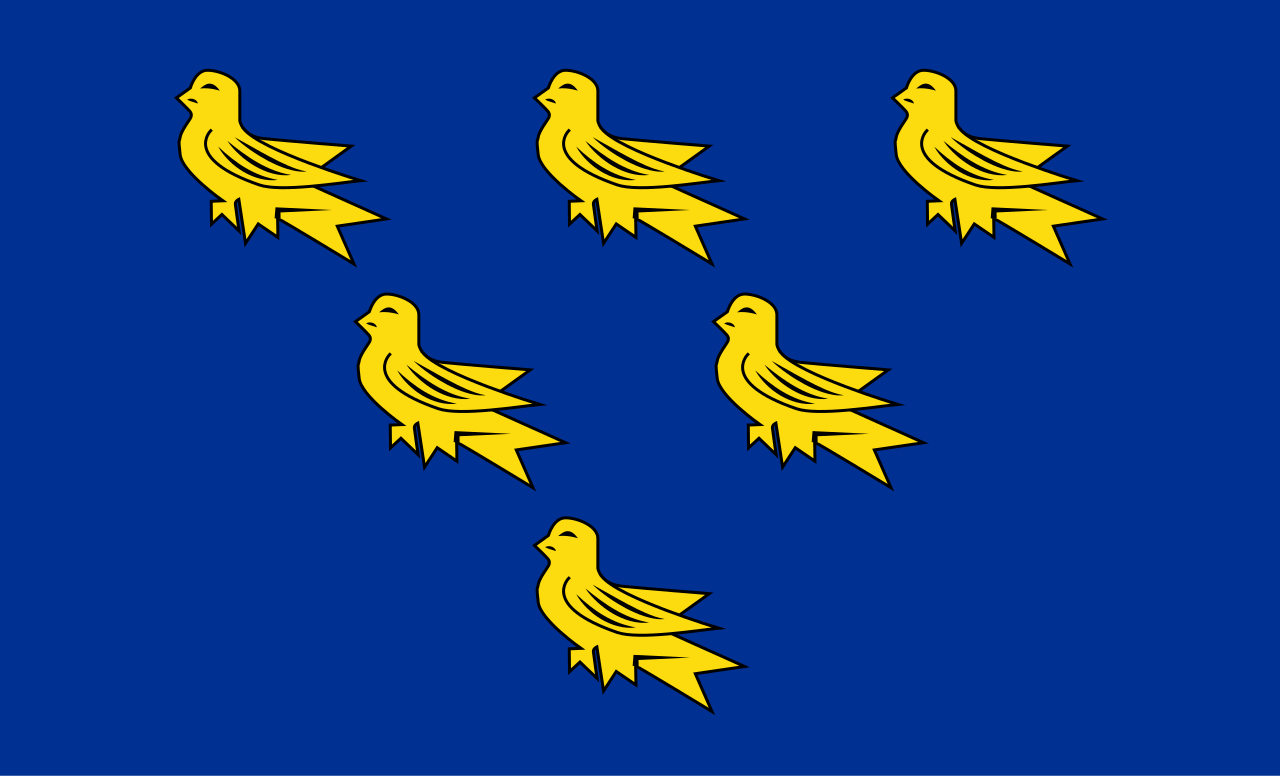
Flag of Sussex — six gold martlets on a blue field
The flag shows six gold martlets on a blue field, set three, two and one — blazoned Azure, six martlets or. The design is the traditional emblem of Sussex; its earliest depiction is credited to the cartographer John Speed in 1611, and it is often linked to the fourteenth-century arms of Sir John de Radynden.
As a flag it is modern in registration if not in spirit: it was entered on the Flag Institute’s registry on 20 May 2011 under the name Saint Richard’s Flag, after Saint Richard of Chichester, the patron saint of Sussex, and first flown officially at Lewes Castle a few days later.
A martlet is a heraldic bird — a swift or house-martin — drawn without feet, forever on the wing. In English heraldry it often serves as the mark of a fourth son, but in Sussex it is simply the county’s own device, multiplied six times.
The number is not decorative: the six martlets stand for the six rapes of Sussex, the great administrative bands into which the county was divided from Norman times — Arundel, Bramber, Chichester, Hastings, Lewes and Pevensey. Each rape ran in a strip from the coast to the Weald, and together the six make up the whole of Sussex — one bird apiece.
Sussex takes its name from the South Saxons — Suth-Seaxe — the Germanic people who settled the coast south of the Weald after Rome. Their realm, the Kingdom of Sussex, was one of the kingdoms of Anglo-Saxon England, sister to the East Saxons of Essex and the Middle Saxons of Middlesex.
That old identity has outlived every reorganisation. When Sussex was split for administration into East Sussex and West Sussex, both county councils kept the six gold martlets in their arms — so the emblem of the whole still binds the two halves together under one ancient sky-blue banner.
The flag of Sussex is six gold martlets on a blue field, blazoned Azure, six martlets or. It is the traditional emblem of the county and was registered by the Flag Institute in 2011 as Saint Richard’s Flag.
A martlet is a heraldic bird, a small swift or martin drawn without feet. In English heraldry it can mark a fourth son, but for Sussex it is simply the county’s ancient device.
The six martlets stand for the six rapes of Sussex, the county’s historic administrative divisions: Arundel, Bramber, Chichester, Hastings, Lewes and Pevensey.
The flag was registered on 20 May 2011 and named after Saint Richard of Chichester, the patron saint of Sussex. It was first flown officially at Lewes Castle.
Yes. When Sussex was divided, both East Sussex and West Sussex County Councils kept the six gold martlets in their arms, so the whole historic county shares the same device.
Last reviewed by the Emblema Mundi editorial team on September 20, 2026.