Constituent country of the United Kingdom
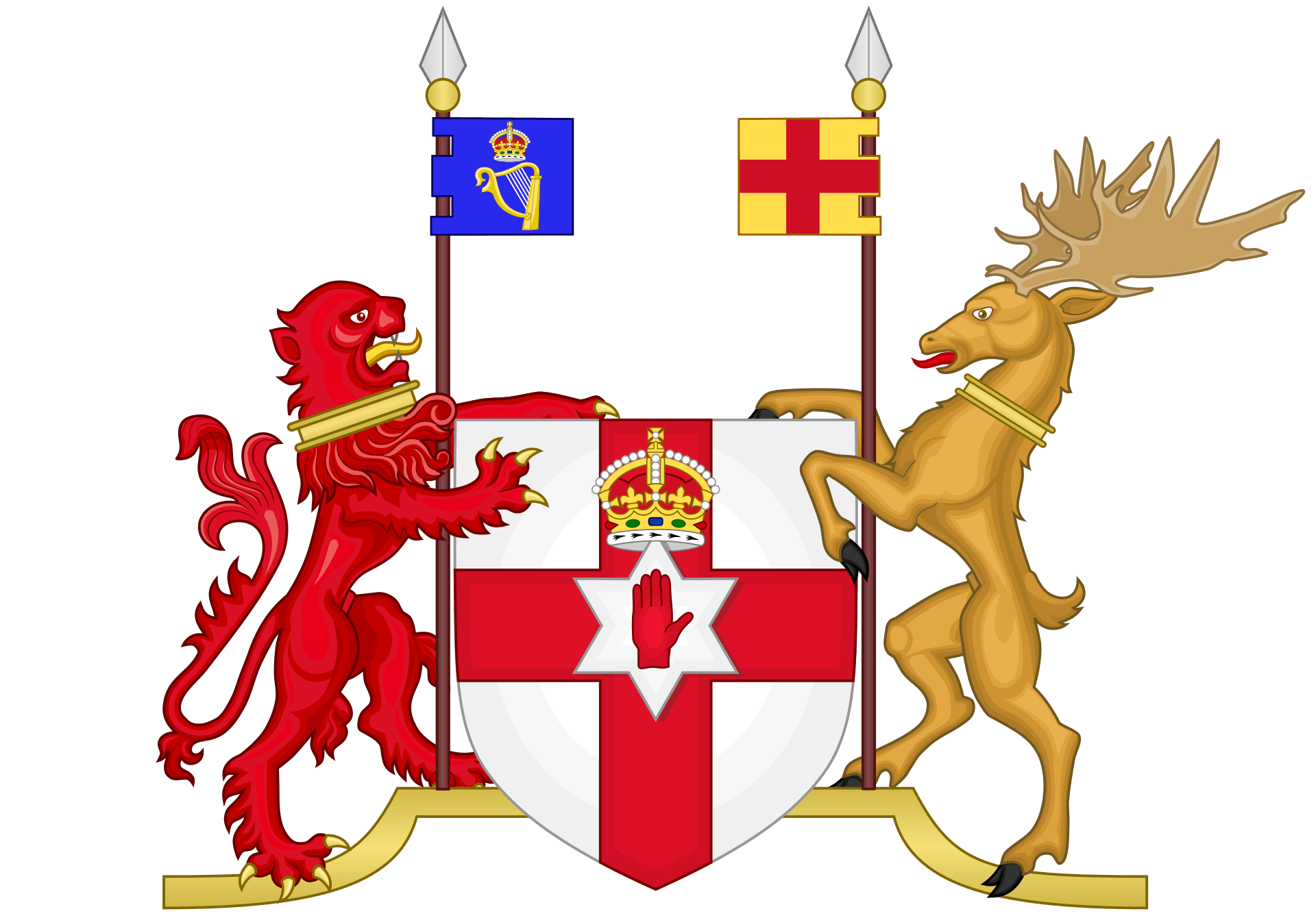
Northern Ireland is the only constituent country of the United Kingdom whose coat of arms and flag are currently in abeyance. The arms granted by royal warrant on 2 August 1924 to the Government of Northern Ireland, and the Ulster Banner derived from them (in official use 1953–1972), have had no legal standing since the Parliament of Northern Ireland was prorogued on 30 March 1972. Only the Union Jack is currently flown as an official symbol by state institutions. The heraldic vocabulary itself — the Red Hand of Ulster, the cross of Saint George, the historic arms of the province of Ulster — predates the modern polity by several centuries.
Click on a country to learn more
| Territory | Northern Ireland (Tuaisceart Éireann; Ulster Scots: Norlin Airlann) |
|---|---|
| Part of | United Kingdom, since the Government of Ireland Act 1920 (effective 3 May 1921) |
| Former coat of arms | Granted by royal warrant of George V, 2 August 1924 |
| Coat of arms status | In abeyance since 30 March 1972; not formally revoked |
| Ulster Banner | In official use 1953–1972 as the flag of the Government of Northern Ireland |
| Current official flag | Union Jack — the only flag flown by state institutions |
| Constituent heraldic element | Red Hand of Ulster (Lámh Dhearg Uladh) |
| Counties | 6 historic counties: Antrim, Armagh, Down, Fermanagh, Londonderry, Tyrone |
| Modern districts | 11 (Local Government Reform, 2015) |
Former Coat of Arms of the Government of Northern Ireland (1924–1972) — Argent, a cross Gules, overall a six-pointed star Argent ensigned by an imperial crown, charged with the Red Hand of Ulster Gules.
Argent, a cross Gules; overall on a six-pointed star of the field ensigned by an imperial crown proper, a dexter hand couped at the wrist also Gules.
The arms were granted by royal warrant of King George V on 2 August 1924 to the Government of Northern Ireland, three years after the polity was established under the Government of Ireland Act 1920. They were designed by the College of Arms in London to combine three distinct references in a single field:
The six-pointed star corresponds to the six counties constituting Northern Ireland at partition — Antrim, Armagh, Down, Fermanagh, Londonderry and Tyrone — as distinct from the nine counties of the historic province of Ulster (which included Cavan, Monaghan and Donegal, now in the Republic of Ireland).
| Colour | Heraldic name | Element | Referent |
|---|---|---|---|
| Silver | Argent | Field, star | The field of Saint George’s cross |
| Red | Gules | Cross, hand | Cross of Saint George; Red Hand of Ulster |
| Gold | Or / proper | Imperial crown | Sovereignty of the British Crown |
On 30 March 1972, following the escalation of the Troubles, the Parliament of Northern Ireland was prorogued by the Northern Ireland (Temporary Provisions) Act 1972; direct rule from Westminster was imposed. The Northern Ireland Constitution Act 1973 subsequently abolished the Stormont Parliament and the Government of Northern Ireland itself. With no successor devolved government in the same institutional form, the 1924 arms fell out of official use.
The royal warrant of 1924 has never been formally revoked, but no Northern Ireland state institution has employed the arms since 1972. The Northern Ireland Act 1998, which followed the Belfast (Good Friday) Agreement, does not designate a coat of arms for the new devolved institutions; the Executive uses stylised departmental branding instead.
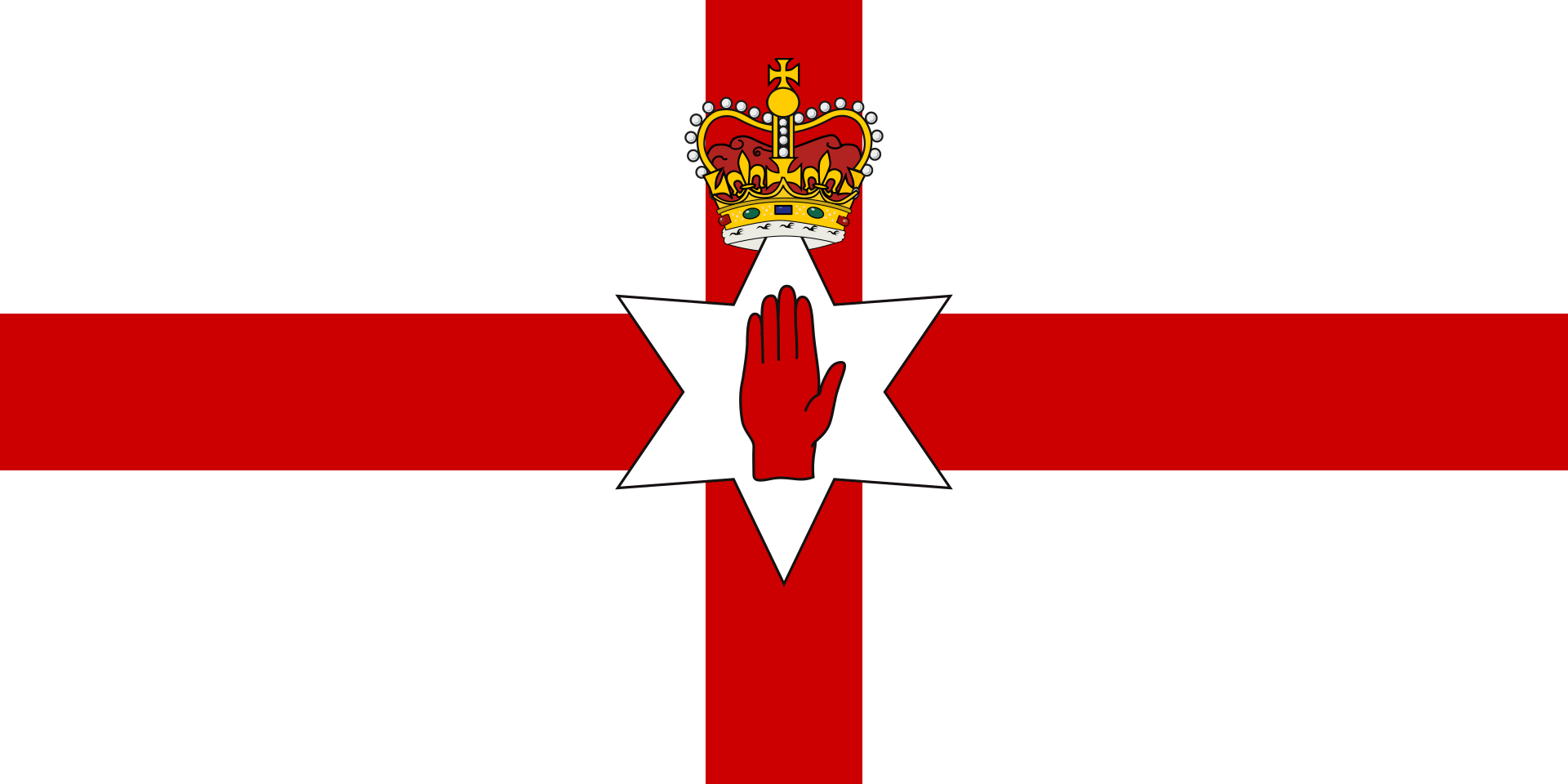
Ulster Banner (1953–1972) — Heraldic banner of the 1924 arms. Ceased official use in 1972; not currently a legally recognised flag.
The Ulster Banner is the banner-of-arms form of the 1924 coat of arms — the shield itself displayed as a rectangular flag. It was first flown officially in 1953, at the coronation of Queen Elizabeth II, and served thereafter as the flag of the Government of Northern Ireland. Under the Stormont Parliament it was hoisted alongside the Union Jack on government buildings and used by the Royal Ulster Constabulary and other state bodies.
Since the prorogation of Stormont on 30 March 1972, the Ulster Banner has had no legal standing as a flag of Northern Ireland. The UK government has confirmed in several parliamentary answers — and the Northern Ireland Office in its Flag Regulations (Northern Ireland) 2000 — that the only flag officially designated for Northern Ireland is the Union Jack.
The Ulster Banner continues in unofficial use, most visibly at international sporting events where Northern Ireland competes as a separate entity: it serves as the flag of the Northern Ireland team at the Commonwealth Games, and is used by supporters of the Northern Ireland football team. In rugby, the island of Ireland fields a single all-island team (the IRFU) under the specifically-designed flag of the Four Provinces; the Ulster Banner is not used.
The Red Hand of Ulster (Lámh Dhearg Uladh) is a pre-heraldic Gaelic symbol that entered European heraldry through the medieval Irish lordships. In heraldic form it is always blazoned as a dexter hand couped at the wrist, Gules — a right hand cut off at the wrist, coloured red.
It is traditionally associated with the O’Neill (Uí Néill) dynasty of Tír Eoghain, the medieval kingdom whose lordship stretched over most of central Ulster from the 5th to the 16th centuries. Legendary Irish sources recount a race for the kingship of Ulster in which a chieftain (often identified as one of the O’Neills or of the ancient Níall Noigiallach line) cut off his hand and threw it ahead onto the shore to claim victory — a folk etymology for a mark whose real origin lies earlier.
The hand is documented as a fixed heraldic charge on Gaelic seals from the 13th century onward and remained in continuous use across successive layers of Irish, Ulster and post-Plantation heraldry.
The Red Hand is one of the few emblems associated with Ulster that predates the divisions of the 20th century and appears across all its traditions:
Or, a cross Gules; on an inescutcheon Argent, a dexter hand couped at the wrist Gules.
The traditional arms of the whole province of Ulster — encompassing all nine historic counties (Antrim, Armagh, Cavan, Donegal, Down, Fermanagh, Londonderry, Monaghan and Tyrone) — are distinct from the 1924 arms of the Government of Northern Ireland. Three counties of historic Ulster (Cavan, Donegal and Monaghan) form part of the Republic of Ireland since 1922.
The provincial arms are recorded in medieval Irish and English heraldic sources and are used in the composite arms of the Four Provinces of Ireland — a device that appears on the flag of the Irish rugby team and on various institutional emblems.
| Arms | Field | Cross | Central charge | Territory |
|---|---|---|---|---|
| Province of Ulster (traditional) | Or | Gules | Red Hand on Argent inescutcheon | 9 counties |
| Government of Northern Ireland (1924–1972) | Argent | Gules | Red Hand on Argent six-pointed star with crown | 6 counties |
As of 2026, Northern Ireland has:
The question of a distinct flag has been deliberately left open by successive UK legislation. Cross-community usage of the historic emblems — particularly the Red Hand and the cross of Saint Patrick (a red saltire on white), one of the elements of the Union Jack — provides a shared heraldic vocabulary that predates the political disputes of the 20th century.
No. The Union Jack is the only officially recognised flag flown by state institutions in Northern Ireland. The Ulster Banner (1953–1972) has had no legal standing since the prorogation of the Parliament of Northern Ireland on 30 March 1972.
A pre-heraldic Gaelic symbol traditionally associated with the O’Neill dynasty of Tír Eoghain. It became a fixed heraldic charge from the medieval period and remains an emblem of the historic province of Ulster across communities.
The Northern Ireland Act 1998 and subsequent legislation deliberately do not designate a distinct flag or coat of arms. Any adoption would require political consensus in a legislature designed around cross-community concurrence.
The 1924 arms use a silver field charged with a red cross of Saint George and a six-pointed star bearing the Red Hand, ensigned by an imperial crown — representing the six counties. The traditional arms of the historic province of Ulster (nine counties) use a gold field with the same red cross and the Red Hand on a silver inescutcheon.
The six points correspond to the six counties of Northern Ireland at the time of the grant — Antrim, Armagh, Down, Fermanagh, Londonderry and Tyrone — as distinct from the nine counties of the historic province of Ulster.
Last reviewed by the Emblema Mundi editorial team on 5 July 2026.