Country
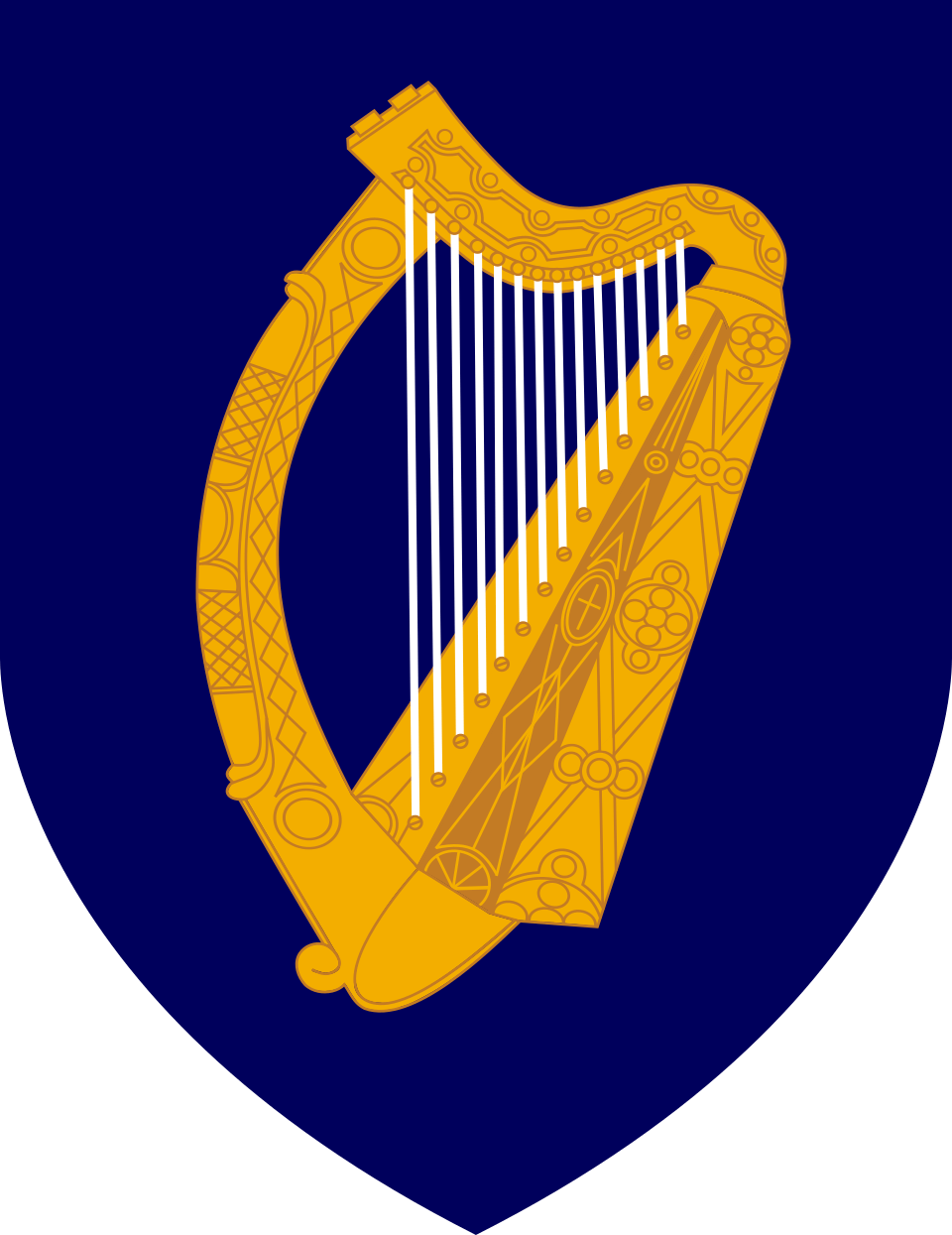
The Irish coat of arms — a golden harp on azure — is one of the rare national arms whose central charge is a musical instrument, and the only one based on a surviving medieval object: the Brian Bóramha harp preserved in Trinity College Dublin. Paired with the green-white-orange tricolour designed in 1848, it expresses both an ancient Gaelic heritage and a modern reconciliation between the two great Irish traditions.
Flag
Not available
| Country | Ireland (Éire) |
|---|---|
| Coat of arms adopted | 1541 by Henry VIII; registered with the Chief Herald of Ireland on 9 November 1945 |
| Flag adopted | 1848 by Thomas Francis Meagher; national flag from 1916; constitutional 1937 |
| Tinctures (arms) | Azure, Or, Argent |
| Blazon | Azure, a harp Or, stringed Argent |
| Flag ratio | 1:2 |
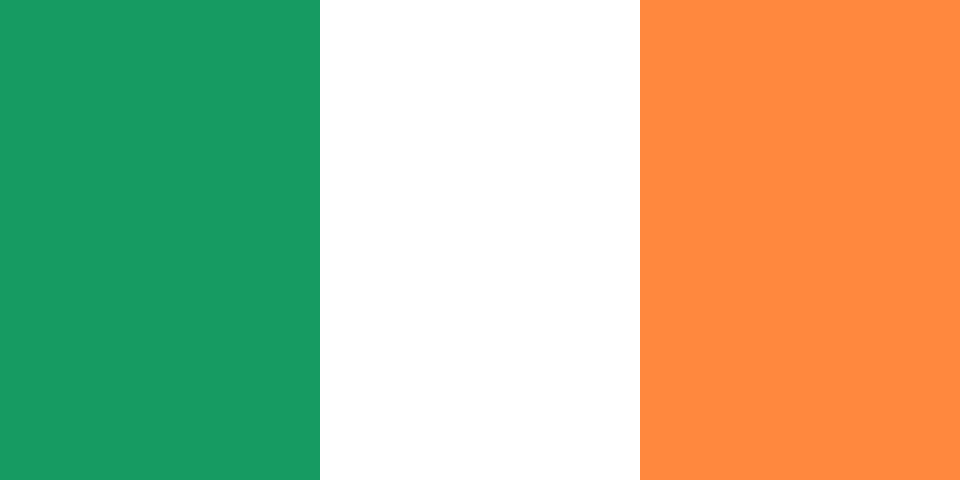
| Flag colours | Green (hoist), white (centre), orange (fly) |
Coat of Arms — Azure, a harp Or, stringed Argent.
Azure, a harp Or, stringed Argent.
A golden harp with silver strings on a blue field. The blazon is as concise as it is venerable: a single charge, a single field, no ornament. Few national arms in Europe are so minimal — and none uses a musical instrument as its principal device.
The instrument depicted is the cláirseach, the Gaelic harp: a triangular wire-strung harp with a curved forepillar and a soundbox carved from a single block of willow. It is sometimes called the Brian Bóramha harp, after the High King of Ireland (died 1014), although the actual surviving instrument in Trinity College Dublin dates from the 14th or 15th century — at least three centuries after Brian's death.
The harp's association with Ireland predates its heraldic use. Anglo-Norman chroniclers from the 12th century onward singled out Irish harpers as the finest in Europe, and the instrument became the visual shorthand for Gaelic civilisation. By the late 13th century, it appears on Irish coinage and seals as the kingdom's distinguishing emblem.
Three artistic conventions have coexisted in modern times:
13th–14th centuries — Origin. Earliest depictions of an Irish harp as a kingdom emblem appear on seals and coinage of the Lordship of Ireland under the Plantagenet kings.
1541 — Kingdom of Ireland. Henry VIII proclaims Ireland a kingdom and adopts a golden harp on blue as its arms. The choice was deliberately Gaelic, intended to signal direct kingship over the Irish themselves rather than mere overlordship.
1603 — Union of the Crowns. When James VI of Scotland inherits England and Ireland, the harp is integrated into the unified royal arms, occupying the third quarter.
1801–1922 — Union with Great Britain. The harp remains the Irish quartering on the royal arms of the United Kingdom, drawn in the Maid of Erin style throughout the Victorian era.
1922 — Irish Free State. Independence brings a new design based on the authentic Brian Bóramha harp. The instrument now faces left, to differ from the trademarked Guinness harp.
9 November 1945 — Formal registration. The Chief Herald of Ireland, established 1943, formally registers Azure, a harp Or, stringed Argent as the arms of the State.
Flag — the Tricolour — Vertical bands of green, white and orange, ratio 1:2.
The Irish tricolour was designed in 1848 by Thomas Francis Meagher, a leader of the Young Ireland movement. Meagher had travelled to Paris during the February Revolution and returned convinced that Ireland needed a national flag in the modern republican mode. A group of French women sympathetic to Irish independence presented him with the first physical tricolour, which he unfurled at a public meeting in Waterford on 7 March 1848.
Meagher explained the design in plain terms: "The white in the centre signifies a lasting truce between the orange and the green, and I trust that beneath its folds the hands of the Irish Protestant and the Irish Catholic may be clasped in generous and heroic brotherhood."
| Colour | Tradition | Meaning |
|---|---|---|
| Green (hoist) | Gaelic Ireland | The Catholic, Gaelic, native Irish tradition. The "greener Ireland" of nationalist symbolism since the 17th century. |
| White (centre) | Peace | A lasting truce, brotherhood, reconciliation between the two communities. |
| Orange (fly) | Williamite Ireland | The Protestant tradition, named for William of Orange (William III) who defeated James II at the Boyne in 1690. |
The tricolour was raised over the General Post Office in Dublin during the Easter Rising of 1916, marking its de facto adoption as the flag of Irish independence. The Irish Free State retained it after 1922, and the Constitution of Ireland (Bunreacht na hÉireann), Article 7, 1937, gave it constitutional status: "The national flag is the tricolour of green, white and orange."
It is hoisted by Irish state institutions, sporting bodies (notably the Gaelic Athletic Association), and citizens worldwide. Northern Ireland's official status remains contested — the tricolour is used there by the nationalist community but is not a recognised symbol of the UK constituent.
Ireland is traditionally divided into four provinces (cúige), each with its own historic arms predating modern administrative geography:
Note that the modern political province of Ulster is split: three counties form part of the Republic of Ireland, while six form Northern Ireland within the United Kingdom.
The Gaelic harp (cláirseach) has been associated with Ireland since at least the 13th century, when Irish harpers were celebrated across Europe as the finest of their craft. It was formally adopted as the royal arms of Ireland by Henry VIII in 1541 and has remained the heraldic emblem of the island through every constitutional change since.
Thomas Francis Meagher, a Young Ireland nationalist, in 1848. He was inspired by the French tricolour, which he had seen during the February Revolution in Paris, and a group of French sympathisers presented him with the first physical flag, which he unfurled in Waterford on 7 March 1848.
Green represents the Gaelic and Catholic tradition; orange represents the Protestant and Williamite tradition (referencing William of Orange); white in the middle symbolises peace and lasting truce between the two communities.
They use the same three colours in mirrored order: Ireland is green-white-orange (1:2 ratio), Côte d'Ivoire is orange-white-green (2:3 ratio). The two designs are entirely independent — Ireland's is from 1848, Côte d'Ivoire's was adopted in 1959 — and the resemblance is coincidental. The risk of confusion is real enough that international ceremonies often display the country's name beneath the flag.
Both designs are based on the same medieval instrument — the Brian Bóramha harp preserved in the Long Room of Trinity College Dublin. But they face opposite directions: Guinness registered its harp (facing right) as a trademark in 1876; when Ireland adopted the harp as a state symbol in 1922, it was drawn facing left to avoid trademark conflict.
Éire is the Irish-language name for Ireland, derived from the Old Irish Ériu, the name of a sovereignty goddess of Gaelic mythology. The 1937 Constitution gives the State two official names: Éire (in Irish) and Ireland (in English).
Last reviewed by the Emblema Mundi editorial team on 14 June 2026.
Ireland is one of the six Celtic nations — see the golden harp and the tricolour beside the emblems of Scotland, Wales, Brittany, Cornwall and the Isle of Man.