County · East of England
Essex carries one of the oldest emblems in England: three seaxes — the curved, notched blades of the Saxons — set silver-and-gold on a red field. They are the arms of the ancient Kingdom of Essex, the land of the East Saxons, and a reminder that the very word Saxon is bound up with the seax itself. Few English counties fly a symbol that reaches so directly back to the Anglo-Saxon age.
Click on a country to learn more
| Country | England (United Kingdom) |
|---|---|
| Region | East of England |
| County town | Chelmsford |
| Emblem | The three seaxes (Saxon blades) |
| Ancient kingdom | Kingdom of Essex (Eastseaxe) |
| Arms granted | 15 July 1932 (College of Arms) |
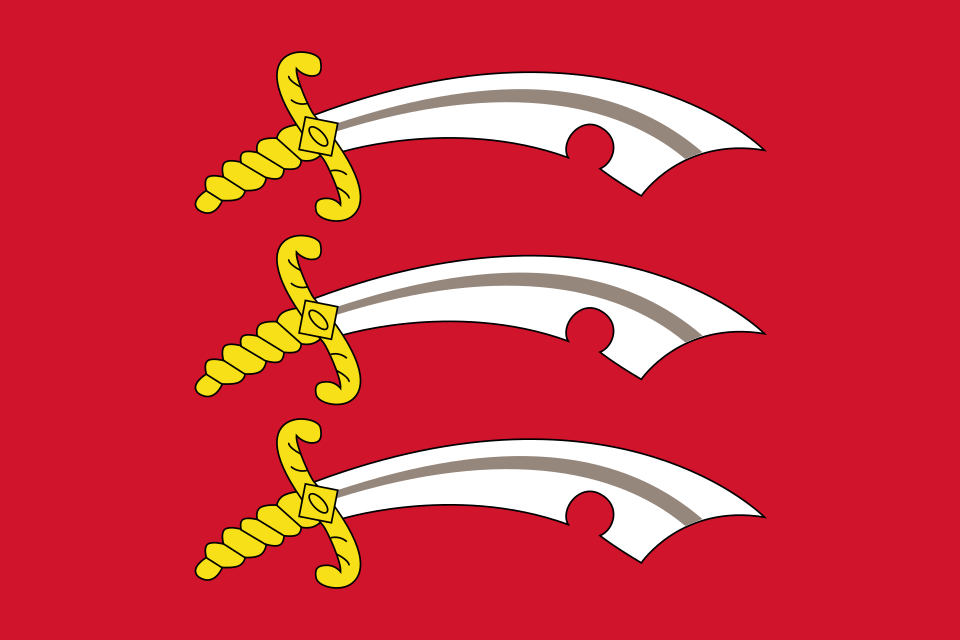
Flag of Essex — three seaxes argent, hilts or, on a red field
The flag shows three seaxes arranged one above another on a red field. Each seax is drawn as a broad, curved, single-edged blade with a notch cut into its back — argent (silver) with or (gold) pommel and hilt. Flown at a ratio of 3:5, it is the banner of the arms of Essex.
The design is ancient in spirit but well attested: the antiquary Richard Verstegan recorded “three seaxes argent in a field gules” as early as 1605, and Essex County Council took up the three seaxes as its symbol in 1889. The Flag Institute lists it among the flags of England’s historic counties.
A seax was a single-edged knife or short sword, the everyday sidearm of the Germanic peoples who settled Britain after Rome. It was so bound up with one of those peoples that tradition holds the Saxons took their very name from it — the folk of the seax.
Essex is, quite literally, the land of the East Saxons: its name is a worn-down form of Eastseaxe, and it was one of the seven kingdoms of Anglo-Saxon England. The settlers came from Old Saxony on the Continent in the fifth century, and the modern county’s boundary still broadly echoes that of the old kingdom. The three seaxes are the arms attributed to that vanished realm, carried down the centuries as the badge of the county that grew from it.
Essex County Council was granted arms by the College of Arms on 15 July 1932, giving official form to the ancient device of the three seaxes.
Blazon: Gules, three seaxes fessewise in pale argent, pommels and hilts or, the edges to the base and the points to the sinister.
In plain terms: on a red shield, three silver Saxon blades with golden hilts, set one above another, their cutting edges upward and their points to the viewer’s right. It is one of the simplest and most striking of English county arms — the whole identity of Essex distilled into three swords and a field of red.
The flag of Essex is three seaxes — curved, notched Saxon blades, silver with gold hilts — arranged one above another on a red field. It is the emblem of the East Saxons, recognised by the Flag Institute as the flag of the historic county.
A seax is a single-edged knife or short sword used by the Saxons. It was so characteristic of these people that it is traditionally said to have given them their very name — the Saxons as the people of the seax.
The three seaxes are the attributed arms of the ancient Kingdom of Essex (Eastseaxe), one of the seven kingdoms of Anglo-Saxon England. The county still takes its emblem from that Saxon heritage, and its boundary broadly echoes the old kingdom.
Essex County Council was granted its arms by the College of Arms on 15 July 1932: Gules, three seaxes fessewise in pale argent, pommels and hilts or. The three seaxes had already been used as the county symbol since 1889, and the design is first recorded in print by Richard Verstegan in 1605.
They carry the same device — three seaxes on a red field. The arms are borne on a shield; the flag is the banner of those arms, flown as the county flag of Essex.
Last reviewed by the Emblema Mundi editorial team on September 20, 2026.